Guangzhou Attractions 9 min read
Nanhai God Temple: Complete Maritime Silk Road Guide
Explore Guangzhou's 1,400-year-old Nanhai God Temple. Ancient maritime silk road history, imperial steles, Boluo Festival, and Line 13 metro access.
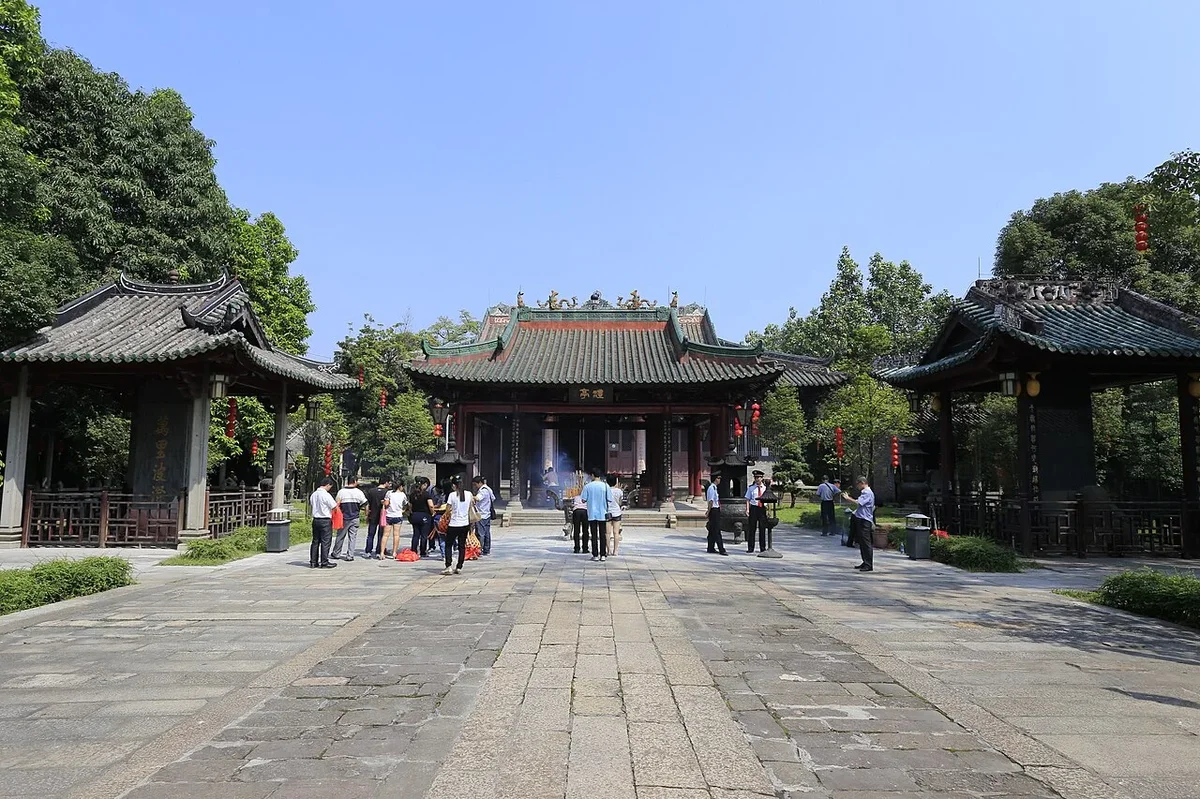
Standing along the northern banks of the Pearl River estuary in eastern Huangpu District, Nanhai God Temple (南海神庙), affectionately called Boluo Temple by Cantonese locals, is one of southern China’s most profound historical sanctuaries. Founded in 594 AD during the fourteenth year of the Kaihuang reign in the Sui Dynasty, the complex has endured for more than 1,400 years.
In classical imperial geography, ancient China recognized four cardinal sea gods protecting the Eastern, Western, Northern, and Southern seas. Among these four legendary maritime shrines, Nanhai God Temple is the sole surviving original sanctuary. For over a millennium, foreign merchant vessels sailing from Southeast Asia, India, and the Persian Gulf dropped anchor in its waters, while imperial fleets offered grand state sacrifices before embarking onto uncharted oceans. Today, this sprawling temple compound stands as a National Key Cultural Relics Protection Unit, celebrating the maritime trade legacy and ancient epigraphy of Guangzhou.
Getting to Nanhai God Temple in Huangpu
Nanhai God Temple is located at No. 22 Xuri Street in Miaotou Village, Sui Dong Subdistrict, Huangpu District. Although positioned in the city’s eastern maritime sector, transit connections are remarkably straightforward.
- Metro Line 13 direct connection Take Guangzhou Metro Line 13 directly to Nanhai God Temple Station (南海神庙站). Leave via Exit C2 and follow the tourist signage southwards along the pedestrian avenue for roughly 600 metres (about eight minutes on foot) to reach the main southern scenic area entrance.
- Public bus routes Multiple city bus lines stop at the nearby Nanhai God Temple Bus Station (南海神庙公交站) along Huangpu East Road, including routes B26, B28, B29, B30, and B31.
- Taxi and ride-hailing A direct taxi or Didi ride from Zhujiang New Town or Tianhe Sports Center takes approximately 35 to 45 minutes via the Guangyuan Expressway or Huangpu East Road, costing roughly 55 to 70 RMB depending on traffic conditions.
Fourteen centuries of maritime history and imperial sacrifices
In antiquity, the open estuary between the Lion Sea (Shiziyang) and the Pearl River formed a bustling sheltered anchorage known as Fuxu Port (扶胥港). As international merchantmen loaded with silks, teas, and porcelain gathered here, local administrators and seafaring merchants recognized the perilous nature of ocean voyages. They turned to Zhurong, the primordial deity venerated as the South Sea God who held dominion over fire, southern skies, and naval waters.
Sui Dynasty Emperor Wen formally ordered the creation of the temple in 594 AD. Subsequent dynasties continually elevated the deity’s status. Emperor Xuanzong of the Tang Dynasty bestowed the noble title King of Guangli (King of Vast Prosperity), while the Song Dynasty raised the honorific to King Hongsheng Guangli. Imperial court envoys regularly journeyed from northern capitals to perform solemn sacrificial rites, offering jade vessels, silk scrolls, and livestock to invoke safe voyages and bountiful harvests.
Although centuries of natural river silt accumulation have pushed the open coastline several kilometres away, the site retains its aura as the starting point of China’s ancient Maritime Silk Road, carrying cultural memories shared with other historic trading ports like Huangpu Ancient Port.
The five-hall central axis and the Hai Bu Yang Bo archway
Covering over 30,000 square metres, Nanhai God Temple follows a strictly symmetrical south-to-north layout, featuring five successive halls that reflect classical Chinese imperial temple architecture.
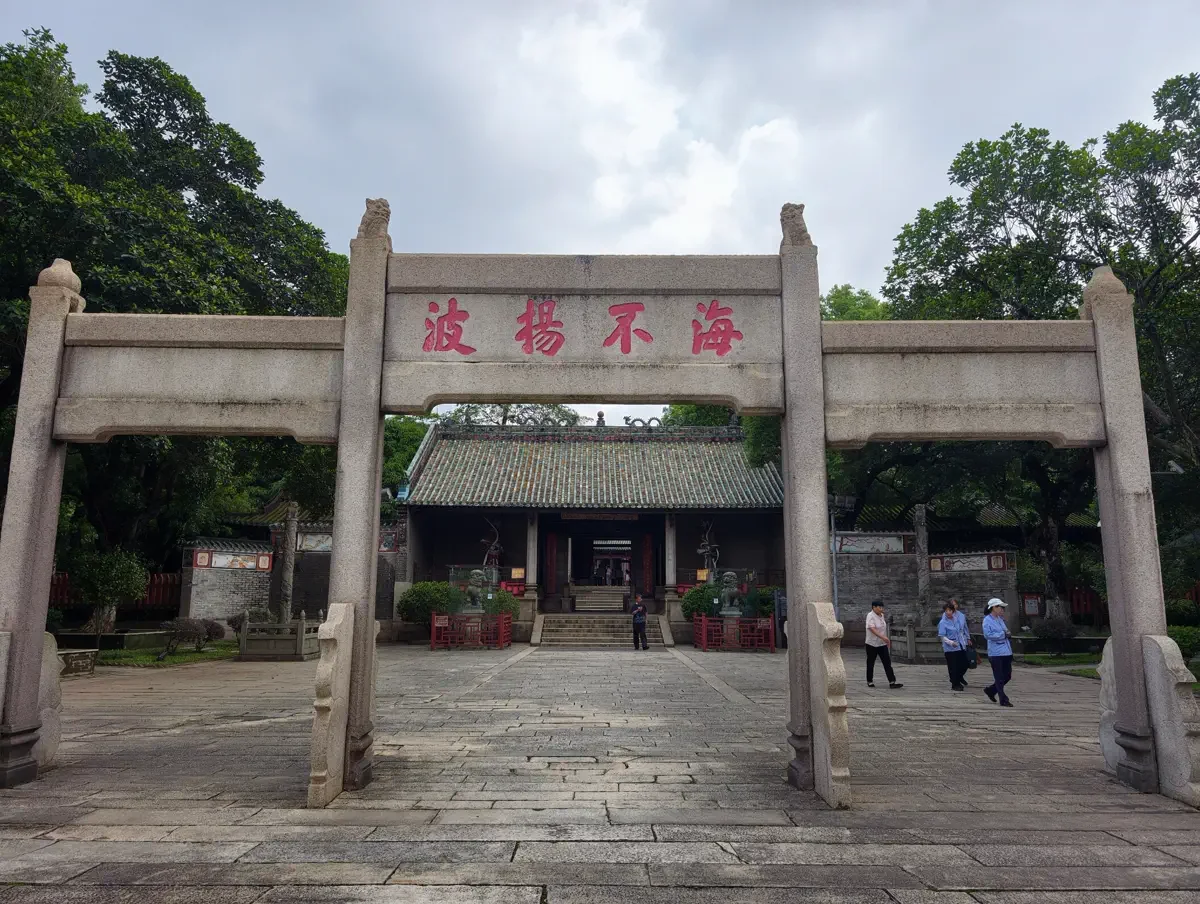
Before reaching the front gates, visitors encounter the iconic Hai Bu Yang Bo (海不扬波) stone archway. Carved from solid local granite, its four pillars support an arch inscribed with four bold vermilion characters translating literally to “No waves rise upon the sea,” conveying the eternal maritime prayer for calm waters and safe voyages.
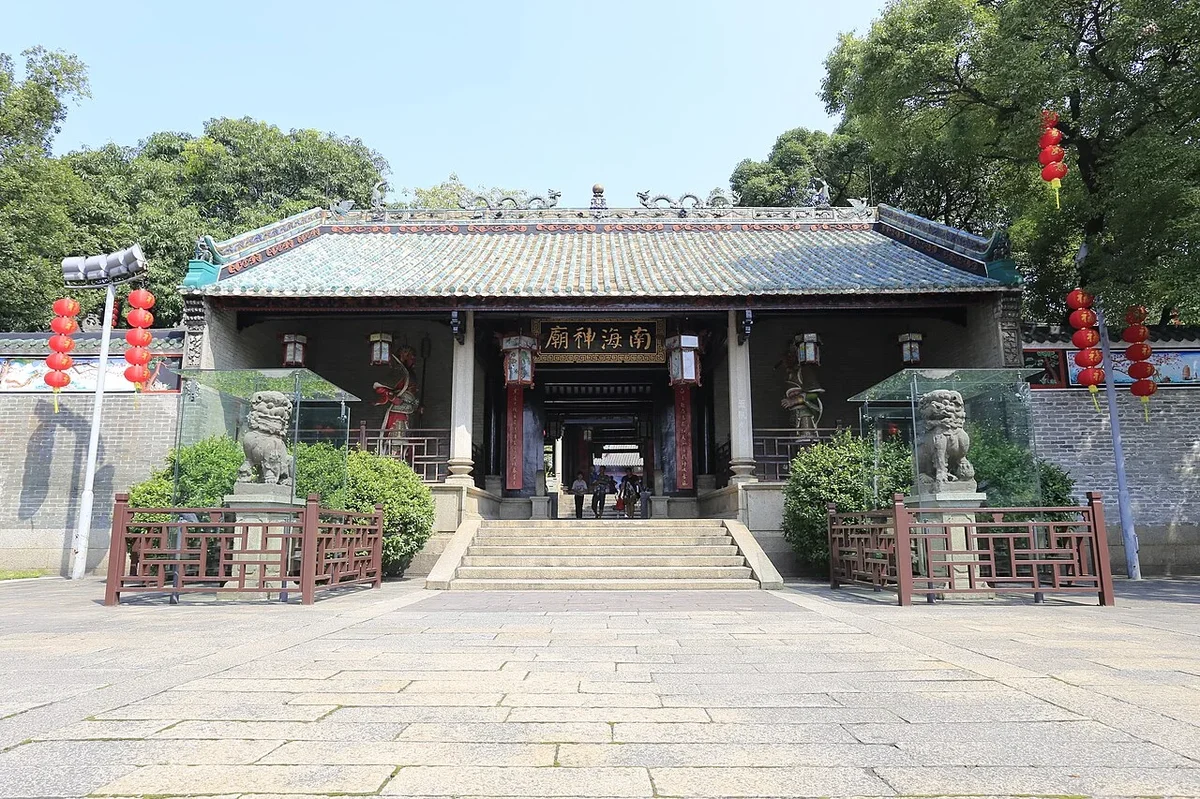
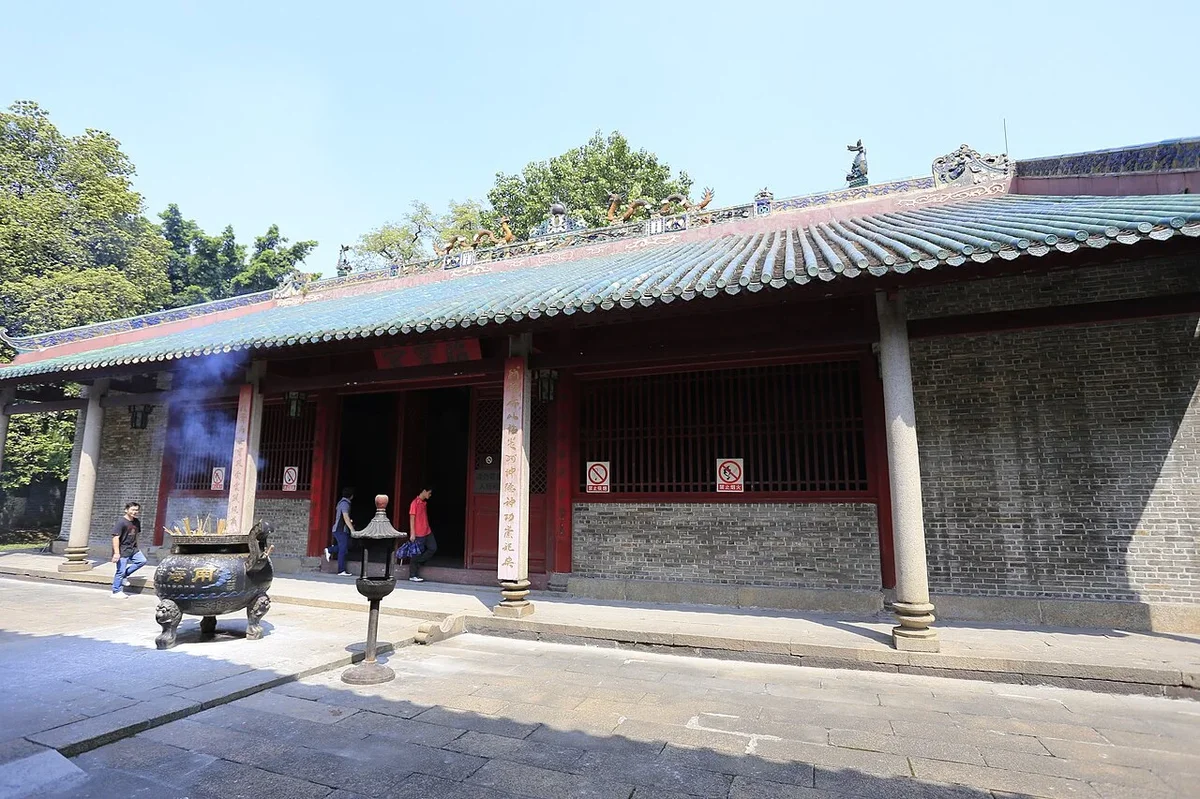
Passing the archway brings visitors to the first gate, Toumen (头门). Resting upon a raised stone terrace, Toumen displays an authentic black plaque with gilded calligraphy reading “Nanhai God Temple.” A pair of intricately carved granite lions in protective glass casings stands guard, while cast-iron naval cannons from the late Qing Dynasty flank the portico.
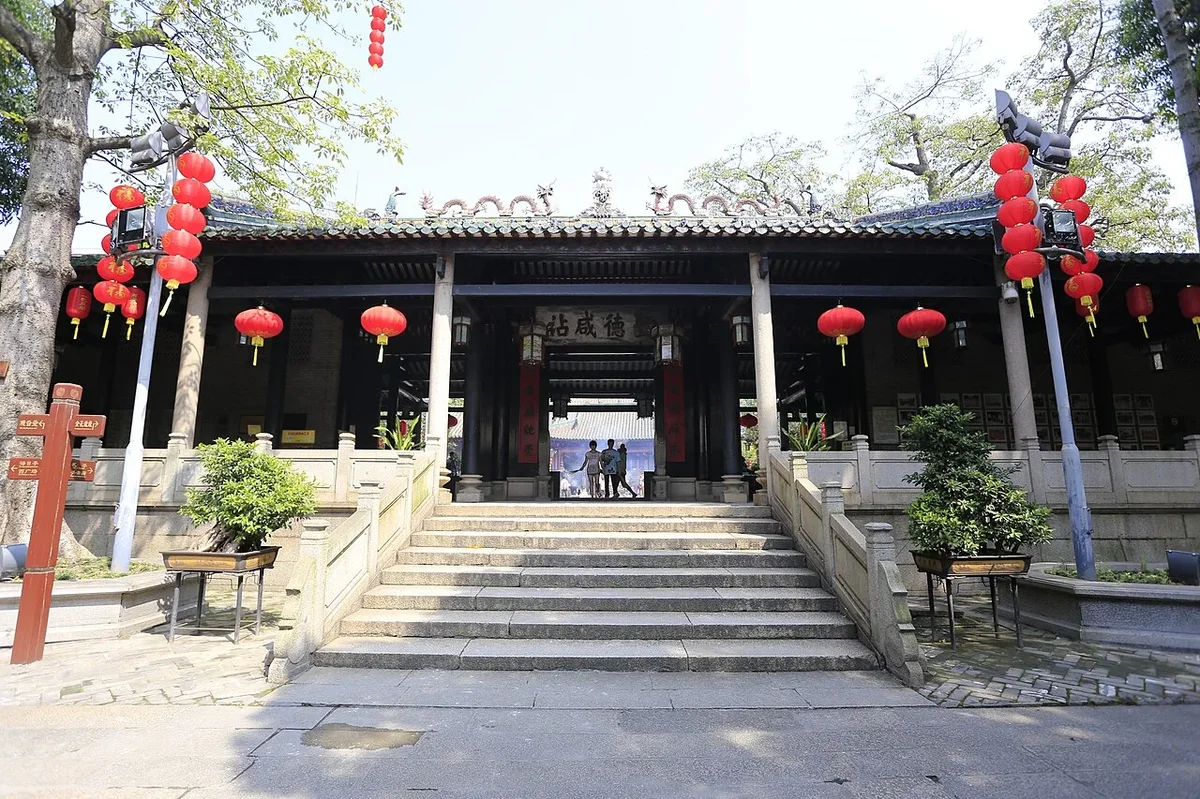
Moving inward brings you through the second hall, Yimen (仪门), which bears an imperial banner reading “De Xian Zhan” (Virtue Reaches All). Beyond Yimen lies a grand stone-paved processional pathway framed by ancient banyans and two imperial stele pavilions. The third hall is the Li Pavilion (礼亭), an open ceremonial pavilion with traditional hip roofs where officials washed hands and donned ritual robes before sacrifices.
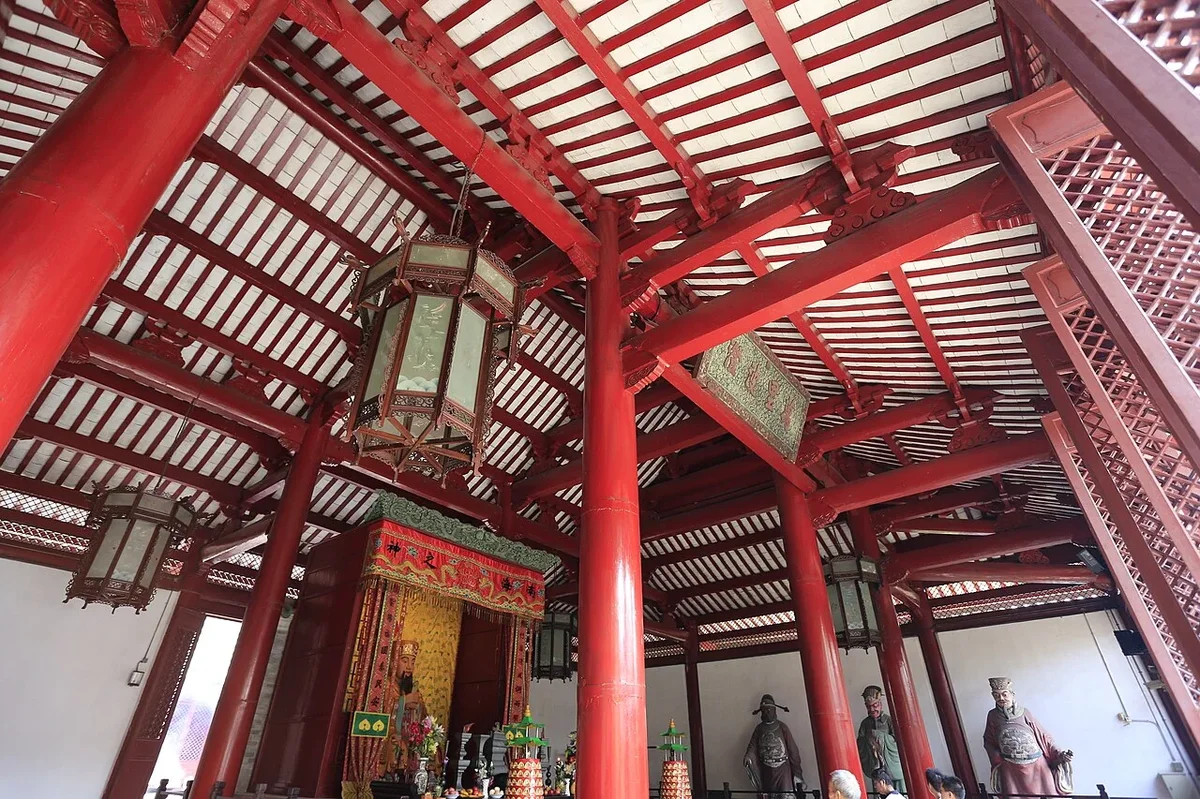
North of Li Pavilion rises the monumental Main Hall (大殿), the spiritual heart of the temple. Supported by colossal timber pillars lacquered in deep vermilion, the hall houses the commanding seated statue of Hongsheng Dahuang, adorned in imperial crown robes. High above the deity hangs an imperial horizontal board inscribed Wan Li Bo Cheng (Ten Thousand Miles of Serene Waves), penned personally by Qing Emperor Kangxi in 1703. Behind the Main Hall stands the fifth hall, Zhaoling Palace (昭灵宫), dedicated to the god’s consort, the Affable Goddess Mingde Shun Furen.
The Southern Forest of Steles and Han Yu's Tang Dynasty stone
Nanhai God Temple is celebrated across China as the Southern Forest of Steles, housing over forty invaluable stone tablets dating from the Tang, Song, Yuan, Ming, and Qing dynasties down to the Republic era.
The crowning gem of this open-air epigraphic archive is the Tang Dynasty Nanhai God Temple Stele, widely known as the Han Stele (韩碑). Erected in 820 AD during the fifteenth year of the Yuanhe reign, its prose was composed by Han Yu, leader of the Classical Prose Movement. The inscription was hand-calligraphed by regional governor Chen Jian and carved by master artisan Li Yuandu. Because of its peerless synthesis of literary genius, calligraphy, and masonry, scholars revere it as the Sanjue Stele (Tablet of Three Perfections).
Wandering through the eastern and western stele corridors reveals works by other legendary literati. Notable exhibits include a poetic stele inscribed with the calligraphy of Song Dynasty master Su Shi, imperial proclamations carved under Ming founding Emperor Zhu Yuanzhang, poetic stanzas by Ming dramatist Tang Xianzu, and successive Qing imperial tablets. Together, they constitute an irreplaceable historical ledger documenting centuries of Chinese maritime governance and classical literature.
The legend of Daxi Sikong and the Boluo Birthday Festival
Near the western corridor stands an intriguing painted clay figure sporting deep-set eyes, a prominent nose, and ancient overseas garb, raising one hand to his brow to scan the distant horizon. This figure represents Daxi Sikong, remembered in Cantonese folk tradition as the foreign guest gazing toward Boluo.
Folk legends tell that during the Sui or Tang era, a tribute ambassador from ancient India visited the temple to pay homage to the South Sea God. Enamoured by the holy precinct, he planted two jackfruit saplings (known in ancient Chinese as boluo trees) within the courtyards. When he returned to the dock, his trading fleet had already set sail on the tide. The distraught traveler stood by the shore day after day gazing southward until he transformed into stone. Touched by his devotion, locals bestowed upon him the posthumous title of Daxi Sikong and enshrined his likeness beside the main courtyard, giving rise to the temple’s popular nickname, Boluo Temple.
Every year from the eleventh to the thirteenth day of the second lunar month, the temple hosts the legendary Boluo Birthday Festival (波罗诞), a folk carnival dating back over a thousand years and designated as a National Intangible Cultural Heritage. Hundreds of thousands of devotees gather from surrounding delta villages to participate in the solemn Five Sons Paying Homage ceremony, carrying village deities on grand palanquins accompanied by dragon dance troupes and firecrackers. Visitors enthusiastically buy hand-crafted paper Boluo Chickens (波罗鸡), whimsical lucky charms crafted with colourful feathers and clay feet that symbolize good fortune, health, and family harmony.
Ascending Zhangqiu Hill to the Yuri Pavilion
After exploring the five central halls, take the winding stone pathway east of the main axis to ascend Zhangqiu Hill (章丘). Although rising only several dozen metres above sea level, this wooded knoll holds an illustrious place in classical Cantonese culture.
Perched atop the summit stands Yuri Pavilion (浴日亭, Pavilion of Bathing in the Sun). During the Song Dynasty, this spot offered an unimpeded vista over the vast Pearl River delta where travelers gathered at dawn to watch the morning sun emerge from ocean swells. In historical rankings of the Eight Scenic Vistas of Guangzhou, “Watching the Sun Rise at Boluo” (波罗浴日) repeatedly claimed top honours.
In 1094, the renowned Song poet Su Shi was exiled southward to Huizhou. Passing through Guangzhou, he climbed Zhangqiu Hill at sunrise and composed his immortal poem Bathing in the Sun at Nanhai Temple. Today, visitors can read Su Dongpo’s poetic lines inscribed on a stone tablet preserved inside the pavilion. Standing along the stone balustrades beneath ancient pines evokes an unmistakable connection to centuries of poetic reverie.
Practical visiting guide and Huangpu heritage day trips
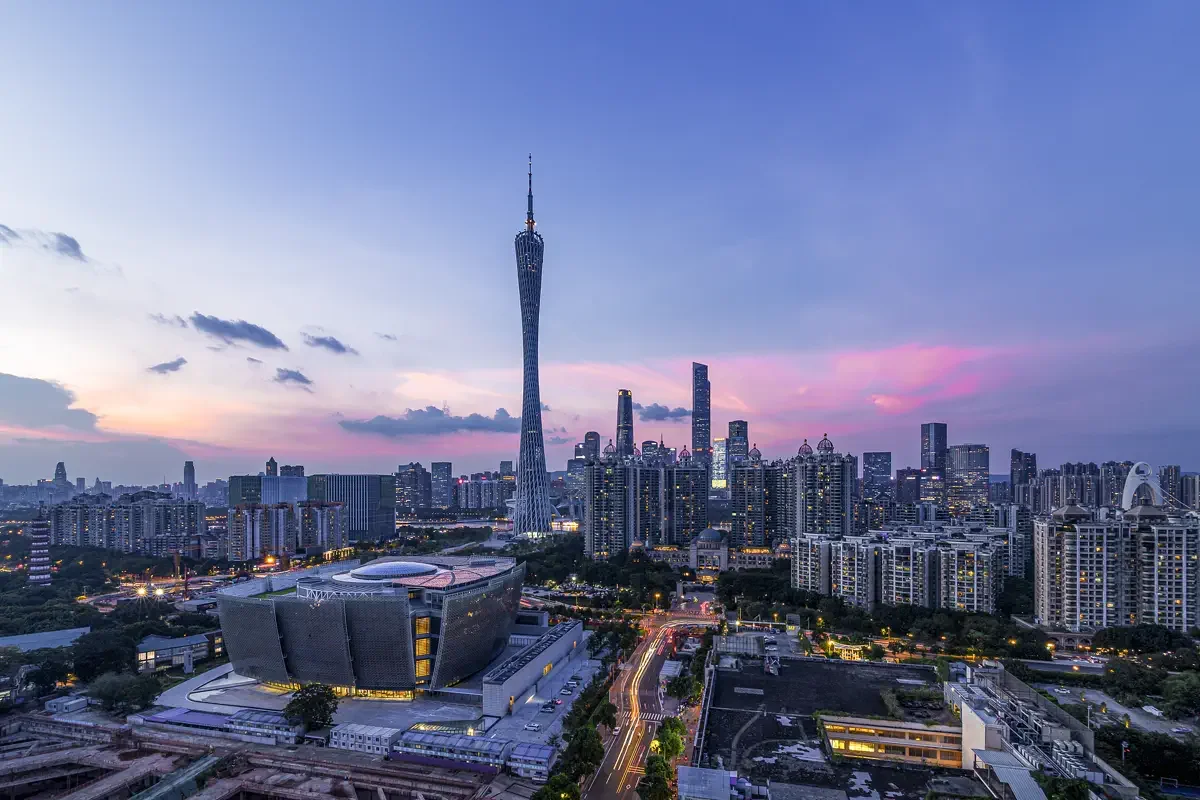
A journey to Nanhai God Temple offers a tranquil counterpoint to downtown Guangzhou’s futuristic high-rises.
- Admission prices and operating hours Standard adult tickets cost 10 RMB, with half-price discounts available for students and seniors holding valid identification. The scenic area is open Tuesday to Sunday from 9 AM to 5 PM, with ticket sales and admission ending promptly at 4.30 PM. The complex is closed on Mondays for monument preservation.
- Photography considerations Handheld cameras and mobile phone photography are welcomed throughout the open courtyards and stone pavilions. Flash photography, commercial shoots, and tripods are restricted inside the wooden halls to protect historic relics and respect worshipping visitors.
- Recommended visit duration Allow approximately two to three hours to leisurely experience the five central halls, examine the ancient stele corridors, and hike up Zhangqiu Hill to Yuri Pavilion.
- Combined Huangpu heritage itinerary Pair your morning visit to Nanhai God Temple with other maritime and military landmarks in Huangpu District. Take Metro Line 13 and transfer south to Huangpu Ancient Port to explore Qing Dynasty customs warehouses and savour traditional Cantonese ginger milk curd. Alternatively, cross to Changzhou Island to tour the prestigious Whampoa Military Academy, completing an unforgettable journey through Guangzhou's ancient and modern maritime milestones.
Frequently asked questions
What is the historical significance of Nanhai God Temple
Founded in 594 AD, Nanhai God Temple is the only surviving ancient imperial sea god temple among China’s four historical maritime shrines. It was the ceremonial departure point where foreign merchants and imperial envoys prayed for safe ocean voyages along the Maritime Silk Road.
How do I get to Nanhai God Temple by metro
Take Guangzhou Metro Line 13 to Nanhai God Temple Station. Take Exit C2 and walk southward along the landscaped pedestrian avenue for about 600 metres to reach the main entrance.
What is the Boluo Birthday Festival
Held annually from the eleventh to the thirteenth day of the second lunar month, the Boluo Birthday Festival is a thousand-year-old folk carnival featuring village deity processions, intangible cultural heritage performances, and the traditional sale of handmade lucky Boluo Chickens.
Why is the temple called the Southern Forest of Steles
The temple preserves over forty imperial, commemorative, and poetic stone tablets spanning the Tang, Song, Yuan, Ming, and Qing dynasties, including the celebrated 820 AD Han Stele composed by Tang literary master Han Yu.
Is Nanhai God Temple open every day
The temple is open Tuesday through Sunday from 9 AM to 5 PM, with last entry at 4.30 PM. It is closed on Mondays except during statutory public holidays.