Guangzhou Attractions 12 min read
Dongshankou Guangzhou: Heritage Villas, Five Famous Gardens, and Modern Cultural Scene
Discover Dongshankou in Guangzhou, home to the Xinhepu historic district with nearly 400 Republic-era red brick garden villas. Explore Kui Garden, Chun Yuan, Peizheng Road, indie boutiques, and curated walking routes.
Just east of Guangzhou’s ancient walled core, where rolling red-soil hills once sloped gently toward the Pearl River, lies Dongshankou (东山口). Today, this atmospheric neighborhood in the Yuexiu District encompasses the Xinhepu Historic and Cultural District (新河浦历史文化街区), preserving roughly 400 early 20th-century Western-style garden mansions. Spanning over 600,000 square meters, it constitutes the largest and most intact cluster of low-rise, courtyard-style modern residential heritage in South China.
Unlike the tight granite alleyways of Xiguan in western Guangzhou (exemplified by Yongqing Fang) or the colonial concessions of Shamian Island, Dongshankou represents an indigenous modernization movement driven by returned overseas Chinese and republican dignitaries. Walking its leafy lanes today reveals a captivating synthesis of Western neoclassical forms, Cantonese domestic wisdom, and a vibrant wave of independent cafes, designer boutiques, and contemporary art labs.
The Rise of Dongshankou: From Temple Hill to Overseas Enclave
Dongshankou’s recorded history traces back to the Ming Dynasty (Chenghua era, late 15th century), when eunuch official Wei Juan erected an expansive religious complex known colloquially as Dongshan Temple outside the Great East Gate (大东门). The surrounding hills became known as Dongshan (“East Mountain”). Cantonese street names still echo this geography: Sibeitongjin (寺贝通津) literally means “the pathway behind the temple leading to the ferry crossing.”
For centuries, Dongshan remained a tranquil rural hilly area covered with pine groves and wild grass. The historic turning point arrived in 1911 with the completion of the Kowloon-Canton Railway (KCR). The Guangzhou terminus was established nearby at Dashatou, connecting the provincial capital directly to Hong Kong and global maritime routes. American Southern Baptist missionaries recognized the area’s clean air, cheap hillside real estate, and strategic rail access, subsequently establishing chapels, theological colleges, modern schools (such as Pui Ching Middle School and Pooi To Girls’ School), and hospitals.
Following the First World War, hundreds of overseas Chinese merchants returning from North America, Southeast Asia, and Australia chose Dongshan over the congested old city. Rather than cramming into damp Cantonese “bamboo tube” row houses, they acquired contiguous tracts of land, graded the hills, and laid out tree-lined residential estates. By the 1920s and 1930s, Dongshan had evolved into an elite residential enclave for Kuomintang military generals, high-ranking diplomats, foreign consuls, and wealthy industrial tycoons.
This stark cultural geography gave rise to the enduring Cantonese proverb: “Xiguan Misses, Dongshan Young Masters” (西关小姐,东山少爷). While the merchant daughters of western Xiguan symbolized hereditary commercial wealth steeped in conservative Lingnan customs, the young gentlemen of eastern Dongshan represented the progressive, Western-educated elite driving the political, educational, and military modernization of Republican China.
Architectural Anatomy of the Red Brick Garden Villas
The residential villas of Xinhepu, frequently referred to as Dongshan Yanglou (东山洋楼), depart dramatically from traditional Chinese axial compounds. They reflect a pragmatic, hybrid design language tailored to Guangzhou’s subtropical monsoon climate.
Materials, Facades, and Western Classical Motifs
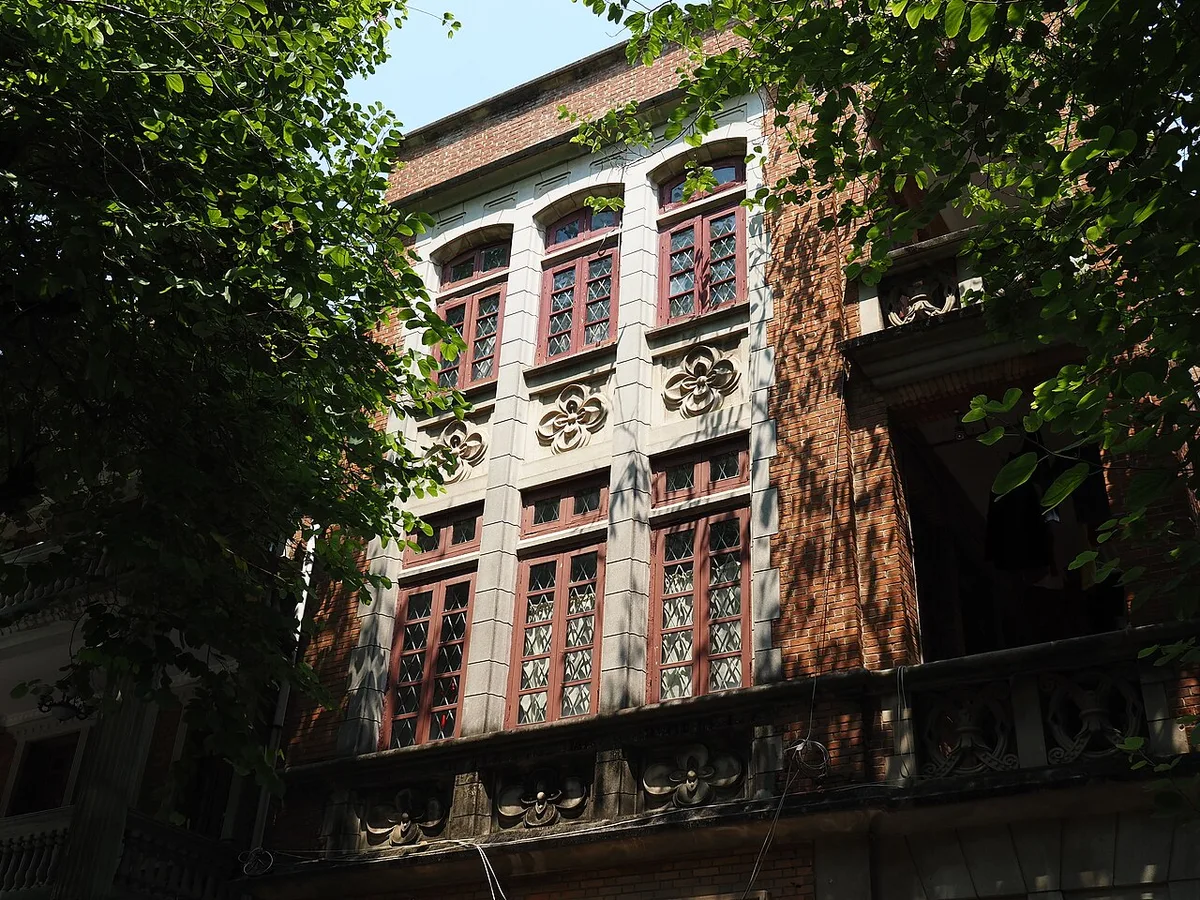
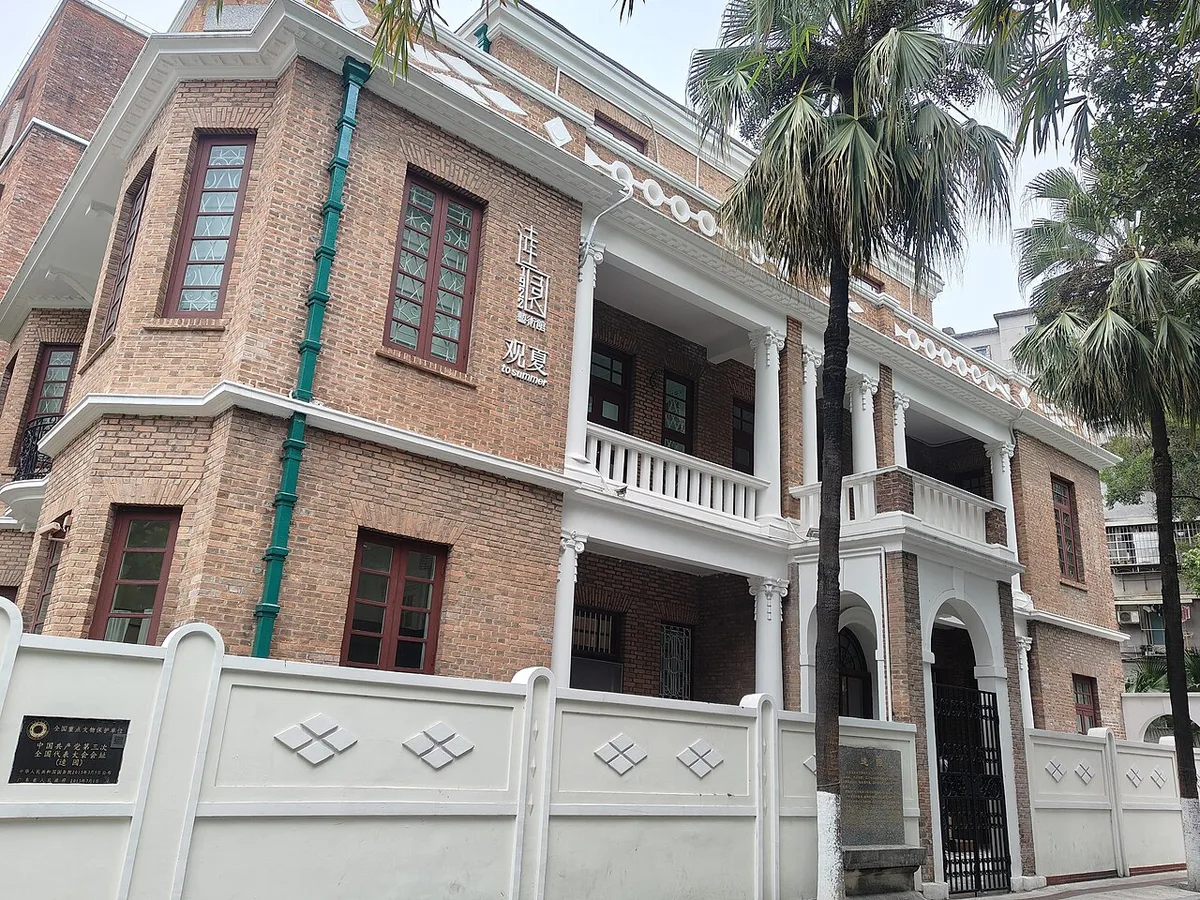
The signature hallmark of Dongshan villas is their exposed red brickwork (qingshui hongzhuan, 清水红砖). Builders imported dense refractory bricks through foreign merchant firms or fired high-grade vitrified bricks in regional kilns around Foshan and Xinhui. Laid with precise recessed or raised mortar joints, these walls have weathered a century of torrential rains and humid summers, taking on a warm, saturated crimson hue.
Architects frequently paired red brick with distinctive exterior plaster finishes, notably shuishuashi (exposed pebble wash aggregate), terrazzo base courses (legao), and Italian roughcast plaster (pidang). Neoclassical details abound: symmetrical pediments, rusticated corner quoins, Roman Doric and Ionic columns flanking elevated porticos, semicircular arched entrance arcades, and wrought-iron balconies forged with stylized floral arabesques.
Inside, foyers and living rooms are paved with imported Portuguese and Italian polychrome cement patterned tiles (huadizhuan), featuring intricate geometric tessellations that retain their vivid pigments. Sweeping staircases crafted from solid tropical hardwoods lead to upper bedchambers, lit by plaster ceiling rosettes and clerestory transom windows.
Climate-Responsive Design in the Subtropics
Behind their European neoclassical elevations, these villas incorporate ingenious passive climate-control engineering:
- Elevated Ground Plinths: Ground floors are raised 50 to 100 cm above grade upon ventilated masonry vaults or granite plinths fitted with iron louvers. This prevents subterranean humidity from seeping into interior living quarters during the muggy spring Huinan season.
- Double-Layer Wooden Louvered Shutters: Tall French windows are equipped with exterior white-painted wooden louvered shutters (baishichuang) paired with interior textured or stained glass. The adjustable louvers shade direct solar glare and deflect torrential monsoon downpours while maintaining continuous cross-ventilation.
- Deep Shaded Loggias and Overhanging Eaves: Projecting balconies and deep arcade verandas shield brick walls from midday solar radiation, cooling interior thermal mass.
- Usable Flat Roof Terraces: Most villas terminate in open rooftop flat terraces surrounded by decorative openwork balustrades (nverqiang), occasionally sheltered by Chinese green-glazed tile hip eaves. These functioned as private evening family retreats to catch river breezes while creating an insulating air cushion above top-floor ceilings.
The Historic Mansions: Five Famous Gardens and Landmark Estates
Among the hundreds of garden villas in the district, the “Five Famous Gardens of Dongshan” (东山五大名园)—Kui Garden, Chun Yuan, Jian Garden, Ming Garden, and Yu Garden—stand out as masterpieces of architecture and witnesses to momentous historical events.
Kui Garden: The 1922 Sentinel and Contemporary Art Lab
Standing proudly at No. 9 Xiguyuan Road (恤孤院路9号), Kui Garden (逵园) was constructed in 1922 by overseas Chinese merchant Ma Zhuowen. Occupying a generous garden plot framed by shade trees and ornamental rockeries, this three-story brick-and-timber mansion features an imposing central portico supported by twin square brick pillars and semicircular Roman arches.
The villa’s most distinctive feature is its neoclassical triangular gable pediment, crowned with stucco relief numerals reading “1922”. This date proved pivotal during the Third National Congress of the Chinese Communist Party (CPC) in June 1923. Because the clandestine congress was held in a nondescript brick-and-tile cottage across the street shrouded by thick bamboo, delegates utilized the conspicuous “1922” roof pediment of Kui Garden as their primary visual beacon to locate the secret meeting hall.
After the original congress hall was destroyed by Japanese aerial bombardment during World War II, archaeologists in the 1970s and 2000s relied on the sightlines remembered by surviving delegates—who recalled gazing directly at Kui Garden’s “1922” pediment from the front door—to calculate trigonometric cross-bearings and unearth the original stone foundations buried one meter underground. Today, Kui Garden has been thoughtfully revitalized as the Kui Contemporary Art Lab (逵园艺术馆), staging rotating fine art exhibits on its lower floors while serving artisanal pour-over coffee in its leafy brick courtyard.
Chun Yuan (Spring Garden): The CPC Central Headquarters
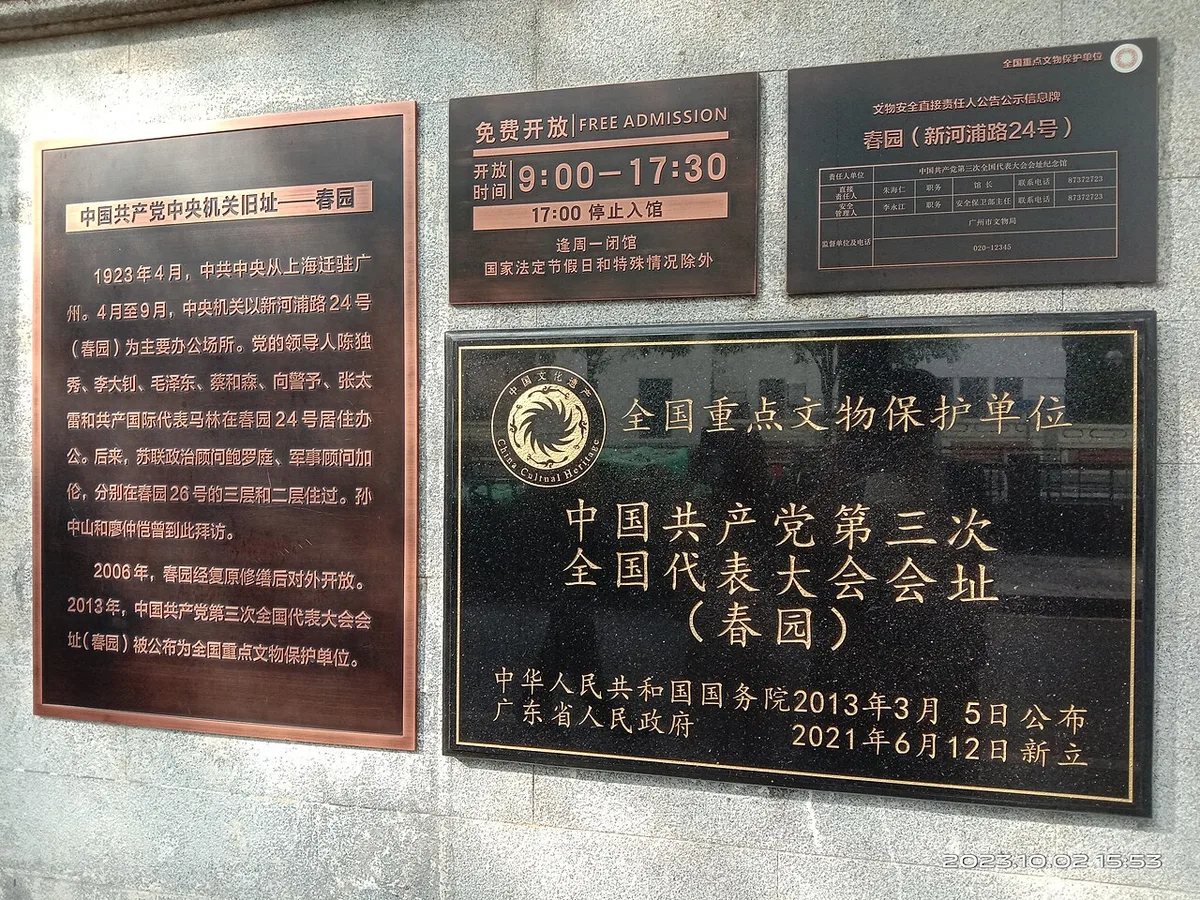
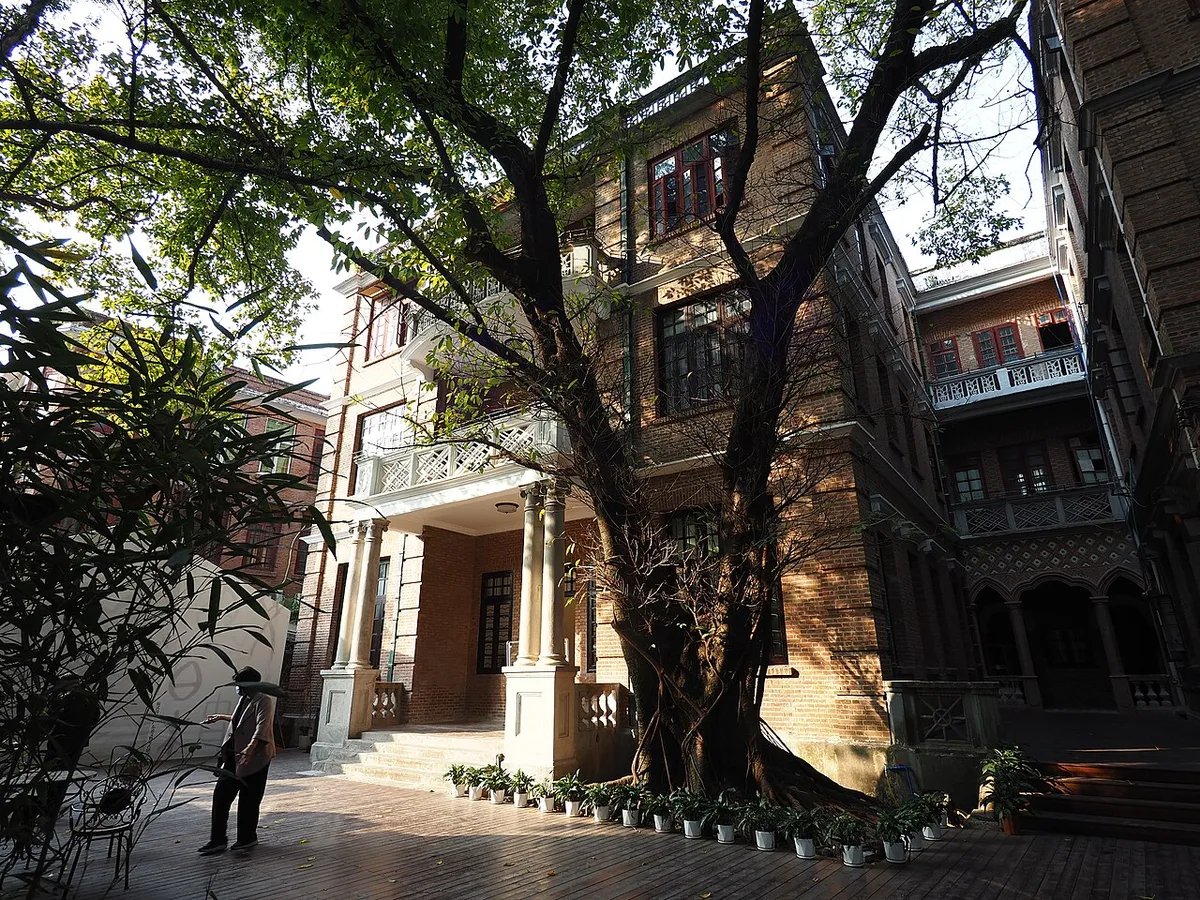
Located along the banks of the canal at Nos. 22–26 Xinhepu Road, Chun Yuan (春园) is a distinguished row of three identical three-story red-brick villas built in the early 1920s by returned American Chinese merchant Li Juemin.
Each residence features raised ground-floor loggias, projecting second- and third-floor cantilevered verandas supported by classical columns, and finely tuck-pointed brickwork. During the 1923 Third CPC Congress, Chun Yuan served as the de facto headquarters of the Party’s Central Committee. Prominent figures including Chen Duxiu, Li Dazhao, and Mao Zedong resided on the second floor, drafting the landmark resolutions that forged the First United Front between the Communists and Sun Yat-sen’s Kuomintang. Today, the complex operates as an official historic memorial with meticulously restored 1920s work desks, period furnishings, and archival displays.
Jian Garden and Ming Garden: Diplomacy and Quiet Seclusion
- Jian Garden (简园), located on Peizheng Road, was built by brothers Jian Zhaonan and Jian Yujie, founders of the patriotic Nanyang Brothers Tobacco Company. Departing from the dominant red brick palette, Jian Garden features a pale yellow stucco exterior influenced by Mediterranean and Spanish revivalist estates, accented by oxblood-red window frames and a semicircular colonnaded driveway. It previously served as the German Consulate in Guangzhou and later as the residence of republican statesman Tan Yankai.
- Ming Garden (明园), nestled down a serene cul-de-sac off Peizheng 1st Horse Road, consists of a pair of identical two-story red-brick villas facing an expansive courtyard shaded by ancient bamboo groves. Its understated Roman entryways and weathered brick facades exemplify the peaceful domestic retreat sought by high-level corporate compradors.
Bai Yuan: The Birthplace of Modern Chinese Archaeology
At No. 12 Xiguyuan Road stands Bai Yuan (柏园, Cypress Garden), a grand compound composed of interconnected Chinese blue-brick and Western red-brick pavilions with wrap-around balconies and octagonal corner turrets.
In October 1928, prominent intellectuals Fu Sinian, Gu Jiegang, and Yang Zhensheng established the Institute of History and Philology (IHP, 历史语言研究所) of the Academia Sinica here at Bai Yuan. It was within these halls that Fu Sinian coined the famous empirical maxim: “Go up to heaven and down to the yellow springs, using hands and feet to search for things” (上穷碧落下黄泉,动手动脚找东西). Here, pioneering scholars Chen Yinke, Zhao Yuanren, and Li Ji laid the intellectual groundwork for modern Chinese archaeology, linguistics, and the monumental excavation of the Shang Dynasty oracle bones at Anyang. Following extensive conservation, Bai Yuan opened as an academic heritage museum showcasing early 20th-century scholars’ quarters and research archives.
Dongshan Church: Gothic Revival in Red Brick
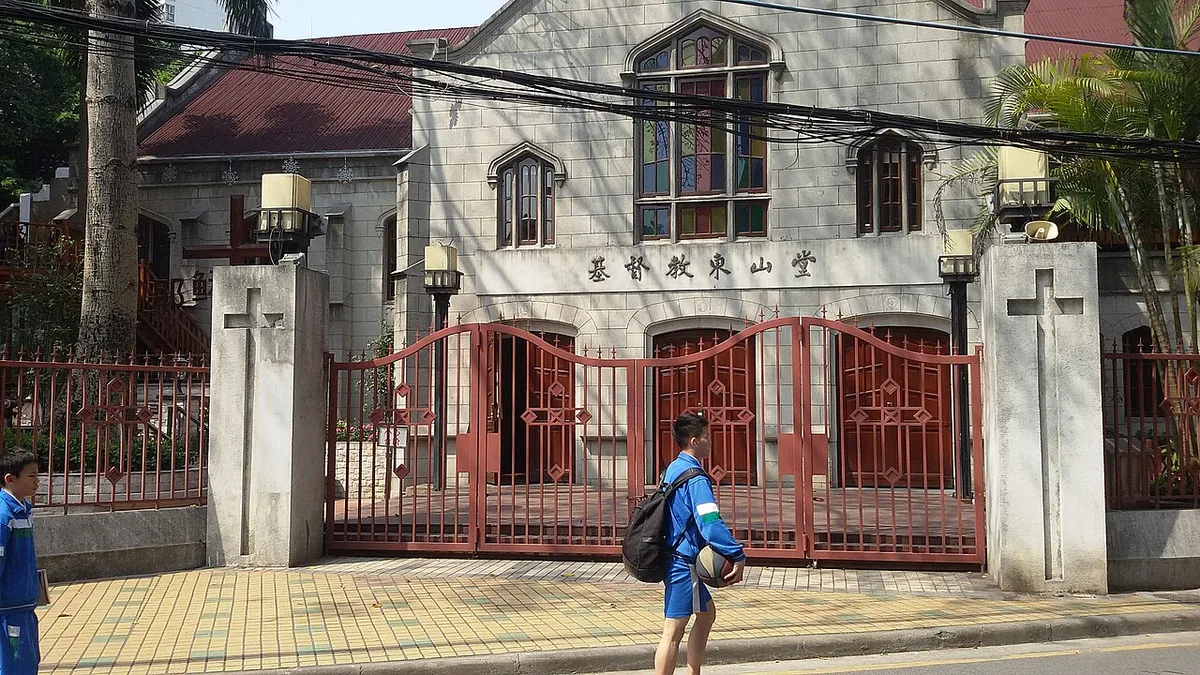
At No. 9 Sibeitongjin, towering over a labyrinth of narrow cobblestone alleyways, stands the commanding facade of Dongshan Christian Church (基督教东山堂). Founded in 1909 by American Southern Baptist missionaries and enlarged to its present proportions in 1923, the church is built of local ashlar granite plinths and dark red brick.
Its symmetric facade features twin square bell towers rising above pointed Gothic lancet windows with white stone tracery. The cavernous interior basilica accommodates up to 1,500 congregants beneath an exposed open-timber roof truss system without central dividing pillars. On Sunday mornings, choral hymns and organ melodies echo through the canopy of ancient banyan trees along Sibeitongjin, invoking the spiritual beginnings of the modern Dongshan quarter.
Curated Walking Itinerary Through Xinhepu and Peizheng Road
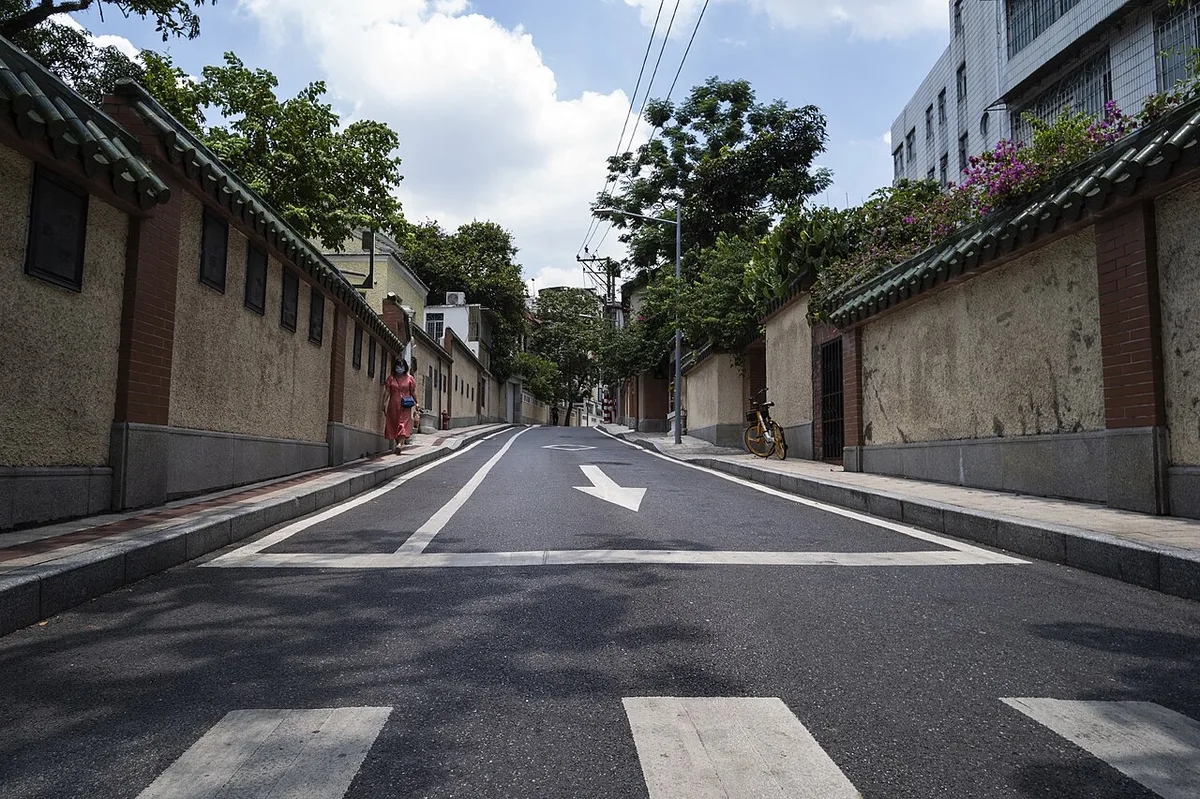
Dongshankou is best savored entirely on foot. Free from rigid gridiron planning, its curving streets ascend natural gentle ridges, creating framed architectural vistas beneath canopies of camphor, banyan, and flowering bauhinia. We recommend allocating 3 to 4 hours for this curated walking circuit:
[Metro Dongshankou Exit E]
       │ (150m south)
[Shuqian Road & Miaoqian West Road] ─── Commercial energy, local market & designer retail
       │
[Xiguyuan Road] ──────────────────────── Kui Garden & CPC Congress Memorial Plaza
       │ (100m south)
[Bai Yuan (No. 12 Xiguyuan)] ─────────── Institute of History & Philology birthplace
       │
[Xinhepu Road Canal Bank] ───────────── Tree-lined waterfront & Chun Yuan Mansions
       │
[Peizheng Road Slope] ────────────────── "Prettiest Slope", Pui Ching Middle School, No. 7 High School
       │
[Yandun Road & Sibeitongjin] ────────── Yu Garden, Jian Garden & Dongshan Christian Church
       │ (250m north)
[Return to Dongshankou Metro]
- Morning Start at Miaoqian West Road: Exit Dongshankou Metro Station via Exit E or F. Walk down Shuqian Road and turn into Miaoqian West Road (庙前西街). Take in the lively juxtaposition of early morning Cantonese wet-market life at Dongshan Meat & Vegetable Market and minimalist avant-garde storefronts.
- Xiguyuan Road Heritage Anchor: Turn south into Xiguyuan Road. Stroll down the tranquil tree tunnel to the Third CPC National Congress Memorial Hall, observing the exposed brick footing remnants of the bombed 1923 hall. Step directly across into Kui Garden (No. 9) to admire its 1922 pediment and gallery displays.
- Scholarly Solitude at Bai Yuan: Walk 50 meters south to No. 12 Xiguyuan Road to tour Bai Yuan, soaking in the quiet courtyard where China’s premier modern historians worked in the 1920s.
- Xinhepu Waterfront Promenade: Turn west onto Xinhepu Road along the shaded canal. Marvel at the sequence of grand villas, stopping at Chun Yuan (Nos. 22–26) to examine the waterfront verandas and preserved revolutionary living quarters.
- The Historic Peizheng Incline: Cut northward onto Peizheng Road, widely hailed as the “prettiest slope in Dongshankou.” Admire the historic brick campuses of Pui Ching Middle School (founded 1889) and Guangzhou No. 7 High School (formerly Pooi To Girls’ School, founded 1888), characterized by green-glazed ceramic tiled roofs crowning neoclassical masonry bases.
- Sibeitongjin and Dongshan Church: Conclude your walk winding through Yandun Road and Sibeitongjin. Pass the gated courtyards of Jian Garden and Yu Garden before arriving at the majestic twin-towered facade of Dongshan Christian Church.
Creative Revitalization and Independent Coffee Culture
Over the past decade, Dongshankou has transformed into Guangzhou’s premier incubator for youth creative culture, urban micro-regeneration, and independent retail. Crucially, this evolution bypassed heavy-handed commercial redevelopment. Instead, independent graphic designers, vintage collectors, fashion buyers, and artisanal coffee roasters individually rented derelict garden outbuildings, ground-floor salons, and residential garages, converting them into curated social spaces.
- Design Boutiques and Concept Spaces: Streets like Miaoqian West Road, Qimilu, and Junyi Road host notable creative establishments including The Song of White Bird (白鸟之歌, olfactory and niche fragrance lab), SND (avant-garde fashion boutique housed within an ethereal brutalist interior), and ART23 Contemporary Art Museum.
- The Dongshan Market Renaissance: At the corner of Miaoqian West Road, the historic Dongshan Meat & Vegetable Market underwent a sensitive architectural redesign featuring a translucent, polychrome tensile roof canopy. Local grandmothers buying fresh Pearl River carp now brush shoulders with young fashion photographers in a seamless blending of daily domesticity and youth culture.
- Artisanal Coffee Culture: Dongshankou is widely considered the specialty coffee capital of Guangzhou. Independent baristas emphasize single-origin light-roast pour-overs (Geisha, anaerobic naturals) as well as creative Cantonese signature concoctions infused with sun-dried Xinhui chenpi (aged tangerine peel), fresh lychee, and osmanthus syrup. Sitting on a wooden bench beneath a sprawling banyan tree in an open-air brick courtyard offers a sublime taste of contemporary Guangzhou life.
Practical Visitor Guide: Transportation, Tickets, and Etiquette
| Category | Practical Details |
|---|---|
| Address | Xinhepu Historic District, Yuexiu District, Guangzhou (广州市越秀区新河浦历史文化街区) |
| Metro Access | Line 1 & Line 6, Dongshankou Station (东山口站), Exit E (for Shuqian Road / Miaoqian West Road) or Exit F (for Dongshan Church) |
| Bus Lines | Routes 3, 215, 811, or Dongshan Bus 1 to Dongshankou (Shuqian Road) Stop |
| Opening Hours | Public streets and alleys: Open 24/7 all year. CPC Memorial, Chun Yuan & Bai Yuan: 09:00–17:00 (last entry 16:30; closed Mondays except statutory holidays). Kui Contemporary Art Lab: 11:00–20:00 (Tuesday–Sunday; closed Mondays). |
| Admission & Booking | Free admission throughout the district. CPC Memorial Hall & Chun Yuan require real-name booking via the official WeChat mini-program (“中共三大会址纪念馆”). On-site booking is generally available on non-peak weekdays. |
| Recommended Duration | 3 to 5 hours (ideal for unhurried photography, gallery browsing, and courtyard coffee). |
| Best Time to Visit | Mid-afternoon (14:30–17:30) on sunny autumn or winter days. The low golden sunlight filters through the camphor trees, casting dramatic warm light across the red brickwork. |
Neighborly Etiquette and Respectful Exploration
- Respect Private Residential Enclaves: A significant portion of Xinhepu’s heritage villas remain private family homes or quiet residential staff quarters. Do not push open unlatched wooden gates, peer through first-floor window grilles, or trespass into private courtyards without explicit invitation.
- Keep Noise Levels Down: Maintain a tranquil volume when strolling through residential lanes such as Peizheng 1st to 9th Horse Roads. Avoid shouting, amplified speakers, or disruptive group filming.
- Do Not Obstruct Narrow Passageways: Commercial photography setups (tripods, clothing racks, bulky lighting equipment) frequently cause bottlenecks on narrow lanes. Be mindful of neighborhood elders and motorists navigating residential parking.
- Protect Architectural Fabric: Never lean heavy equipment against vintage lime-mortar joints, climb decorative perimeter brick walls, or pluck blossoming branches hanging over courtyard railings.