Guangzhou Attractions 11 min read
Chen Clan Ancestral Hall: Lingnan Art & Metro Guide
Visit Chen Clan Ancestral Hall (Chen Clan Academy) in Liwan, Guangzhou. Qing Dynasty carvings, Shiwan pottery roof ridges, folk museum exhibits, and metro tips.
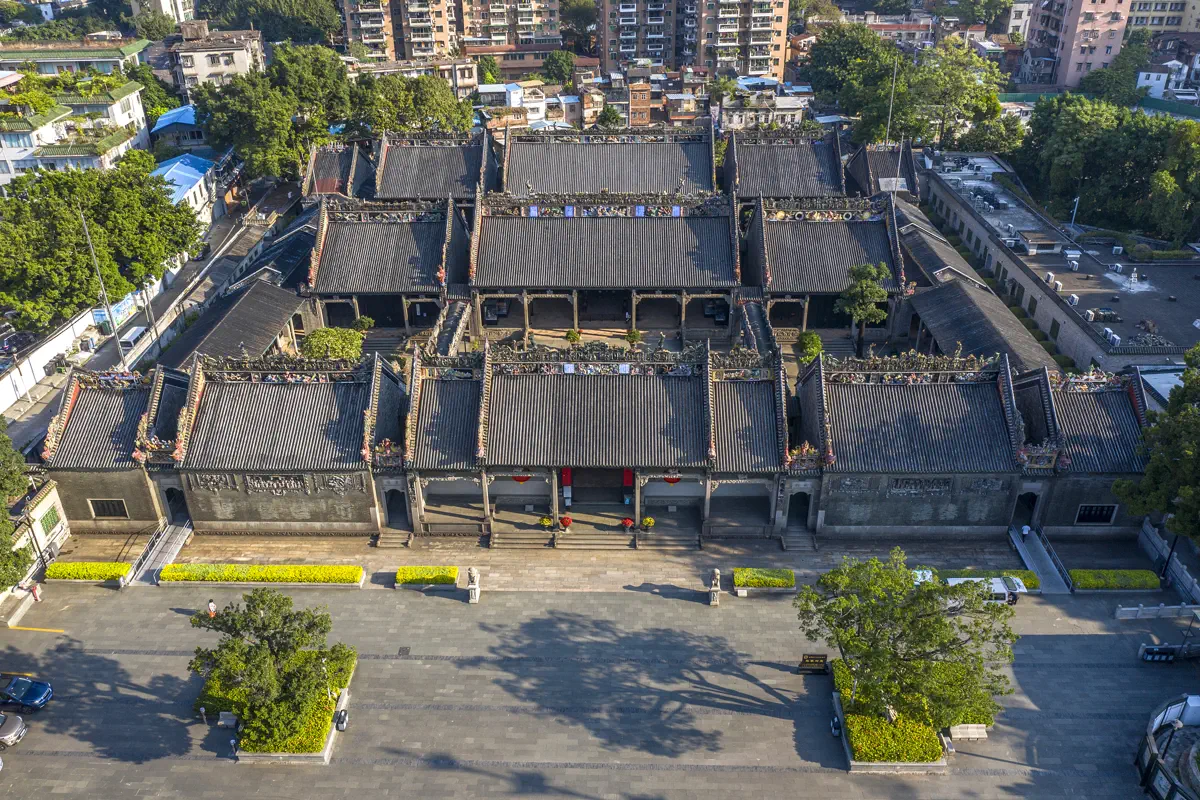
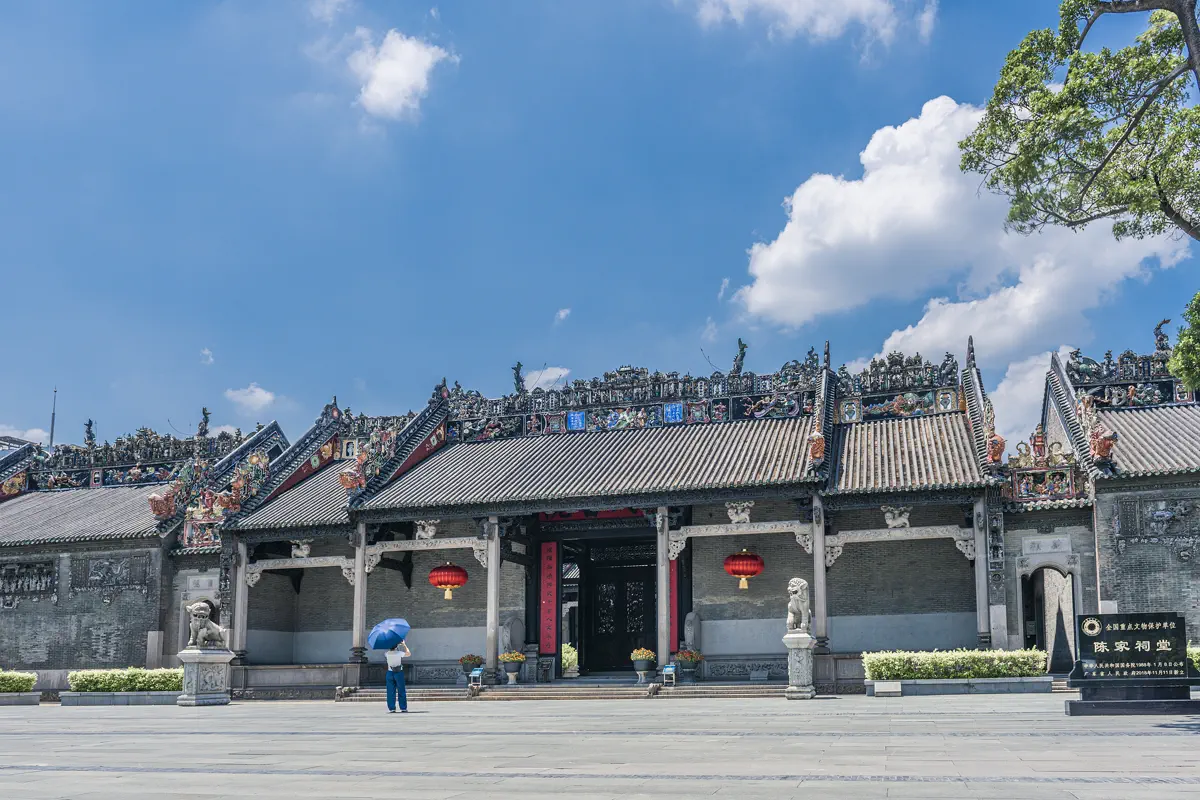
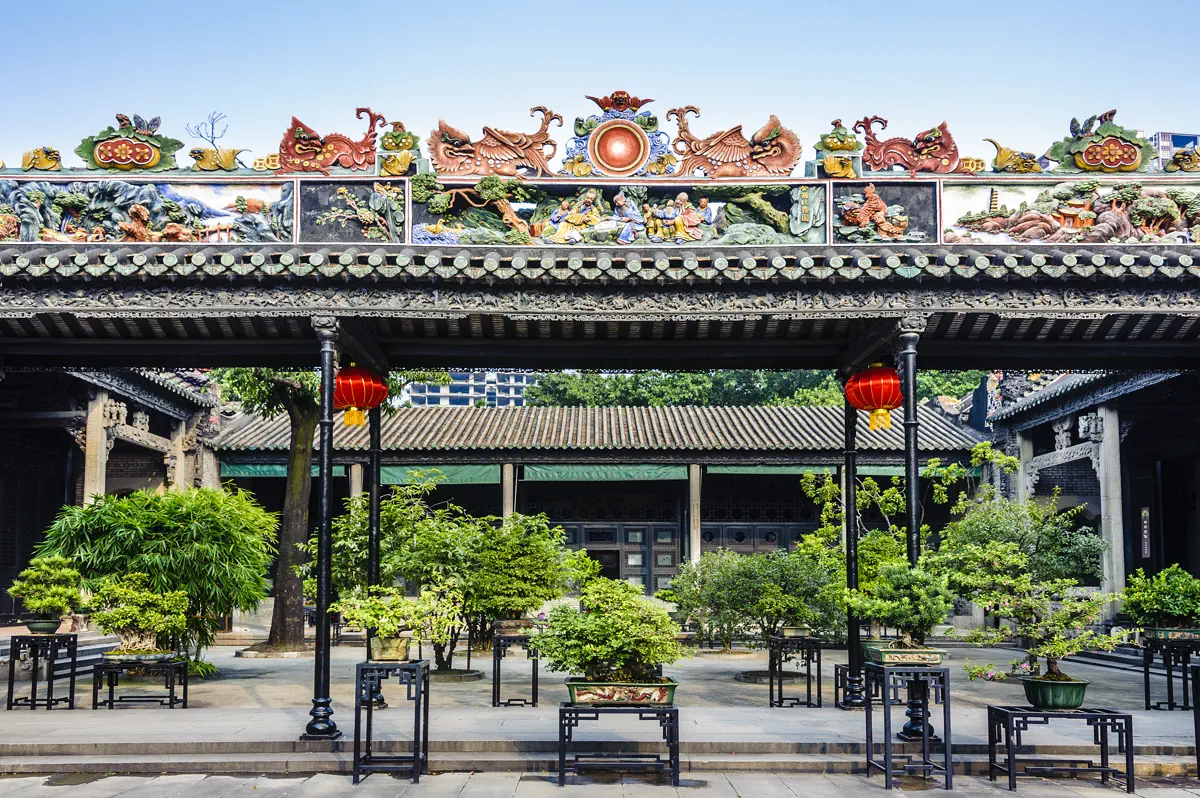
Rising amid the bustling streets of northern Liwan District along Zhongshan 7th Road, the Chen Clan Ancestral Hall (陈家祠), officially named the Chen Clan Academy (陈氏书院), stands as the ultimate benchmark of classical Lingnan decorative architecture. Completed in 1893 during the late Qing Dynasty, this expansive temple complex synthesizes all seven traditional southern decorative arts into a unified architectural ensemble: wood carving, stone carving, brick carving, ceramic pottery ridge sculpture, lime plaster relief, cast iron openwork, and polychrome mural painting.
When scholar and poet Guo Moruo visited the hall in 1959, he penned the famous commemorative couplet: “Human skill can replace the work of nature, yet nature’s work cannot rival that of humankind” (天工人可代,人工天不如). Today, the hall is safeguarded as a National Key Cultural Relics Protection Unit and serves as the permanent home of the Guangdong Folk Art Museum (广东民间工艺博物馆), welcoming travelers seeking the authentic cultural roots of Canton.
Lineage history: a 72-clan academy for imperial examinations
Unlike standard family ancestral shrines erected to honor a single direct ancestral branch, the Chen Clan Ancestral Hall is a joint lineage complex (hezu ci, 合族祠). In the late nineteenth century, prominent Chen leaders and wealthy merchants from 72 counties across Guangdong Province banded together to finance and construct a communal headquarters in provincial capital Canton.
Construction commenced in the 14th year of Emperor Guangxu’s reign (1888) and reached completion in 1893. The complex functioned simultaneously as an ancestral hall and an educational academy. Here, young Chen scholars traveling from distant towns, mountainous counties, and Pearl River delta villages could lodge, study, and receive academic support while taking the rigorous provincial civil service examinations (keju, 科举).
The compound also provided legal counsel, tax representation, and an overseas liaison hub for the extensive Chen diaspora returning through Guangzhou. Because donations flowed from affluent lineage networks across Guangdong and Hong Kong, no expense was spared. Master craftsmen, brick carvers, ceramic sculptors, and wood artisans from Foshan, Shunde, Panyu, and Chaozhou were hired to produce the most elaborate decorative finishes ever gathered into a single southern Chinese compound, rivaling famous heritage gardens like Yuyin Shanfang and Baomo Garden.
Architectural layout: three entries, nine halls, and breeze corridors
The Chen Clan Ancestral Hall covers an expansive total area of 15,000 square metres, with a built footprint of approximately 6,400 square metres. It adheres to an unyielding north-south central axis, configured in the classical layout known in Chinese architecture as “three entries, three routes, nine halls, and two flanking wings” (三进三路九堂两厢杪).
- The Three Entries: Progressing from south to north, visitors encounter the Front Gate Hall (前座), the central ceremonial Juxian Hall (聚贤堂), and the rear Ancestral Tablet Hall (后座).
- The Three Routes: The central ceremonial line is flanked symmetrically by eastern and western secondary axes, separating private scholar rooms from public ceremonial pavilions.
- The Nine Halls: Three main halls on each of the three routes create nine interconnected courtyards, each serving distinct ritual, educational, and administrative purposes.
- The Flanking Wings: Longitudinal side wings called *xiangmiao* originally housed the Rixin Academy (日新书院) and Wenchang Temple (文昌庙), buffered by slender granite-paved Qingyun Alleys (青云巷).
Guangzhou’s subtropical monsoon climate brings intense summer heat, torrential downpours, and humid spells. The architects tackled this through bioclimatic passive cooling: deep roof eaves shade walls from direct sunshine, high gabled roofs allow rising heat to gather well above head level, and spacious central light wells (tianjing, 天井) draw breezes through open breezeways and veranda corridors. Even on sweltering humid afternoons, natural airflow keeps the covered pavilions surprisingly comfortable.
Roof ridge treasures: Shiwan pottery and outdoor plaster relief
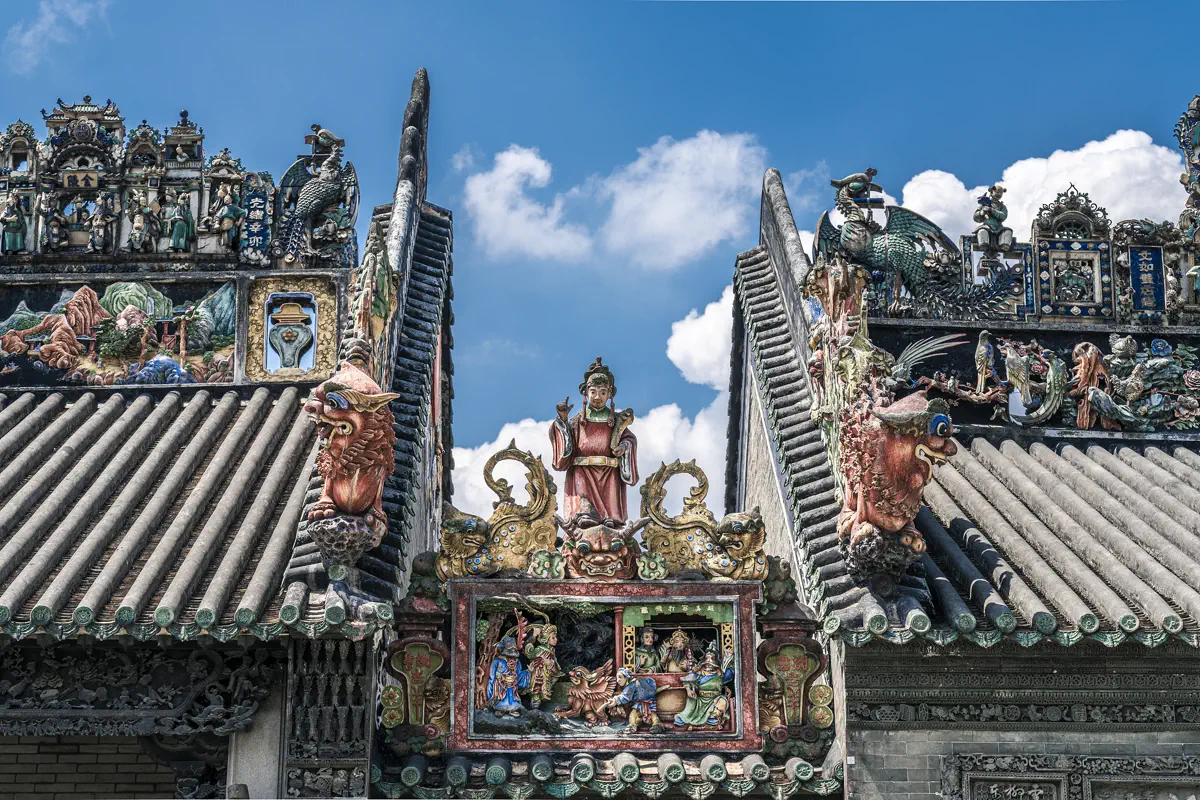
The most celebrated visual spectacle of Chen Clan Ancestral Hall sits perched along the roof lines. Eleven monumental ceramic pottery ridges, spanning over 160 metres in total length, adorn the main roof ridges and stepped gable profiles.
These polychrome glazed ridges were custom crafted in the historic Shiwan kilns of Foshan (石湾窑). Master potters molded complex Cantonese opera scenes, mythological tales, and folk celebrations containing hundreds of three-dimensional figurines, including the Investiture of the Gods (封神演义), the Gathering of Immortals, and dramatic naval battles. Each miniature ceramic warrior, deity, horse, and mythical creature features individual facial expressions, theatrical costumes, and mineral glazes. Fired at high temperatures, these vivid Shiwan greens, blues, yellows, and browns have withstood over a century of typhoon winds, heavy rains, and searing sunshine without losing their brilliance.
Beneath the ceramic ridges, on gables, corridor eaves, and pediments, visitors will find extensive lime plaster relief (huishu, 灰塑), locally known as huipi. Artisans mixed slaked lime, shredded straw fiber, brown sugar syrup, and glutinous rice paste to create a malleable mortar. Applied directly onto brick frameworks, the relief was hand-sculpted in thick three-dimensional layers before being hand-painted with mineral pigments.
Plaster relief scenes depict the Eight Sights of Canton, swirling bats for fortune, roaming qilin beasts, and ripe pomegranates symbolizing abundant progeny. Beyond artistic display, this resilient lime plaster provides essential structural binding that anchors heavy gables against fierce coastal storms.
Wall marvels: water-polished brick carvings and granite stonework
Along the exterior front wall flanking the main entrance gates, large panels of water-polished brick carvings (zhuandiao, 砖雕) command immediate awe. Unlike northern Chinese brick carving where individual bricks are carved before assembly, Lingnan masters ground fine-grained dense blue-gray bricks until perfectly smooth, laid them flush with hairline mortar seams, and carved the entire relief in situ.
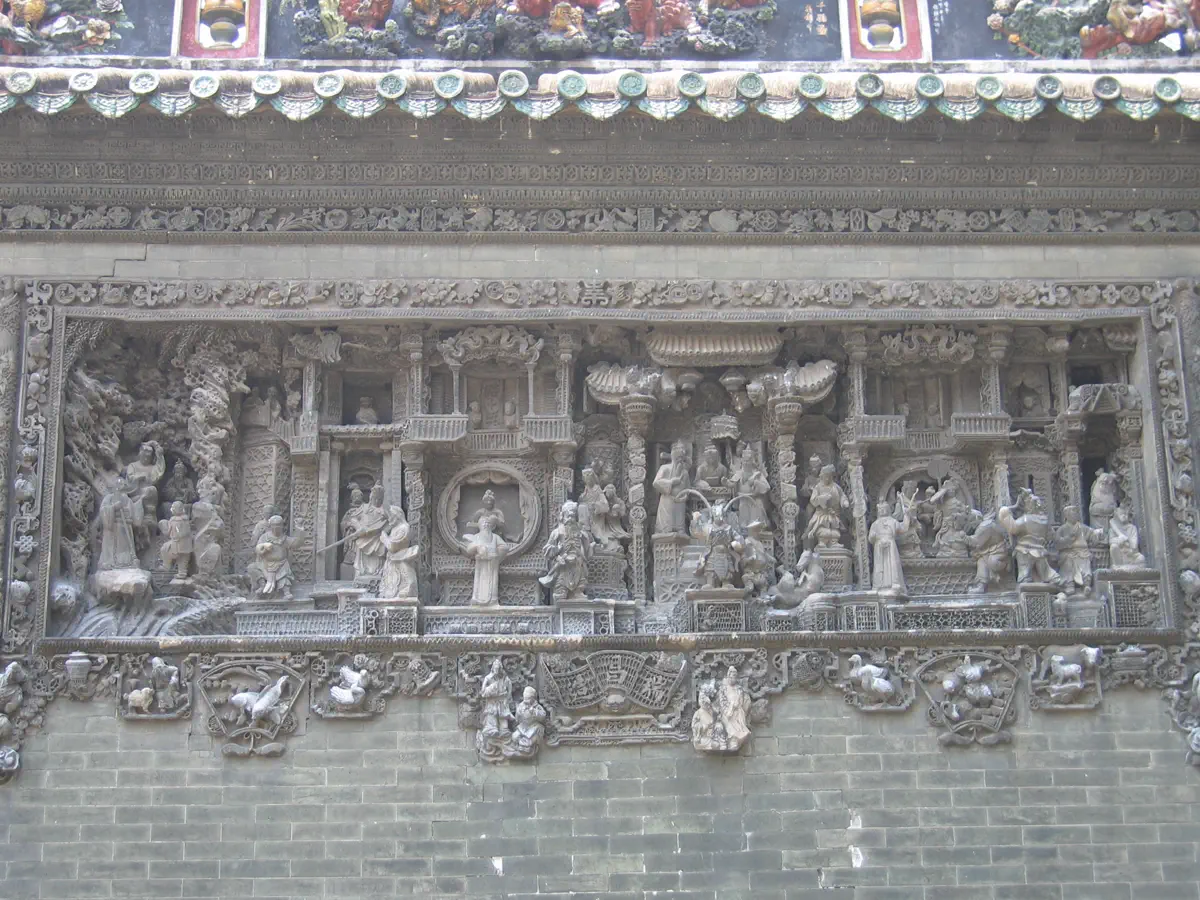
The crowning piece on the western entrance wall portrays the famous scene from the classical Chinese novel Water Margin: Heroes Gathering at Mount Liang (梁山聚义). Measuring roughly four metres wide and nearly three metres tall, this single continuous brick panel features dozens of distinct martial heroes, ornate pavilions, banqueting tables, flapping battle banners, galloping horses, and cascading mountain crags.
In some deep sections, the carvers chiseled through up to six distinct spatial layers, hollowing out spear tips, stirrups, and window lattice bars less than a few millimetres thick. On the eastern facade, an equally celebrated companion brick carving illustrates Liu Qing Taming the Fierce Stallion (刘庆伏狼驹), full of dynamic equine motion.
At ground level, massive white and gray granite supports the architecture. Twelve exterior monolithic granite pillars carry the front porch weight, seated upon ornate stone drum bases (baogushi, 抱鼓石) carved with coiled dragons, paired qilins, and guardian lions that guard the thresholds from evil spirits.
Juxian Hall: openwork iron railings and gilt-wood shrines
Juxian Hall (聚贤堂), the central gathering hall, formed the spiritual and administrative core of the ancestral compound where elders held meetings, resolved clan disputes, and hosted banquet receptions. In front of the hall lies an expansive stone platform terrace (yuetai, 月台) bordered by finely carved granite balustrades.
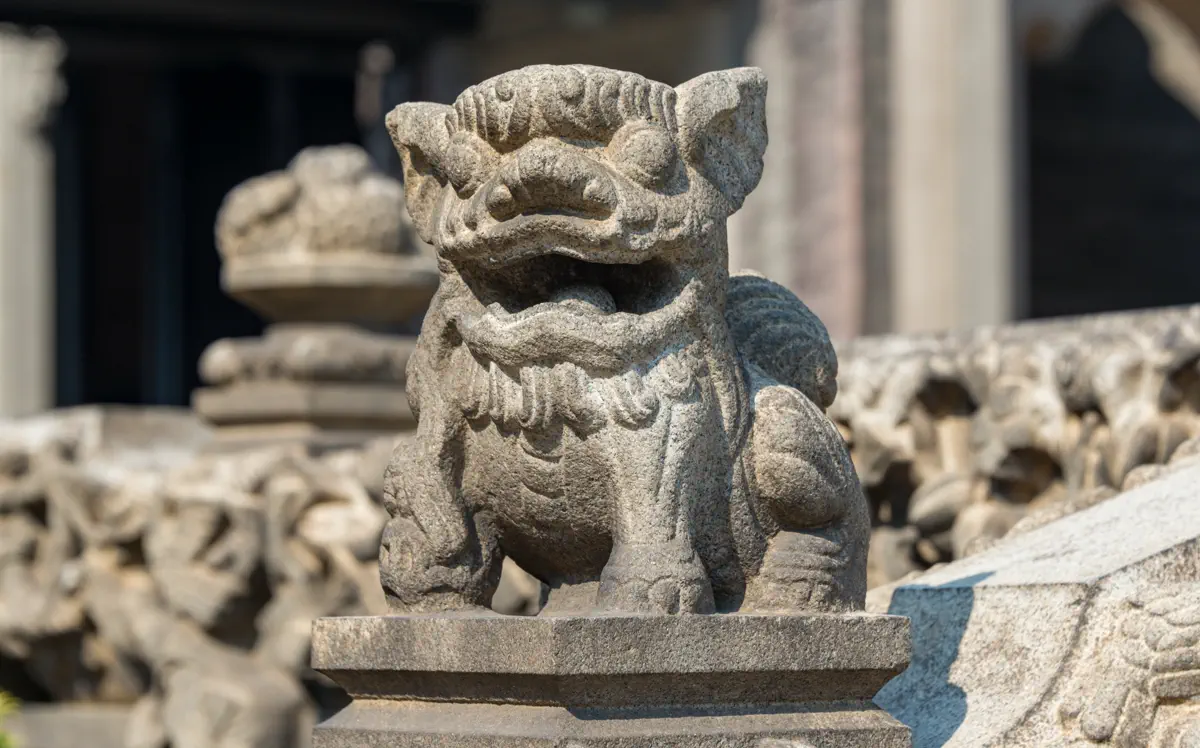
Twenty-four stone posts line this terrace, each crowned with a hand-carved stone lion cub displaying playful, animated gestures—some rolling on their backs holding decorative balls, others sheltering smiling cubs between their paws. Set between these stone pillars are openwork cast-iron railing screens, produced using Western-style sand-cast iron techniques imported to nineteenth-century Canton. These black iron panels feature auspicious Chinese botanical themes such as the Three Friends of Winter (pine, bamboo, and plum blossom), demonstrating how Lingnan craftsmen embraced international metalworking methods without compromising traditional aesthetics.
Inside the halls, timber wood carving dominates every structural element. Beams, purlins, king-posts, and bracket complexes are crafted from dense tropical hardwoods including ironwood (tieli mu) and Borneo camphorwood (kundian mu). The shrines in the rear halls once held thousands of ancestral tablets mounted upon elaborate tiered pedestal tables.
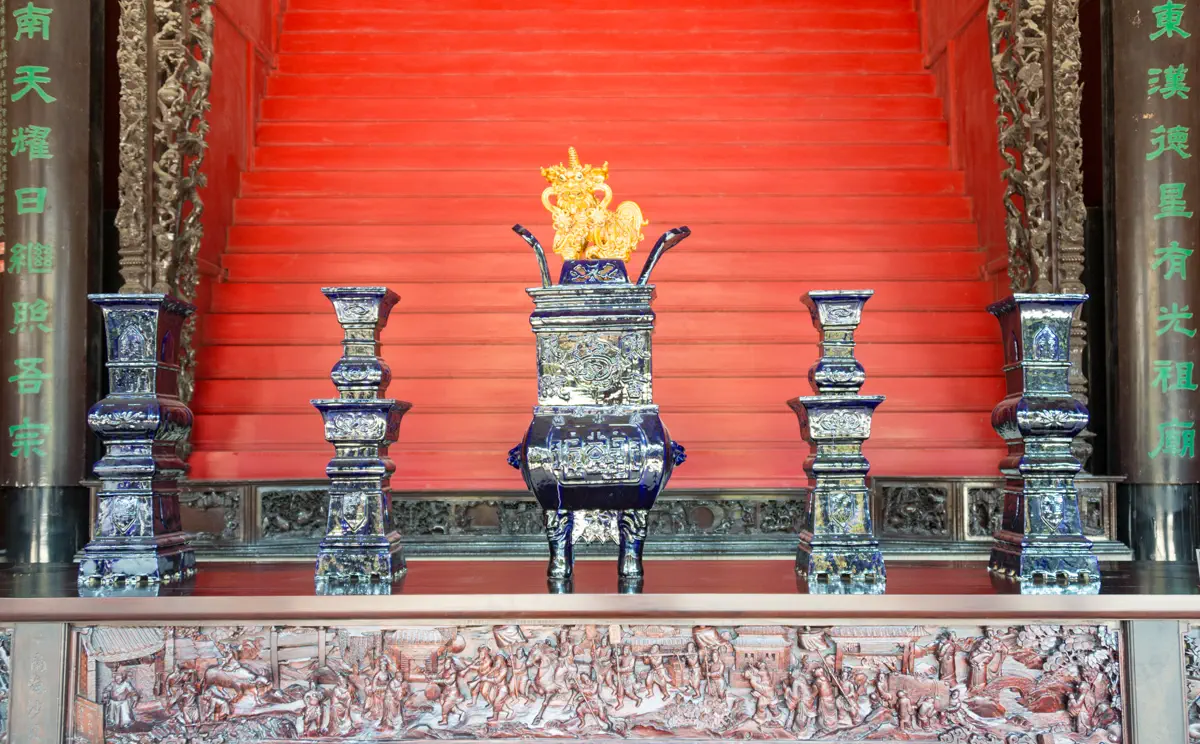
The folding partition screens separating inner courtyards feature double-sided openwork gilt-wood carvings. Through meticulous pierce-carving, artisans ensured that the design on both front and back looks completely finished while allowing breezes and soft filtered sunlight to penetrate into interior rooms.
Guangdong Folk Art Museum: embroidery, porcelain, and ivory balls
Since 1959, the Chen Clan Ancestral Hall has housed the Guangdong Folk Art Museum. The historic side rooms, scholar chambers, and former lecture halls now host rotating and permanent exhibitions showcasing the finest non-material cultural heritage crafts of the Lingnan region:
- Cantonese Embroidery (Guangxiu, 广绣): Celebrated as one of China's Four Great Embroideries, renowned for bold colors, gold-thread couching, and peacock or lychee motifs. Look for the famous embroidered screens depicting court ladies and tropical flora that resemble vivid oil paintings.
- Canton Painted Porcelain (Guangcai, 广彩): Developed during the Qing Dynasty Thirteen Hongs trading era to cater to European royal courts. Plain white Jingdezhen porcelain was shipped to Canton, hand-painted with intricate polychrome enamels and burnished gold leaf, and refired into shimmering showpieces.
- Chaozhou Gilt Woodcarving (Chaozhou Jinqi Mudiao): Dazzling camphorwood carvings coated in pure gold foil, depicting opera narratives with multi-tiered figures floating against leafy canopies.
- Intricate Carved Concentric Ivory and Bone Balls: Masterpieces of Southern carving where a single solid sphere is hollowed out from the inside into 20 to 40 concentric, independently rotating spheres, each adorned with lace-like filigree patterns. Following wildlife protection laws, modern artisans continue this technique using mammoth tusk and ox bone.
- Duan Inkstones (Duan Yan, 端砚): Originating from Zhaoqing along the West River, these natural purple stone inkstones are prized by calligraphers for their velvet-smooth texture and iridescent stone eye formations (*shiyan*).
Tickets, hours, and practical visitor advice
Visiting the Chen Clan Ancestral Hall is effortless thanks to its central location in downtown Guangzhou and direct metro connectivity.
- Address: No. 34 Enlong Lane, Zhongshan 7th Road, Liwan District, Guangzhou (广州市荔湾区中山七路恩龙里34号).
- Metro: Take **Metro Line 1** or **Line 8** directly to **Chen Clan Academy Station** (陈家祠站). Use **Exit D** (equipped with escalator access directly into the greenery square) or **Exit E**. The monumental entrance is visible immediately upon reaching ground level.
- Admission ticket:
- Standard adult ticket: **10 RMB**.
- Concession ticket: **5 RMB** (students with valid ID, adults aged 60–64).
- Free entry: Children under 18 accompanied by adults, seniors aged 65 and above, and active military personnel (free ticket booking still required).
- Opening hours: Tuesday to Sunday, 09:00–17:30 (ticket sales stop and last admission at 17:00). **Closed on Mondays** for regular heritage conservation, except on Chinese national public holidays.
- Ticket booking: Visitors can book mobile tickets in advance through the official WeChat miniprogram *"Guangdong Folk Art Museum"* (广东民间工艺博物馆), or scan on-site QR codes at the gate. Foreign visitors can enter by scanning passport details at the turnstile.
- Recommended visit duration: Allow 1.5 to 2.5 hours to leisurely admire both the architectural carvings and the museum gallery collections.
- Photography tip: Early morning between 09:00 and 10:30 provides the softest natural light along the northern facades, while afternoon sunlight creates dramatic shadow relief across the western water-polished brick carving wall. A telephoto zoom lens (70–200mm) is strongly recommended for capturing high-perched ceramic ridge figures and rooftop plaster details.
Pairing with nearby Xiguan and Liwan attractions
Thanks to its prime Old Canton location, the Chen Clan Ancestral Hall serves as the natural starting anchor for a full-day heritage and culinary walking tour through historic Liwan District:
- Morning at Chen Clan Academy (09:00–11:30): Begin your day here before tourist tour groups peak, admiring the brick carvings, Shiwan roof pottery, and folk art exhibits.
- Stroll down to Hualin Temple & Jade Street (11:45–13:00): Walk south down Kangwang Road or take Line 8 one stop to Hualinsi Station to explore Hualin Temple, Bodhidharma's landing place in Canton with its hall of 500 arhat statues, framed by the bustling jade gemstone market.
- Dim Sum Lunch in Old Xiguan (13:00–14:30): Enjoy traditional Cantonese tea and handmade dim sum at historic tea houses—refer to our dedicated Guangzhou dim sum guide and what to eat in Guangzhou food guide for local recommendations like shrimp dumplings, siu mai, and water chestnut cake.
- Afternoon at Yongqing Fang & Lychee Bay (14:30–17:00): Head west into Yongqing Fang to discover restored 1930s arcade streets, Bruce Lee's ancestral home, the Cantonese Opera Art Museum, and the picturesque waters of Lychee Bay.
- Sunset & Evening along Shamian Island or Shangxiajiu: Wrap up your day walking among European colonial heritage villas on Shamian Island along the Pearl River, or browse nighttime street snacks along Shangxiajiu Pedestrian Street. For travelers planning a comprehensive weekend stay, consult our curated 3–4 day Guangzhou travel itinerary and master Guangzhou travel guide.
Frequently asked questions
Is the Chen Clan Ancestral Hall suitable for international travelers who don't speak Chinese?
Yes, thoroughly. Informational panels beside major architectural highlights, brick carvings, and exhibition galleries feature bilingual Chinese and English explanations. Visitors can also scan official QR codes beside key displays on their smartphones to listen to multilingual audio commentary.
Do I need to make advance reservations to visit Chen Clan Ancestral Hall?
While same-day tickets are typically available on normal weekdays via the entrance QR code, reservations through the official WeChat miniprogram (广东民间工艺博物馆) are strongly advised for weekends and statutory holidays (such as Golden Week, Labor Day, or Spring Festival), when daily capacity limits can sell out.
Is Chen Clan Academy wheelchair and stroller accessible?
The external courtyard paths and main breezeways are paved with smooth granite flagstones and are largely accessible. However, entering several historical raised halls and inner threshold pavilions requires crossing traditional wooden raised thresholds (*mankan*, 门槛), where manual assistance is needed to lift wheelchairs. Staff at the visitor service center near Exit D can provide barrier-free guidance and wheelchair loan services upon request.
What is the difference between Chen Clan Ancestral Hall and other Lingnan gardens in Guangzhou?
While classical private residential gardens like Yuyin Shanfang in Panyu emphasize miniature waterways, rockeries, and scholar study nooks, the Chen Clan Ancestral Hall is a ceremonial communal ancestral temple. Its primary architectural significance lies in monumental architectural decoration—specifically the highest concentration of museum-grade brick, stone, and wood carvings alongside historic Shiwan ceramic roof ridges in all of southern China.
Can I take photos and videos inside the museum?
Non-commercial still photography and handheld video recording are fully permitted throughout the open-air courtyards and exhibition halls. However, the use of flash photography, tripods, and commercial selfie stabilizer setups is strictly prohibited inside indoor exhibition galleries to safeguard sensitive silk embroidery, lacquerware, and historic wood finishes.