Guangzhou Attractions 8 min read
Shawan Ancient Town: Liugeng Hall, Oyster Walls & Food
Visit Shawan Ancient Town in Panyu, Guangzhou. Explore 800-year-old Liugeng Hall, oyster shell walls, Cantonese music halls, and fresh ginger buffalo milk curd.
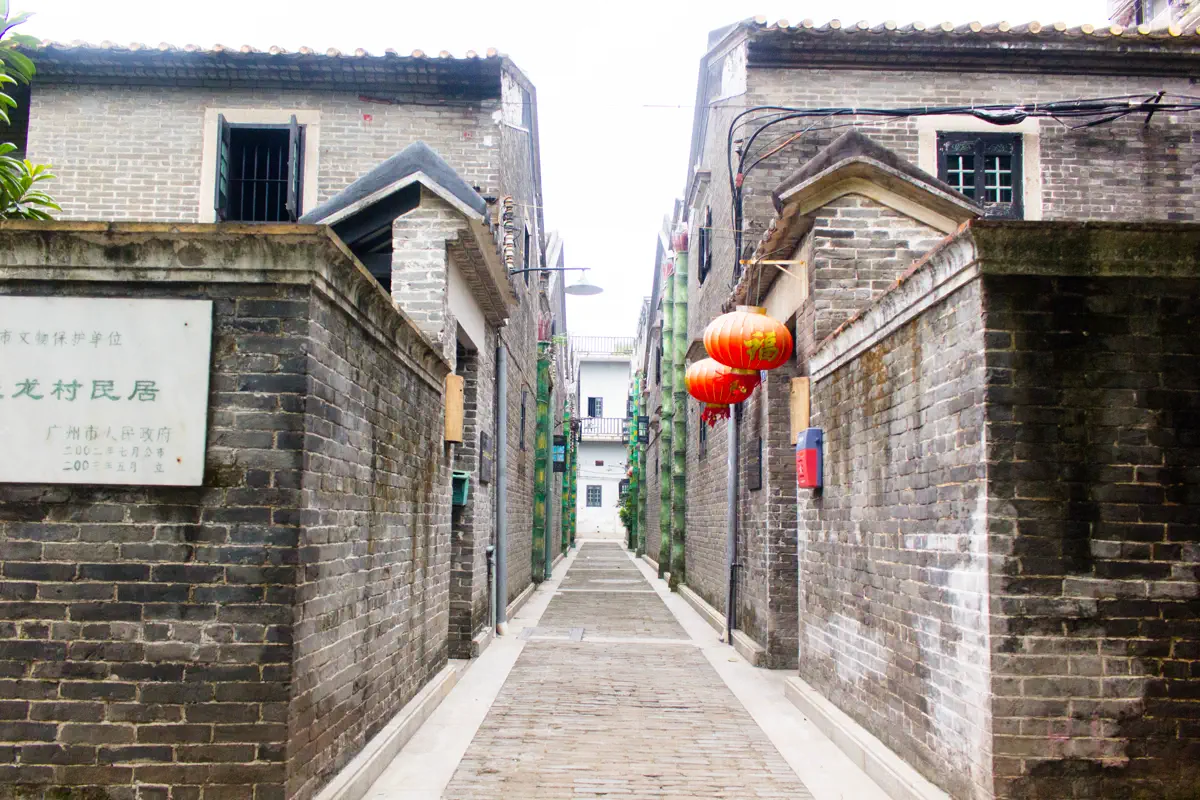
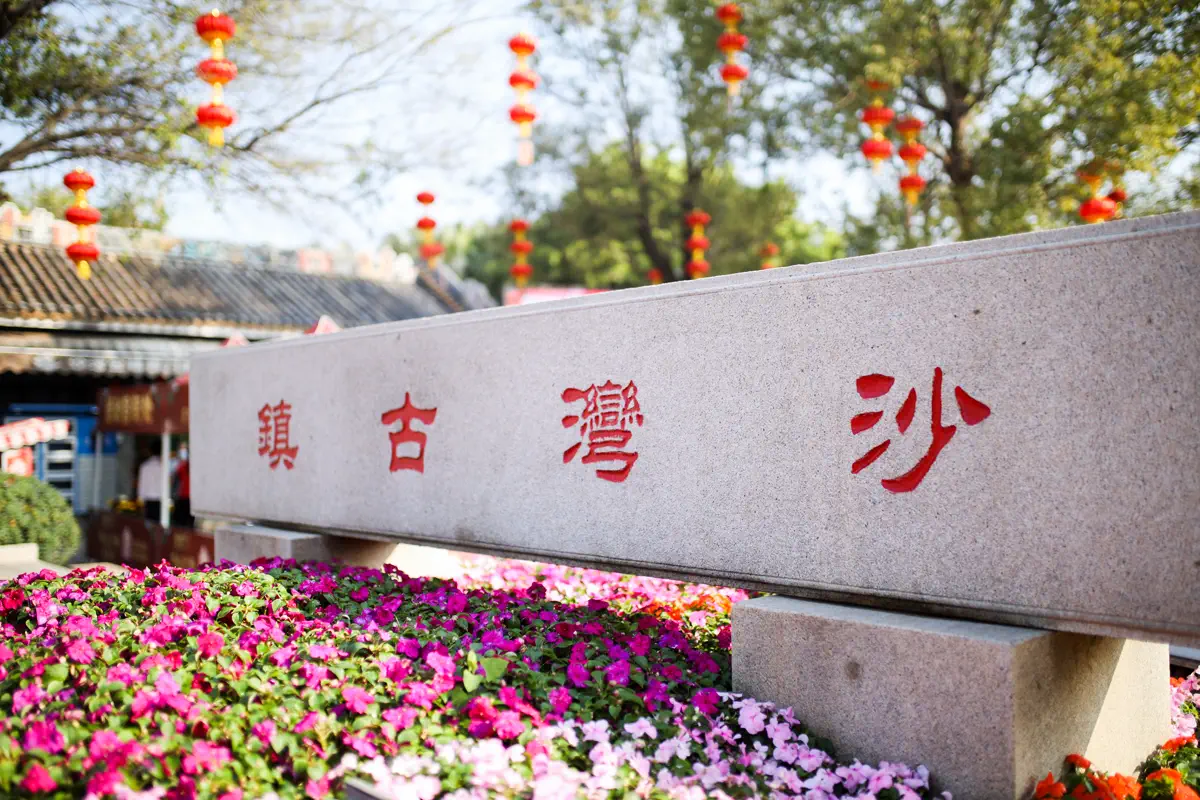
Shawan Ancient Town (沙湾古镇) is an 800-year-old Cantonese clan settlement in southern Guangzhou’s Panyu District. Founded during the Shaoxing era of the Southern Song Dynasty (1131–1162), the village developed as the ancestral stronghold of the prominent He (何) lineage on the fertile water delta of the Pearl River. Unlike sanitized film-set reproductions, Shawan remains an active residential community where gray-brick alleys, soaring wok-ear pediments, oyster shell walls, and monumental ancestral halls sit alongside everyday village kitchens.
The settlement is renowned across Guangdong as a birthplace of traditional Cantonese music (Guangdong Yinyue) and as the cradle of Lingnan water buffalo dairy craft. If you want to see authentic village clan architecture beyond central Guangzhou’s Chen Clan Ancestral Hall or the urban lanes of Yongqing Fang, Shawan offers a tranquil rural perspective easily reached within a day trip.
Getting to Shawan Ancient Town
Shawan sits roughly 35 kilometres south of Tianhe and Yuexiu districts. Public transit connects smoothly via metro and local feeder buses.
- Metro and feeder bus: Take Guangzhou Metro Line 3 south to Shiqiao Station (市桥站). Leave from Exit B, walk roughly 100 metres to the Baiyue Square bus stop, and board bus Fan 67 (番67路) directly to the Shawan Ancient Town South Gate stop (沙湾古镇南门). The bus ride takes about 35 to 40 minutes and costs 2 to 3 RMB. Alternatively, bus Fan 68 (番68路) drops passengers at the Shawan Culture Center stop near the West Gate.
- Taxi or ride-hailing: From Shiqiao Metro Station Exit B, a direct Didi or metered taxi ride along Shiliang Road takes 15 to 20 minutes and costs between 25 and 35 RMB. From central Guangzhou (Zhujiang New Town or Beijing Road), a direct taxi takes about 50 to 60 minutes and costs 90 to 120 RMB.
- Driving and parking: Navigate to the South Gate Parking Lot (沙湾古镇南门停车场) or West Gate Parking Lot. Both offer ground-level parking spaces for around 10 to 20 RMB per day.
Liugeng Hall and He Clan ancestral architecture
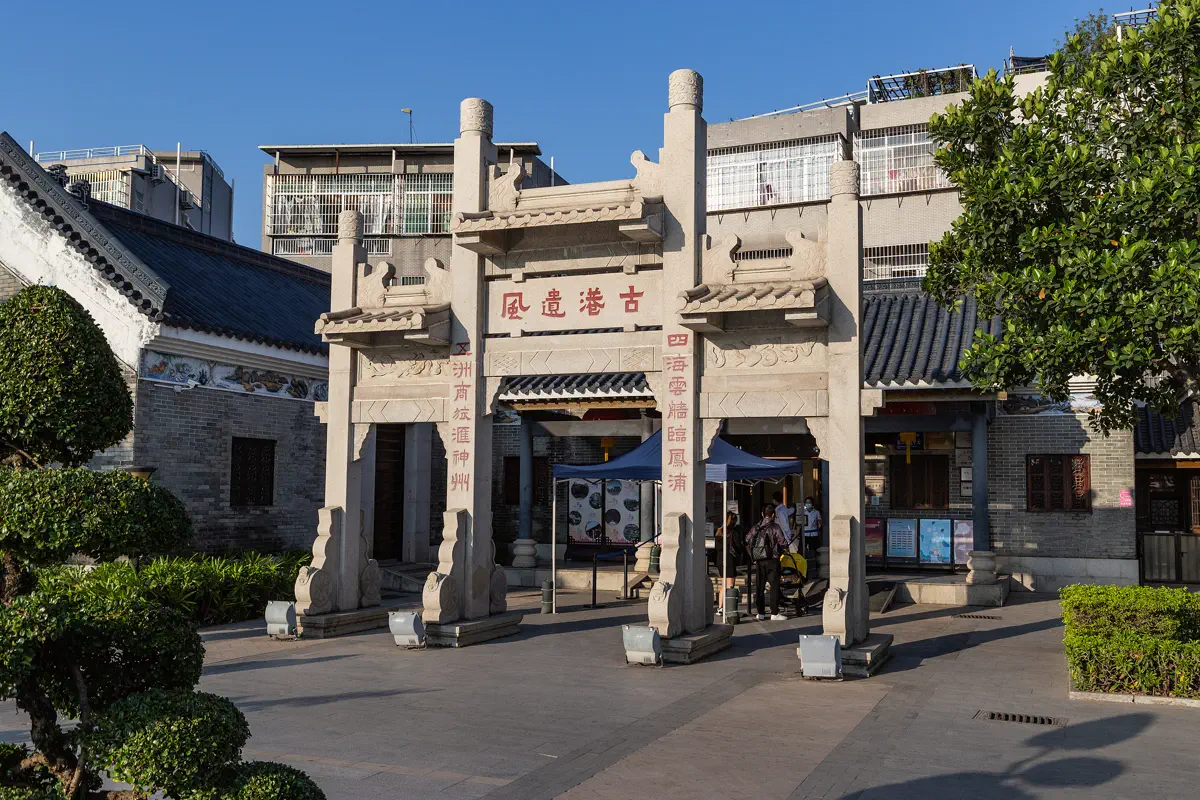
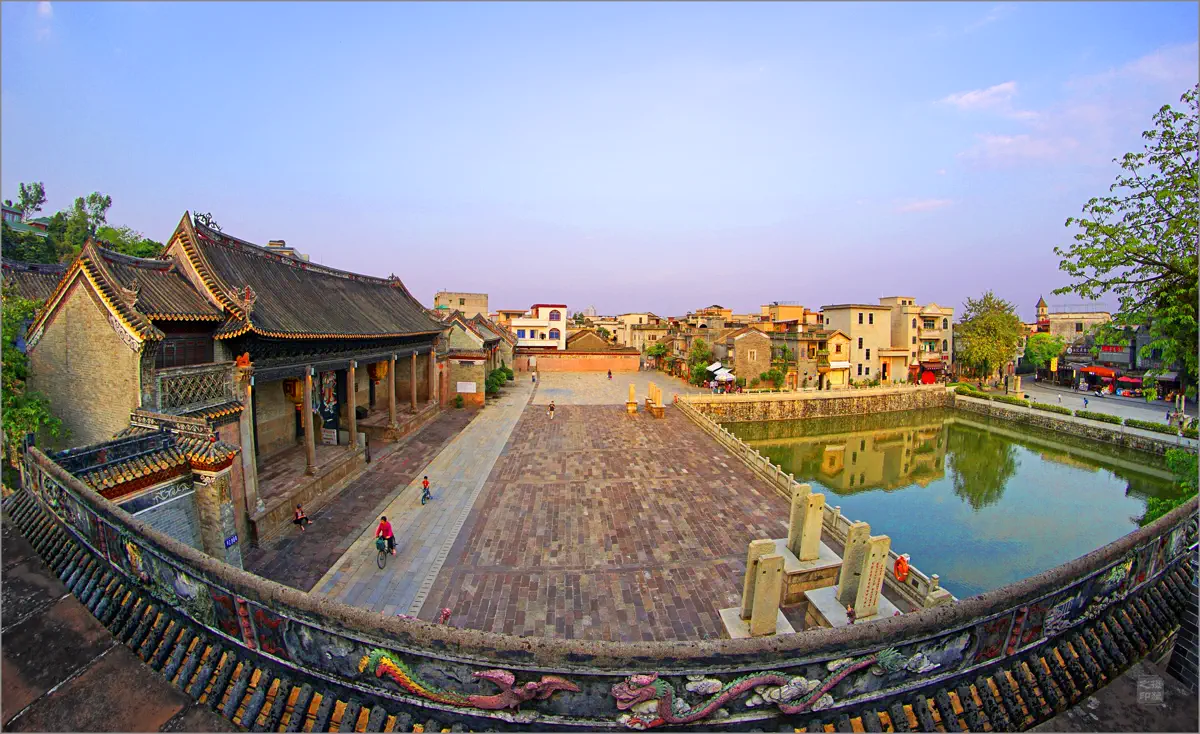
The centrepiece of Shawan is Liugeng Hall (留耕堂), the Grand Ancestral Hall of the He Clan. First erected in 1275 during the Yuan Dynasty to honour the founding ancestor He Renjian, the hall was destroyed and rebuilt three times during the Ming and Qing dynasties. Spanning over 3,300 square metres with a five-entry courtyard layout, Liugeng Hall is recognized by architectural historians—including Liang Sicheng—as one of the most magnificent village clan halls in Guangdong.
The name “Liugeng” derives from an ancestral motto: Planting quiet virtue from the ancestors, leaving fertile fields of the mind for future generations to till. In front of the primary gate lies an expansive granite terrace and a wide rectangular pond reflecting the tiled eaves. Bordering the terrace are dozens of carved granite flagpole steles, recording the names and years of He clan scholars who passed the imperial civil service examinations as Juren and Jinshi.
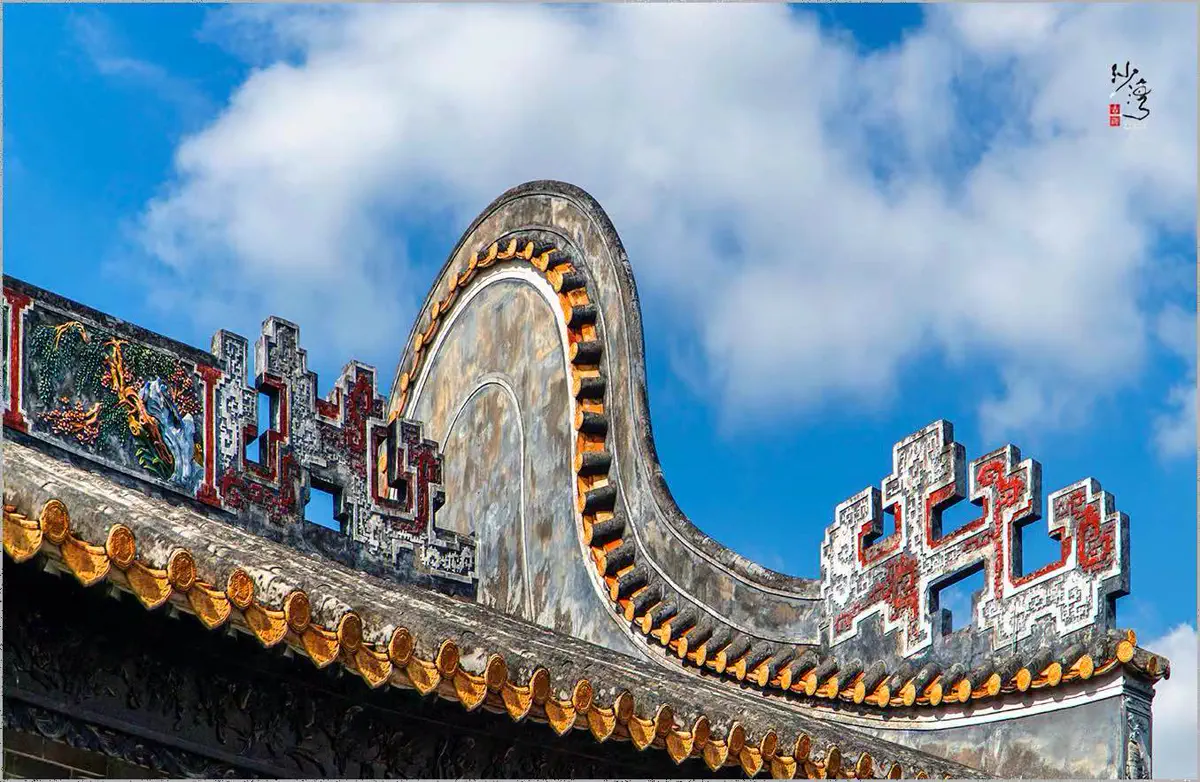
Inside the complex, the Xiangxian Hall (象贤堂) is supported by towering timber columns of rare nanmu and solid granite pillars. Roof ridges feature intricate polychrome lime plaster sculptures (灰塑) showing auspicious mythical creatures, flowers, and folk tales, handcrafted from slaked lime, glutinous rice paste, and brown sugar.
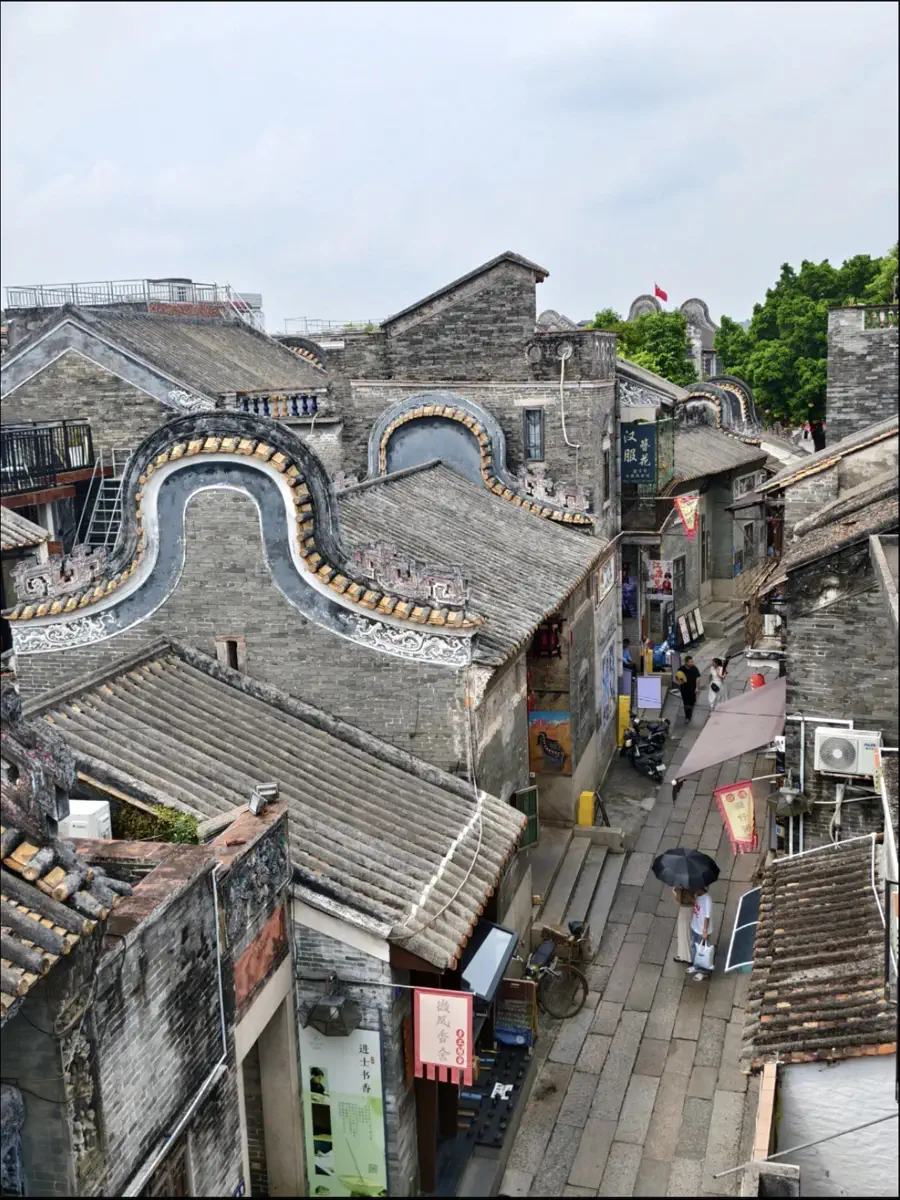
Throughout the village streets, residential compounds feature the iconic Lingnan wok-ear gable walls (镬耳屋). These crescent-shaped masonry walls curved upward like the official ear-flaps of Ming dynasty bureaucratic hats, symbolizing imperial scholarly achievement while serving a vital practical role: they act as firebreaks to halt the spread of flames between tightly packed wooden rafters during village blazes.
Centuries-old oyster shell walls and alley walks
As you explore the maze of flagstone lanes along Guangyu Road (光裕路) and Chepei Street (车陂街), you will encounter massive walls constructed entirely from discarded oyster shells. Reaching heights of four to five metres, these defensive and climatic masonry works are rare surviving marvels of historical coastal architecture along the Pearl River estuary.
During the Ming and Qing eras, villagers harvested giant oyster shells from the Lion Sea (Shiziyang) and surrounding bays. Masons laid the shells in diagonal 45-degree overlapping rows, bonded with a traditional mortar of lime, sticky rice slurry, and sand. The rough, corrugated shell surface quickly channeled torrential summer monsoon rainfall down to street gutters, while the thick shell layers provided natural thermal insulation, keeping rooms cool in blistering subtropical heat and dry during humid spring fog. In addition, the sharp, jagged edges of the shells deterred thieves from scaling compound boundaries at night.
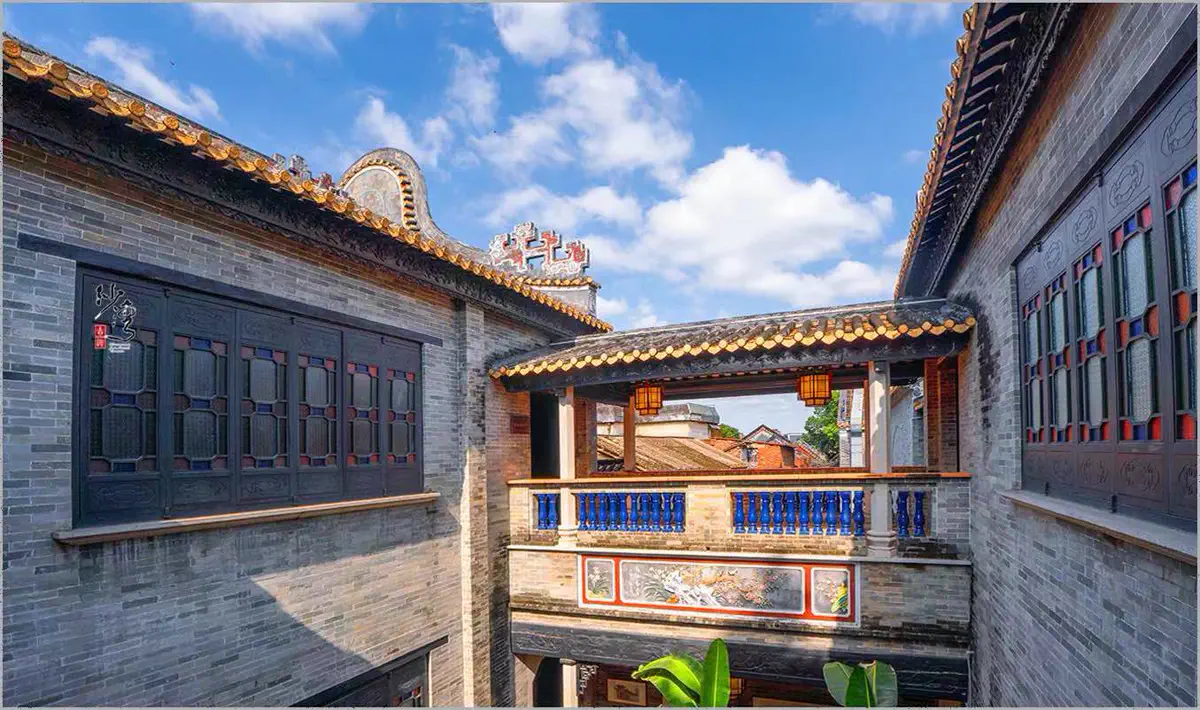
Beyond the oyster walls, courtyards in historic residences feature internal skywells (tianjing), colored Manchu stained-glass transom windows, and carved partition screens that optimize cross-ventilation.
Wenfeng Pagoda and the birthplace of Cantonese music
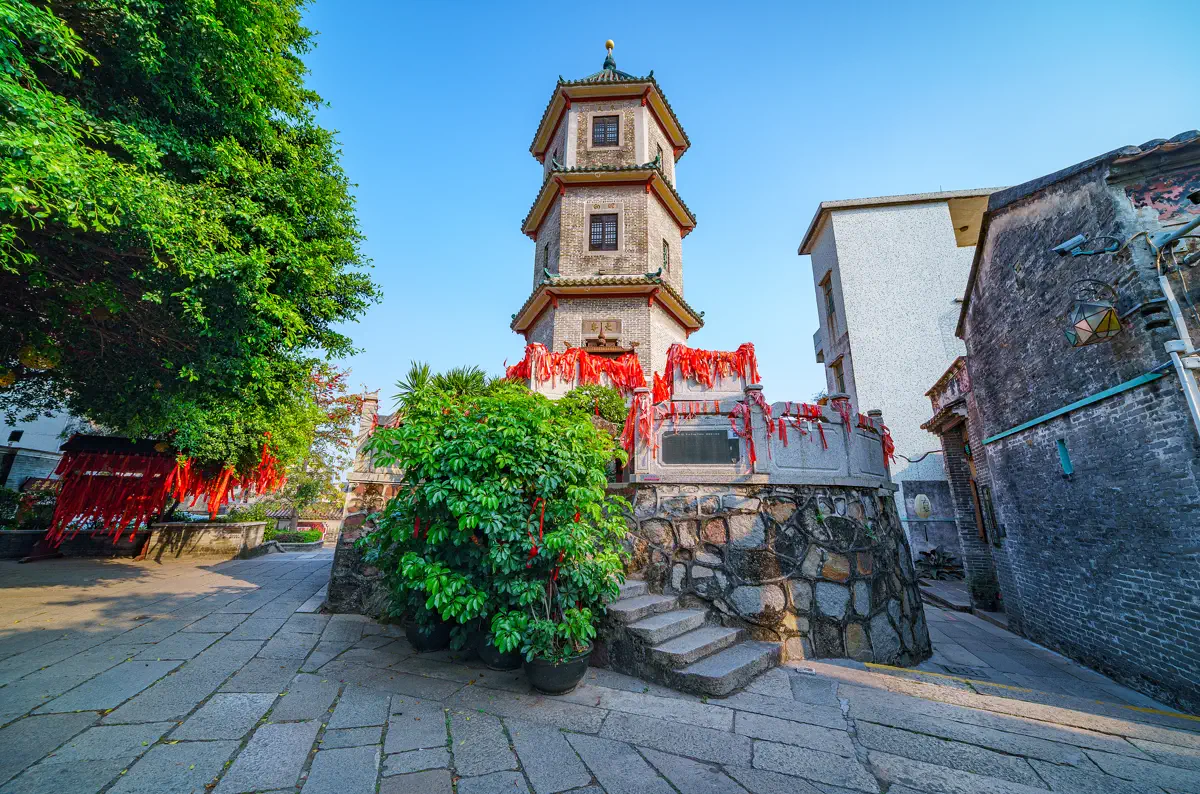
At the northern entrance of Guanyong Street stands Wenfeng Pagoda (文峰塔), also known as the Pagoda of Literature. Erected during the Qing Dynasty atop a platform of dressed granite boulders, this three-tiered hexagonal brick structure honours Wenkui, the stellar deity of literature and scholarly success. The iron fence surrounding its base is draped with vermilion silk ribbons tied by local families praying for high scores in university entrance exams.
Shawan holds an equally revered place in Chinese performing arts as the cradle of Cantonese folk music. Tucked inside an unassuming courtyard sits Sanren Hall (三稔厅), named after the three carambola (starfruit) trees growing in its private garden. In the late 19th and early 20th centuries, master musicians of the He family—notably He Liutang, He Yunian, and He Shaoxia—gathered here to compose foundational classics of Lingnan music, including Dragon Boat Race (赛龙夺锦), Raindrops Beating on Banana Leaves (雨打芭蕉), and Hungry Horse Shaking the Bell (饿马摇铃). Today, the hall exhibits historic pipa, gaohu, and qinqin instruments once played by the masters.
The village is also home to the national intangible cultural heritage of Shawan Piaose (沙湾飘色). During the annual North God (Beidi) temple festival on the third day of the third lunar month, young children in dazzling opera costumes are carried through the crowded lanes balanced atop thin steel armatures concealed within parade floats, seemingly floating unsupported in midair.
Water buffalo milk treats and Shawan cuisine
No trip to Shawan is complete without tasting its dairy treats, produced using provincial intangible heritage methods that date back several centuries. Thanks to the lush pastures along the Pearl River waterways, local farmers raised water buffaloes whose milk contains a high natural fat content of 8% to 10%—more than double that of standard dairy cattle.
The signature dish is fresh Ginger Milk Curd (姜埋奶, Jiangmainai). The dessert relies on an elegant biochemical reaction: spicy local young ginger is crushed fresh into the bottom of a porcelain bowl, and buffalo milk heated to around 70°C to 80°C is poured swiftly from height into the ginger juice. The ginger protease enzymes rapidly coagulate the milk proteins within two to three minutes without artificial gelatin. When the porcelain lid is lifted, the custard has set into a silky pudding firm enough to support a small ceramic spoon. The result is warm, velvety, and gently fiery on the tongue. Veteran shops like Cow Empress (奶牛皇后) and Qinfangyuan (沁芳园) along the main lanes have served this specialty for decades.
For a savoury meal, try Climbing the Golden Mountain (爬金山). Chefs beat fresh dace fish paste until bouncy and heap it into a conical “golden mountain” on an oiled platter over a simmering pot of fish broth. Diners use chopsticks to scrape portions of the paste directly into the broth, where it cooks in seconds into tender, springy fish morsels. Other village staples include pan-fried dace fish patties, chilled crunchy fish skin with peanuts, and gourou-niu (狗牛肉)—a sweet herbal-spiced glutinous rice dessert named playfully for its dark, savory appearance. Discover more regional specialities in our Cantonese food guide.
Tickets, opening hours and planning your visit
The open streets and residential lanes of Shawan Ancient Town are free to enter 24/7 without tickets. Visitors can wander the alleys, admire the oyster shell walls, and dine at local eateries freely.
Entry to the enclosed heritage halls—including Liugeng Hall, Sanren Hall, He Shaoxia’s Former Residence, and the Piaose Exhibition Hall—requires a combo ticket:
- Combo ticket price: 30 to 40 RMB per adult (subject to seasonal on-site pricing). Concessions apply for seniors aged 60+ and children.
- Exhibition hall hours: Daily from 09:00 to 17:30 (ticket sales and last entry at 17:00).
- Recommended duration: 3 to 5 hours.
Suggested day trip itinerary
- 10:00 – 12:30: Arrive via Metro Line 3 and bus Fan 67. Enter through the South Gate, wander along Guangyu Road to view the oyster shell walls, inspect the Wenfeng Pagoda, and explore the vast courtyards of Liugeng Hall.
- 12:30 – 13:45: Lunch at an alley restaurant. Order *Climbing the Golden Mountain* fish paste hotpot, followed by a bowl of freshly curdled warm ginger buffalo milk.
- 13:45 – 15:30: Visit Sanren Hall to learn about Cantonese musical history, drop into heritage craft workshops, and photograph the quiet residential lanes away from main souvenir shops.
- Afternoon extension: Board bus Fan 67 from Shawan to its terminus at Baomo Garden (roughly 25 minutes by bus or 15 minutes by taxi) to spend the afternoon amid classical waterside pavilions and giant koi ponds, or return north toward the Southern Han Mausoleums Museum in Guangzhou Higher Education Mega Center. See our 3–4 day Guangzhou itinerary and comprehensive Guangzhou travel guide for seamless regional transit planning.
Frequently asked questions about Shawan Ancient Town
Is Shawan Ancient Town worth visiting if I have already seen the Chen Clan Ancestral Hall?
Yes. While the Chen Clan Ancestral Hall is an exquisite urban academy built in the 1890s, Shawan represents a living 800-year-old water-town clan settlement. Liugeng Hall predates the Chen Clan Hall by centuries and possesses an authentic village context, surrounded by real oyster shell walls, working residents, and rural culinary traditions.
How do I order fresh ginger milk curd if I do not speak Chinese?
Most shops display a photographic menu or let you point to “姜埋奶” (Jiangmainai). Staff will set an empty bowl with ginger juice on your table, bring a metal pitcher of hot buffalo milk, and pour it before you. Wait 2 to 3 minutes until the liquid sets before digging in.
Is the town accessible for travelers using strollers or wheelchairs?
Most primary lanes are surfaced with relatively flat granite slabs, making main routes reasonably manageable. However, interior ancestral courtyards have raised stone door thresholds (门槛) that require lifting strollers or wheelchairs over them.