Guangzhou Attractions 7 min read
Hualin Temple Guangzhou: Bodhidharma, 500 Arhats & Guide
Visit Hualin Temple in Liwan, Guangzhou. Explore the cradle of Zen Buddhism where Bodhidharma landed, the Hall of 500 Arhats, and the White Marble Relic Pagoda.
Tucked deep behind the bustling jewelry stalls of the jade markets in Liwan District, Hualin Temple (华林禅寺, often simply Hualin Temple) is easily missed by shoppers walking along Shangxiajiu Pedestrian Street. Yet this quiet sanctuary carries immense weight in Chinese religious history. In 526 AD during the Southern Dynasties, the Indian monk Bodhidharma landed on the northern banks of the Pearl River right here, founding what locals revere as Xilai Chudi (西来初地, "The First Landing from the West"). As the cradle of Zen Buddhism in China, the temple retains its historic Ancestor Hall, an intricate white marble pagoda holding Buddhist relics, and a rare cross-shaped Hall of 500 Arhats featuring a statue traditionally said to depict Marco Polo.
The Chinese name is 华林禅寺 or 华林寺, and English maps label it Hualin Temple or Hualin Buddhist Temple. The address is 31 Hualinsiqian, Xiajiu Road, Liwan District. Use the Chinese characters when consulting map applications or taxi drivers.
How to get to Hualin Temple
Located in the heart of historic Xiguan, Hualin Temple connects smoothly to Guangzhou's metro network:
The most direct approach is taking Metro Line 8 to Hualin Buddhist Temple Station (华林寺站). Walk out of Exit C or Exit E, head south along Kangwang South Road, and turn into the pedestrian alleyways of the Hualin Jade Market. The temple gate is a three- to five-minute walk from the station exit.
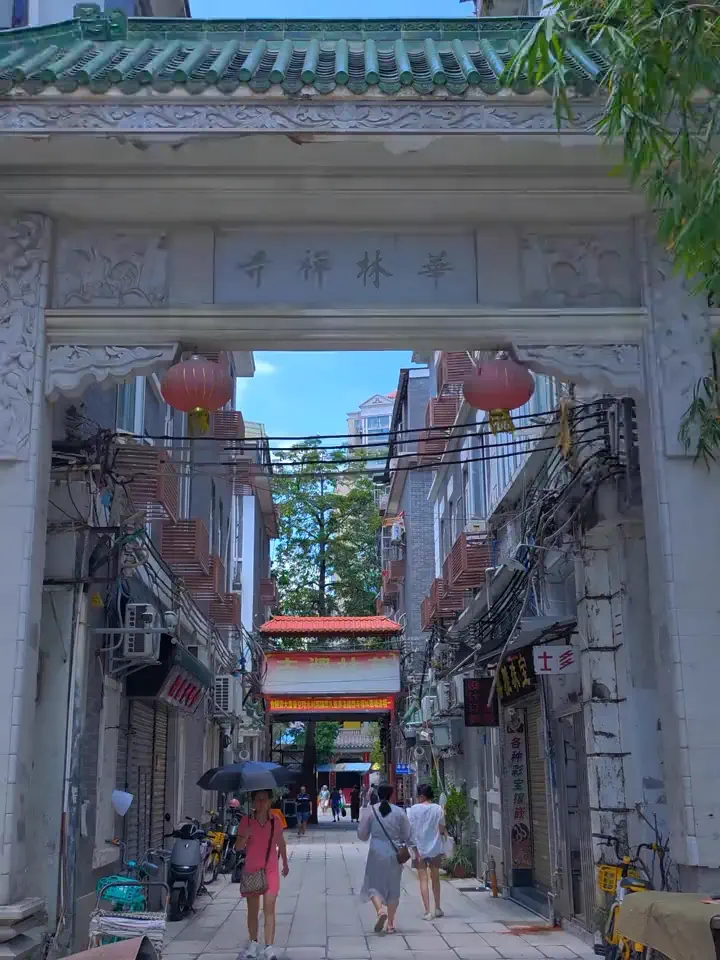
If you are already strolling through Shangxiajiu Pedestrian Street, walk into the small alleyway beside Minghui Building on Xiajiu Road. Heading north for about 200 metres brings you directly beneath the grand stone archway of Hualin Temple.
From Metro Line 1 at Changshou Road Station (长寿路站), leave via Exit D and walk south down Baohua Road toward Xiajiu Road before turning toward Hualin Temple Street. The walk takes about ten minutes and passes beloved neighborhood eateries like Baohua Noodle Shop and Chen Tianji.
Driving or taking a taxi directly to the gate is strongly discouraged. The surrounding streets form China's largest wholesale jade and gemstone trading hub, meaning alleys are narrow, congested with pedestrians, and devoid of public parking.
Bodhidharma and the First Landing from the West
To appreciate Hualin Temple, you must understand its historical primacy within Chinese Zen (Chan) Buddhism. In 526 AD, the Persian-Indian monk Bodhidharma arrived by sea in Guangzhou after a perilous multi-year voyage. He came ashore at Xiuyifang Wharf, erected a simple thatched shelter, and began preaching Buddhist scriptures. This initial hermitage was known as Xilai Nunnery (西来庵), and the neighborhood took the name Xilai Chudi.
In 1654 during the Qing Dynasty, Master Zongtong led a comprehensive expansion of the monastery, renaming it Hualin Temple. During its Qing peak, it was revered alongside Guangxiao Temple, the Temple of the Six Banyan Trees, and Haichuang Temple as one of Guangzhou's "Five Great Buddhist Monasteries." While urban modernization reduced the monastery's original footprint over the past century, its core spiritual sanctums remain intact.
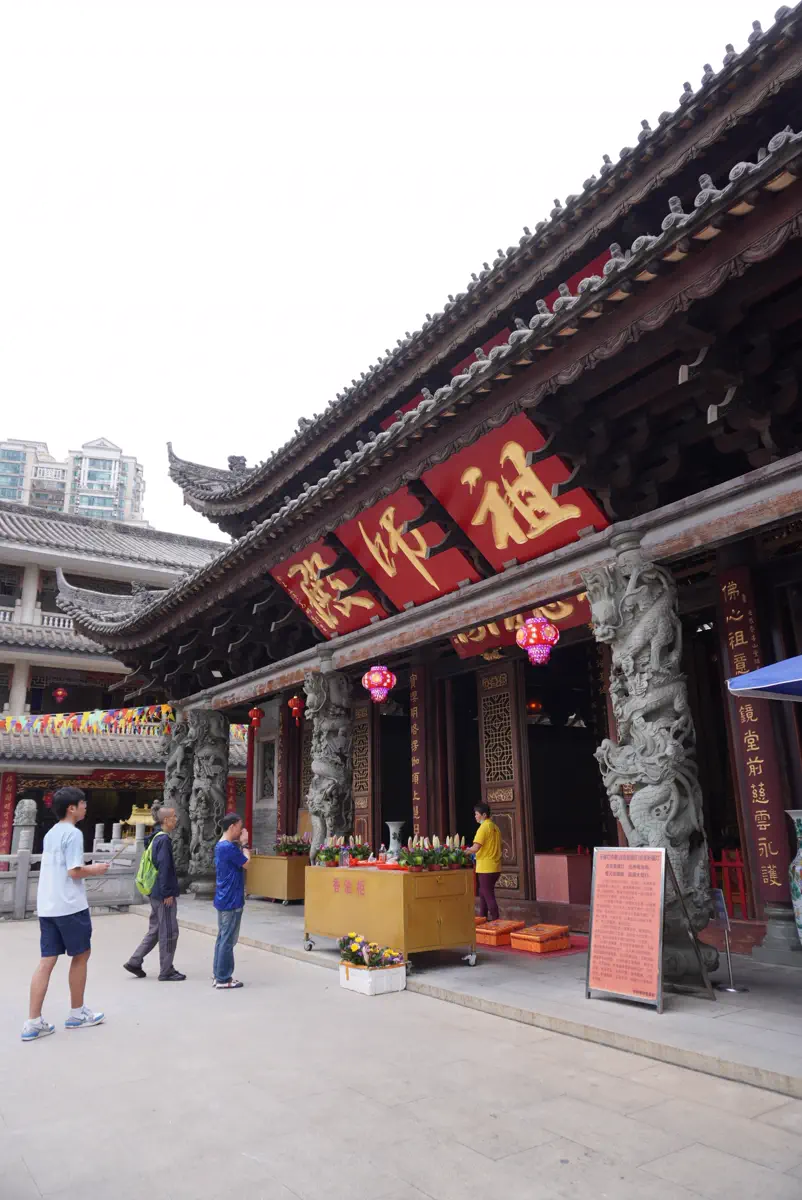
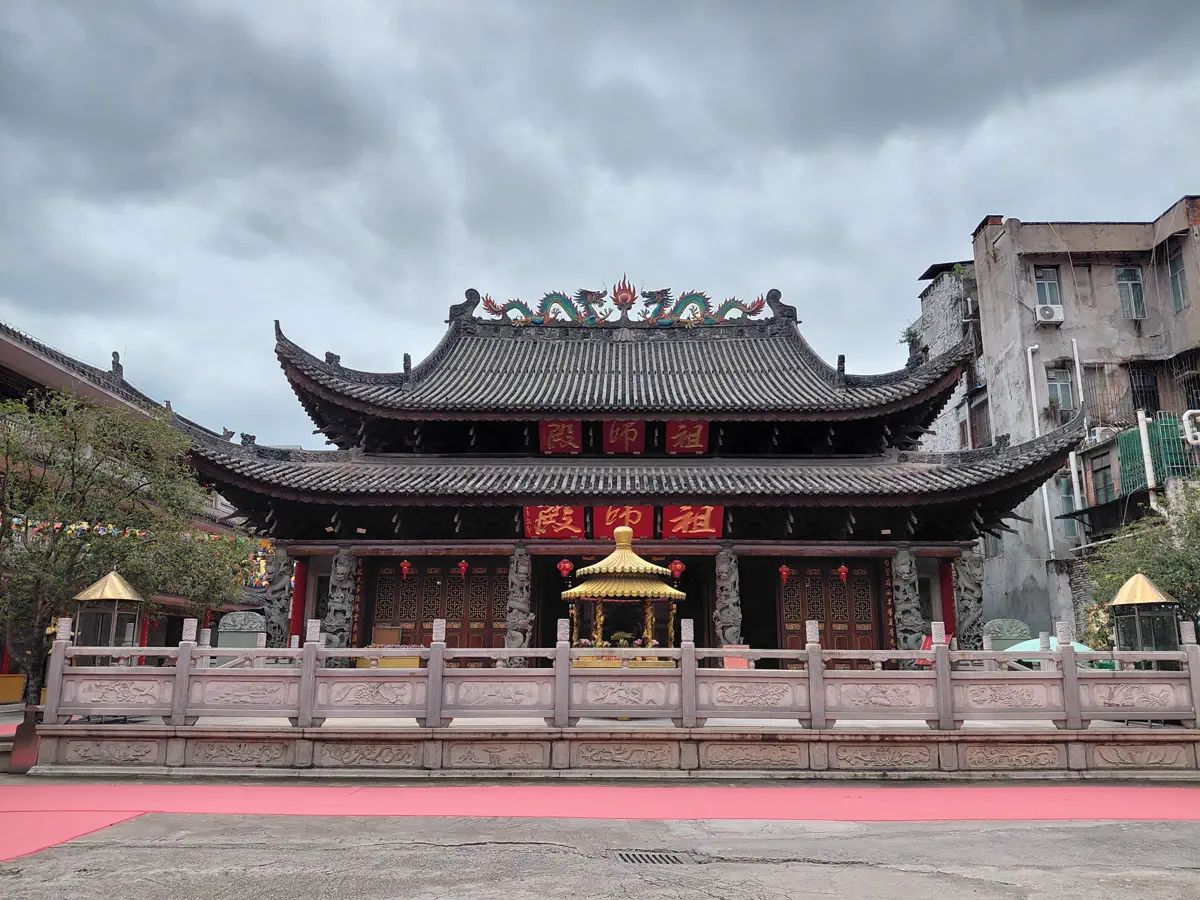
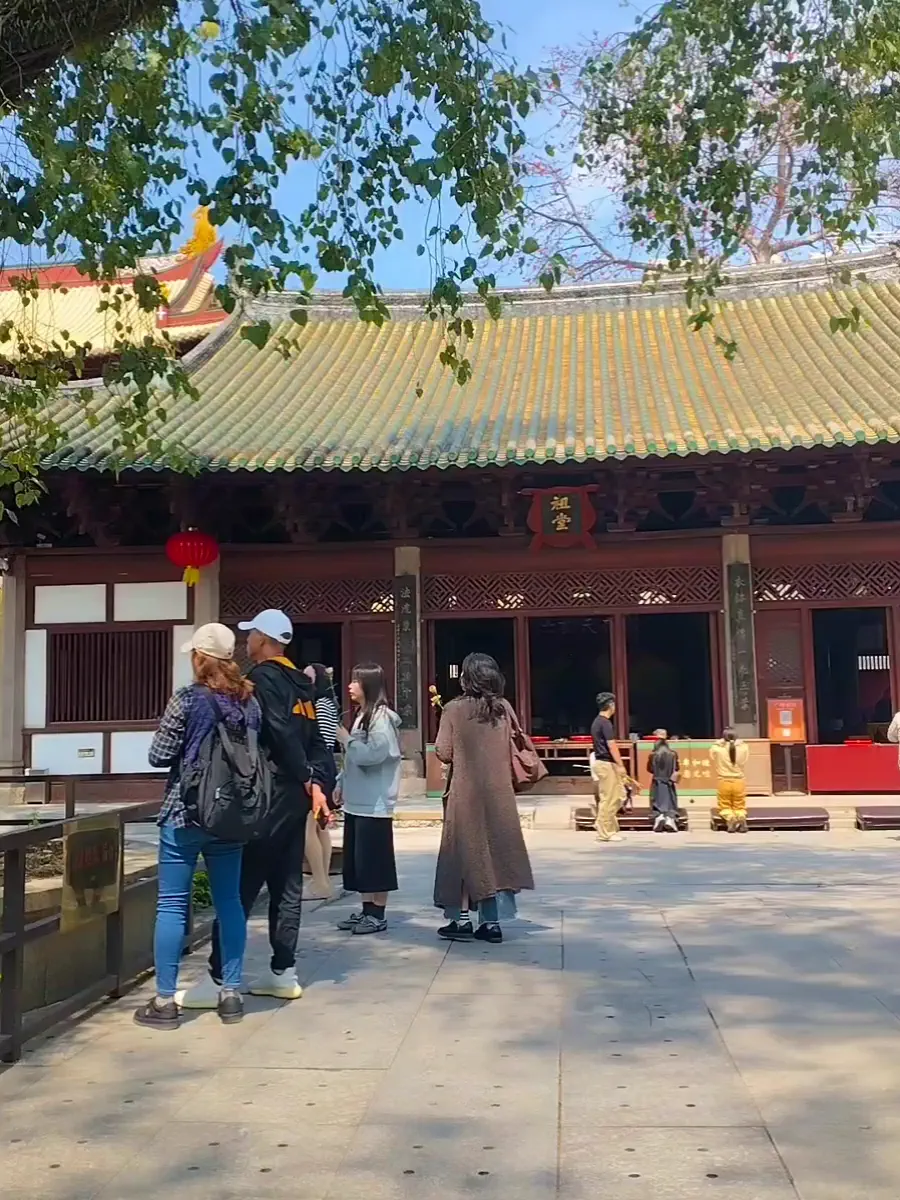
Passing through the temple gates, you are greeted by the Ancestor Hall (祖师殿). Built with a traditional Lingnan hip-and-gable tiled roof, the ridge features vibrant ceramic sculptures of dragons playing with a pearl. Two massive granite columns carved with coiling dragons support the eaves, sheltering a gilded incense burner. Inside sits a dignified bronze statue of Bodhidharma. Incense smoke drifts up into the timber rafters as neighborhood locals chant prayers in quiet devotion.
The Hall of 500 Arhats and the Marco Polo statue
The temple's crowning architectural wonder is the Hall of 500 Arhats (五百罗汉堂), situated in the eastern courtyard.
First constructed around 1851 during the Daoguang reign of the Qing Dynasty, the hall features an ingenious floor plan shaped like the Chinese character "田" (tian, a four-quadrant field). Walking along its intersecting corridors, visitors encounter five hundred life-sized clay statues of Buddhist Arhats, each rendered with unique facial expressions and postures. Some gaze fiercely, some lower their eyes in serene meditation, some cradle miniature pagodas, and others grin with open-chested joy, showcasing the pinnacle of 19th-century Lingnan clay modeling craft.
Among these five hundred sculptures, the 291st figure—Venerable Kumaralata—draws international travelers. Unlike the bare-chested Indian ascetics or robed Chinese monks surrounding him, this statue has deep-set eyes, an aquiline nose, a brimmed European traveler's hat, a buttoned Western tunic, and a cane in his hand. Oral tradition records that when craftsmen restored the hall in the late Qing Dynasty, they deliberately modeled this figure on Venetian explorer Marco Polo, who had traveled extensively through Yuan Dynasty China. Seeing a European traveler immortalized as a Buddhist saint in an ancient Chinese shrine remains a rare testament to Guangzhou's ancient role along the maritime Silk Road.
At the intersection of the hall's corridors sits an ornate, gilded multi-tier wooden pavilion. Walking softly through the shaded walkways to examine the expressions of all five hundred figures takes about thirty minutes.
The White Marble Relic Pagoda and courtyard
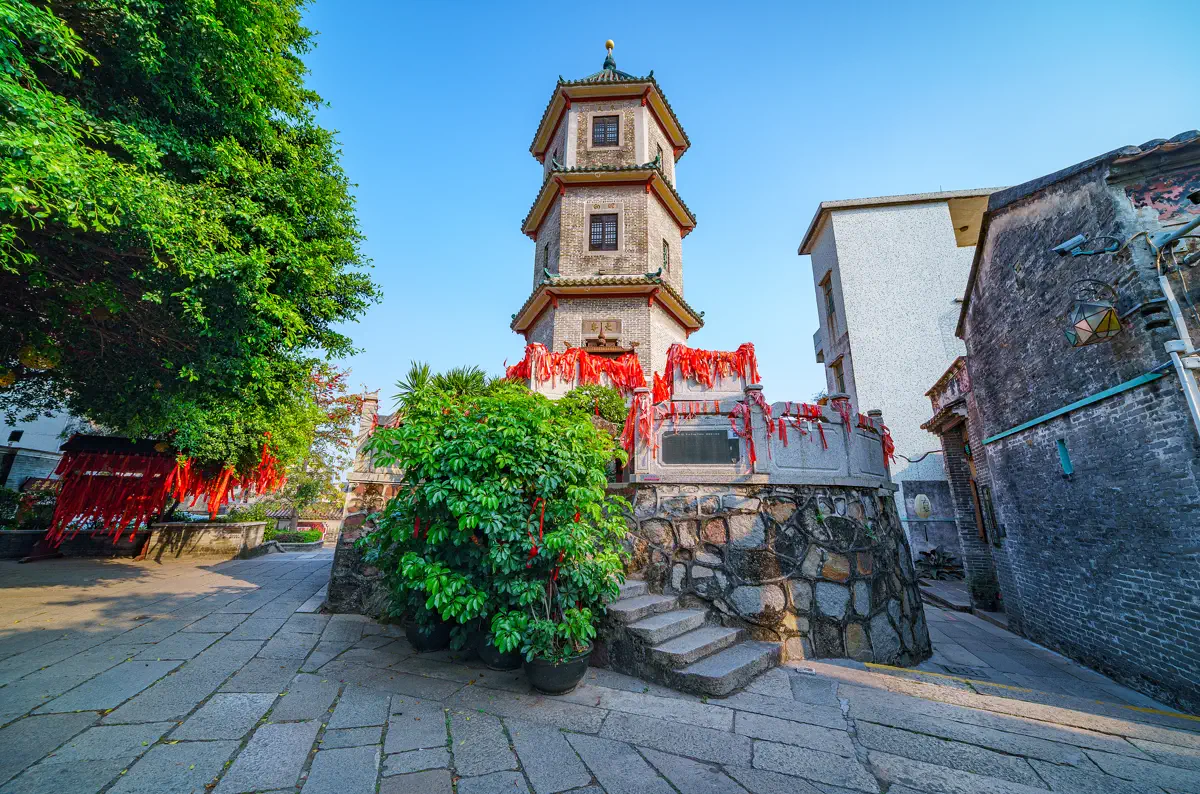
Standing in the stone-paved courtyard beside the Ancestor Hall is the White Marble Relic Pagoda (华林寺舍利塔).
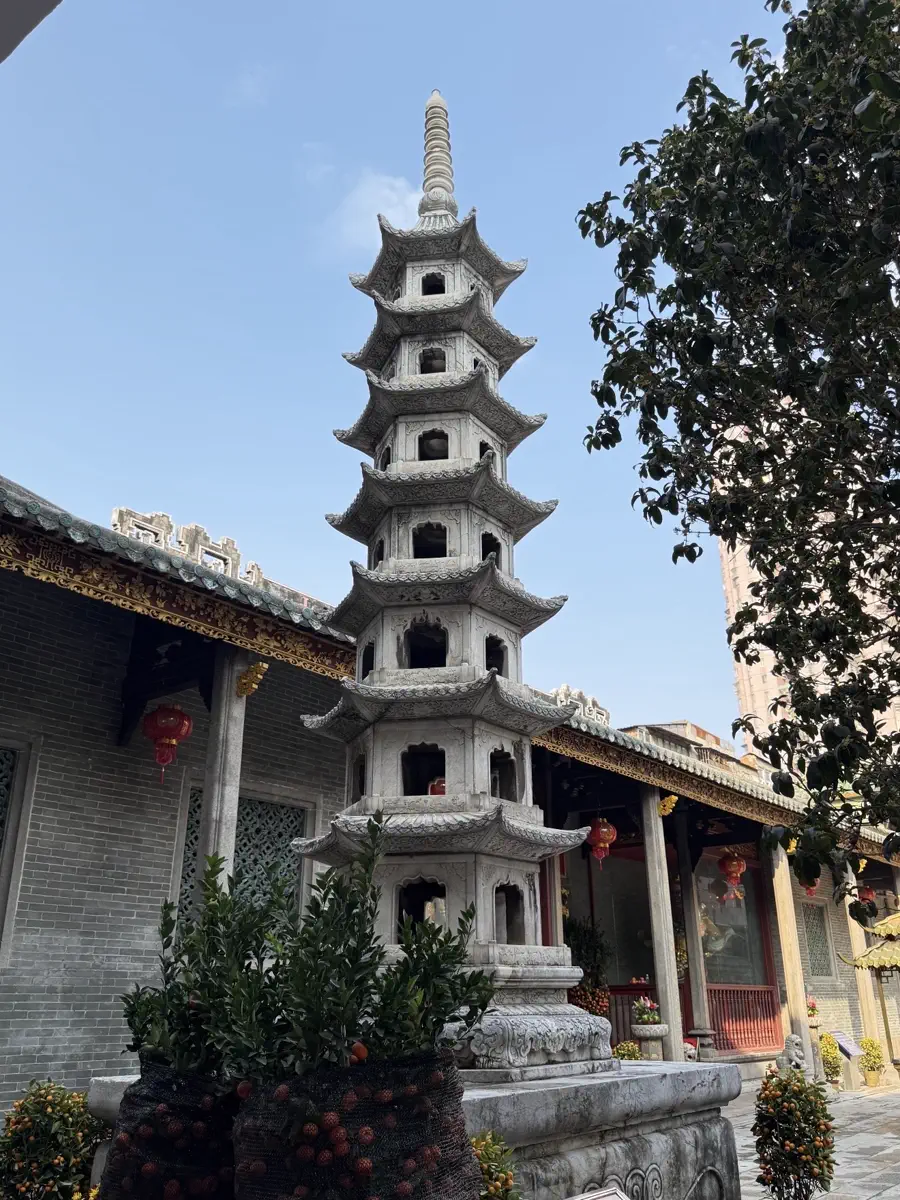
Carved entirely from solid white marble during the Kangxi reign of the Qing Dynasty, the pagoda stands over seven metres tall. Modeled after multi-storey octagonal timber pagodas, every tier features detailed stone bracket sets (dougong), upturned eaves, and arched niches. The broad stone pedestal is adorned with relief carvings of rolling waves, lotus blooms, and auspicious clouds.
The pagoda historically housed genuine Buddhist relics (sarira) of Gautama Buddha. Moved off-site for preservation during mid-20th-century upheavals, the relic pagoda was respectfully returned to Hualin Temple in 1994 through coordinated efforts between religious authorities and cultural preservation bureaus. Today, surrounded by potted kumquat trees, leafy banyans, and weathered brick corridors, it radiates ancient calm.
Just ten paces outside the temple walls, the sensory world shifts dramatically. Grinding wheels polish raw jade, traders barter over nephrite bracelets, and street vendors hawk street food. This sudden contrast between temple tranquility and bustling commercial vitality is the quintessential charm of old Guangzhou.
How to fit Hualin Temple into your Guangzhou itinerary
Hualin Temple is ideal for pairing with surrounding cultural landmarks in western Guangzhou:
Start your morning around 9:30am by taking Line 8 to Hualin Buddhist Temple Station. Spend an hour exploring the Ancestor Hall, the White Marble Pagoda, and the Hall of 500 Arhats in the morning quiet.
By 10:30am, step outside into the Hualin Jade Market, taking ten minutes to browse the bustling stalls along Hualinsiqian. Walk three minutes onto Shangxiajiu Pedestrian Street for lunch at Tao Tao Ju (for dim sum) or Nanxin (for double-skin milk pudding).
In the afternoon, follow Dishifu Road west toward Yongqing Fang and the Cantonese Opera Art Museum, before continuing on foot to Lychee Bay. This makes a relaxed half-day walking loop entirely within the Xiguan heritage corridor.
For visitors exploring Guangzhou's religious history, combine Hualin Temple with Guangxiao Temple and the Temple of the Six Banyan Trees in Yuexiu District. Visiting Bodhidharma's landing spot in the morning followed by the site of Huineng's tonsure in the afternoon traces the full arc of Zen Buddhism's transmission into southern China. This thematic trail connects directly into Day 2 of our 3–4 day itinerary.
For broader citywide travel logistics, consult our comprehensive Guangzhou travel guide.
When to go
Hualin Temple is typically open daily from 8:00am to 5:00pm. Aim to arrive between 9:00am and 11:00am on a weekday. The morning light falls gracefully across the stone pagoda, and the halls are uncrowded save for a few local worshipers.
On the 1st and 15th days of the lunar month, as well as major Buddhist festivals, crowds surge as locals visit to burn incense and pray for good fortune. If your focus is quiet architectural photography or studying the Arhat statues, choose an ordinary weekday instead.
Hualin Temple questions, answered
Is admission to Hualin Temple free?
Yes. Admission is completely free, and no tickets are required at the entrance.
Do I need to book tickets in advance?
No advance reservation is needed. Visitors can enter directly through the front gate during open hours.
Can I take photos inside the Hall of 500 Arhats?
Photography without flash is generally tolerated, but visitors must remain respectful. Do not use tripods, avoid photographing worshipers during prayer, and maintain a quiet, reverent tone inside the hall.
How much time do you need at Hualin Temple?
One hour is plenty of time to view the Ancestor Hall, the White Marble Pagoda, and make a complete circuit of the Hall of 500 Arhats.
Practical schedules reflect 2026 listings and may vary on religious holidays. Historical details regarding Bodhidharma's landing at Xiuyifang follow records from the Guangzhou Municipal Bureau of Ethnic and Religious Affairs. Pagoda architecture and relic provenance cross-reference documentation from the Chinese Buddhist Association and Guangdong Provincial Cultural Relics Bureau. Transit connections reflect the Guangzhou Metro Line 8 timetable.