Guangzhou Attractions 9 min read
Peasant Movement Institute: Guangzhou Red Wall Temple Guide
Explore the Peasant Movement Institute in Guangzhou. Ming Confucian temple architecture, red wall photography, Mao's revolutionary history, and Line 1 metro tips.
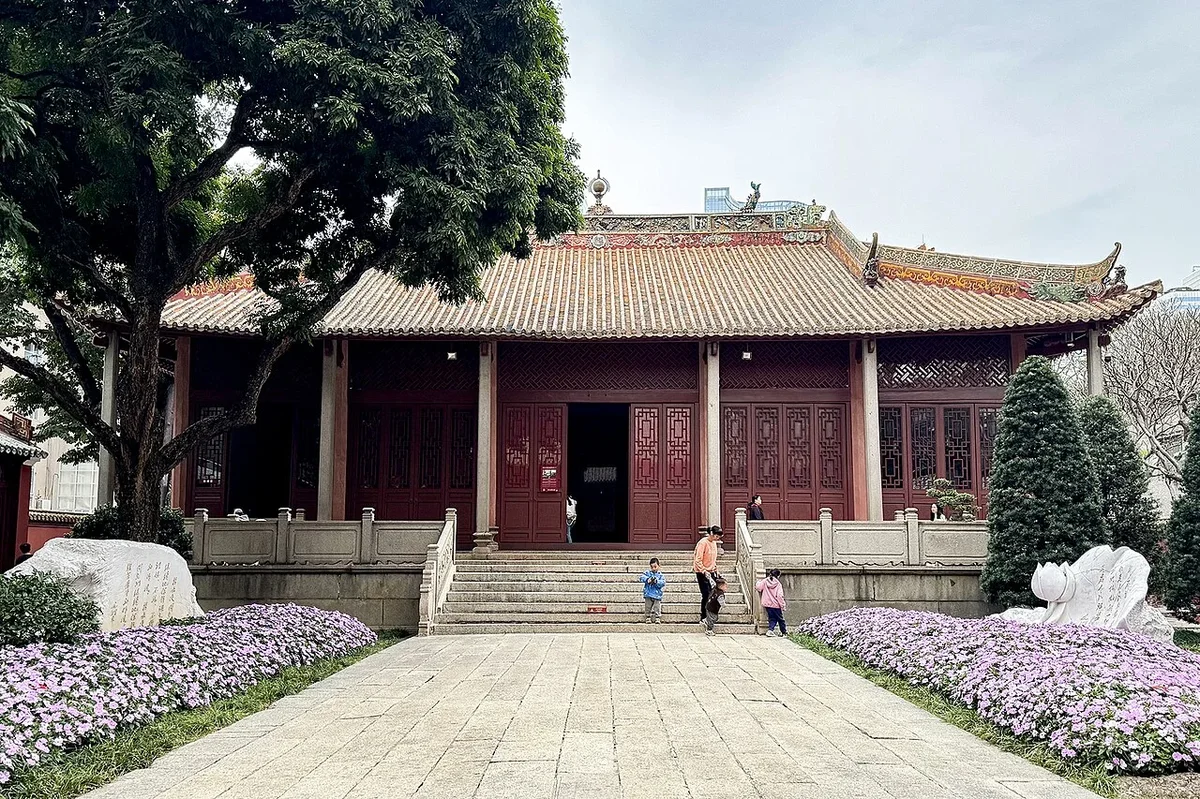
Along the bustling shopping strip of Zhongshan 4th Road in downtown Yuexiu District stands one of southern China’s most fascinating architectural syntheses. Enclosed behind imposing vermilion boundary walls and leafy banyan canopies, the complex known today as the Peasant Movement Institute (农民运动讲习所旧址) began life more than six centuries ago as Panyu Confucian Temple (番禺学宫).
During the Ming and Qing dynasties, this sacred precinct served as both the county altar for worshipping Confucius and the official academy where local scholars sat imperial examinations. In 1926, young revolutionary Mao Zedong transformed the courtyards into a vanguard training school for agrarian peasant organizers. With its yellow glazed tiles, carved stone bridges, ancient courtyards, and deep crimson walls, the site is warmly celebrated by Guangzhou residents as the city’s Little Forbidden City, offering a peaceful sanctuary where imperial scholarship and modern Chinese history meet.
Getting to Peasant Movement Institute
The memorial complex is located at No. 42 Zhongshan 4th Road in the historic core of Yuexiu District, making it exceptionally straightforward to reach by public transit.
- Metro Line 1 direct access Take Guangzhou Metro Line 1 directly to Peasant Movement Institute Station (农讲所站). Leave via Exit C, turn right, and walk roughly thirty metres westward along Zhongshan 4th Road. The prominent grey stone ceremonial archway and outer crimson wall appear immediately on your right.
- Public bus connections Numerous municipal bus lines stop right outside the museum gates at the Peasant Movement Institute Stop (农讲所站), including routes 1, 76, 102, 107, 108, 125, 243, and 517.
- Walking from nearby cultural landmarks The site sits within easy strolling distance of other major historic attractions. It is an easy eight-minute walk eastward from the Beijing Road Pedestrian Street and the palace archaeological ruins of the Nanyue King Museum, or a fifteen-minute walk south of Yuexiu Park.
Six centuries of Confucian heritage as Panyu Confucian Temple
Panyu Confucian Temple was first established on this site in 1370 during the third year of the Hongwu reign in the early Ming Dynasty. In imperial Guangzhou, two administrative counties, Nanhai and Panyu, shared jurisdiction over the provincial capital. Each maintained its own official county temple and school. While Nanhai’s temple was lost to urban development during the twentieth century, Panyu’s temple survived remarkably intact.
The architectural ensemble visible today largely dates from a comprehensive reconstruction carried out in 1770 during the thirty-fifth year of Emperor Qianlong’s reign. Built in strict accordance with the classical layout of imperial Chinese academies, the complex follows the time-honoured principle of temple on the west and school on the east.
Unlike the vernacular folk ancestral shrines found across the Pearl River Delta, such as the Chen Clan Ancestral Hall with its exuberant pottery ridge sculptures and iron castings, Panyu Confucian Temple was built strictly according to Beijing imperial court specifications. It features solemn hip-and-gable roofs, tiered bracket systems, marble terraces, and yellow glazed tiles, a regal colour scheme permitted only for Confucian temples and imperial palaces. In 1961, the State Council designated the entire compound as one of China’s very first National Key Cultural Relics Protection Units.
The classical temple layout and the crescent Pan Pond
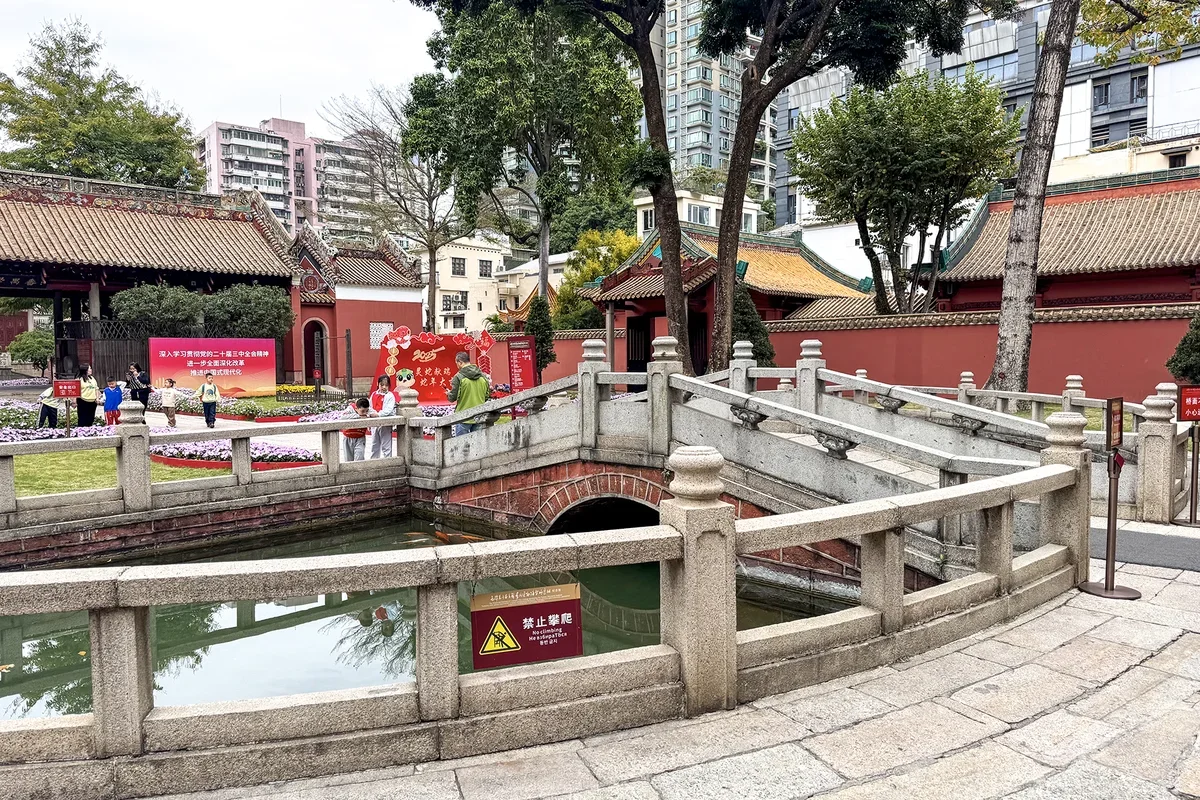
Entering the complex through the front gates brings visitors onto a paved granite ceremonial avenue arranged along a strict south-to-north central axis. The grounds open with the Lingxing Gate, a four-column stone archway, leading directly toward the Pan Pond (泮池).
In imperial tradition, this semi-circular lotus pool was the supreme symbol of academic status. When local candidates successfully passed the rigorous county imperial examinations to become licensed scholars (xiucai), the magistrate and academy directors led them across the three-arch stone bridge in a formal initiation ceremony known as You Pan (crossing the Pan pool). Today, the pool’s tranquil green water reflects blooming water lilies and the vibrant red walls of the flanking wings, while large ornamental carp glide lazily beneath the weathered stone arches.
Directly north of the bridge stands the Dacheng Gate and the grand Dacheng Hall (Hall of Great Achievement). As the primary ceremonial pavilion, Dacheng Hall rests upon a broad stone moon terrace (yuetai). The hall spans five bays wide by five bays deep, sheltered beneath double-eaved hip-and-gable roofs with glazed ceramic eaves. Its roof ridge displays dynamic relief moldings of coiling dragons chasing pearls, representing the highest architectural rank in Ming and Qing Guangzhou.
Mao Zedong and the 1926 revolutionary cadre school
The quiet academic sanctuary took on world-historical significance in the mid-1920s during the First United Front between the Kuomintang and the Chinese Communist Party. Recognizing that China’s vast peasant population was fundamental to national transformation, visionary organizers, including Peng Pai, established the Peasant Movement Institute in Guangzhou in 1924.
Between May and September 1926, the institute moved into Panyu Confucian Temple for its sixth and most influential term, with thirty-two-year-old Mao Zedong appointed as the institute director. Over three hundred young recruits from twenty provinces across China travelled to Guangzhou to undergo rigorous physical, military, and political training.
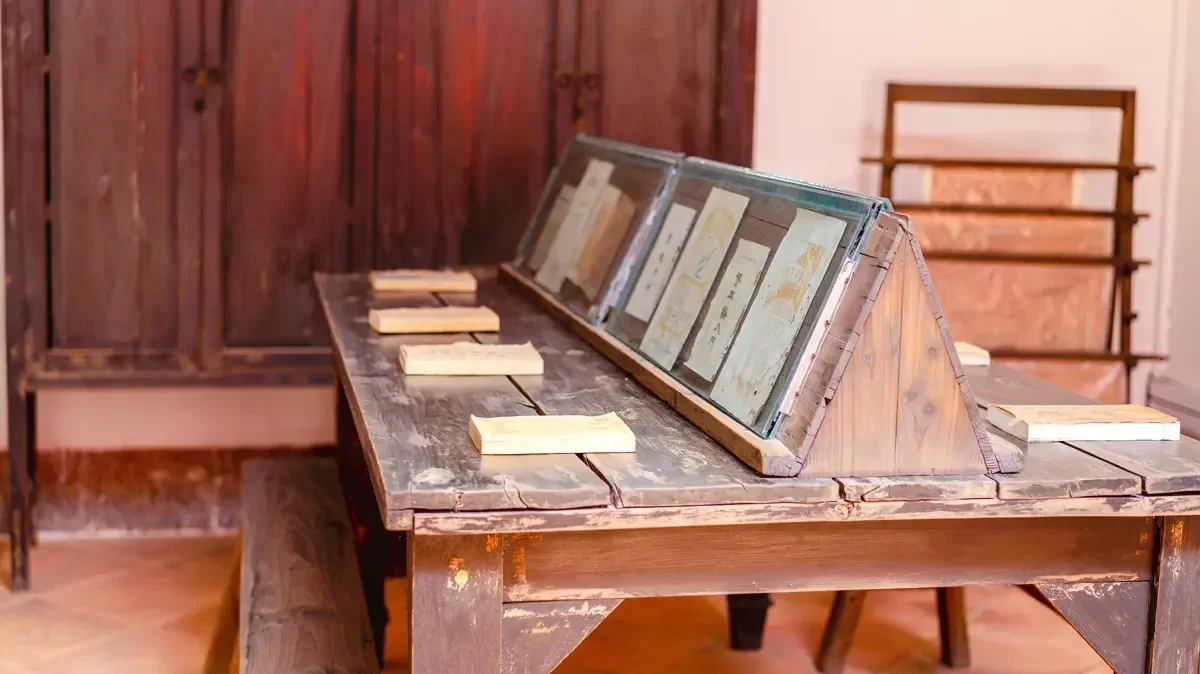
Walking through the restored side galleries today reveals the austere daily routines of those young cadres. The temple wings were converted into communal barracks with wooden bunk beds, straw sandals, and simple washbasins. The Eastern Hall became a vibrant reading room where trainees studied political economy, rural sociology, and agrarian field surveys.
Distinguished leaders of the era delivered guest lectures here, including Zhou Enlai, who taught military tactics, Xiao Chu’nü, who taught social movements, and Peng Pai, who shared practical lessons from the Haifeng peasant soviets. Graduates of this six-month intensive program returned to their home villages across Hunan, Jiangxi, and Guangdong, forming the core organizational backbone for the Autumn Harvest Uprising and the founding of the rural revolutionary base areas.
Minglun Hall and traditional Lingnan scholarship
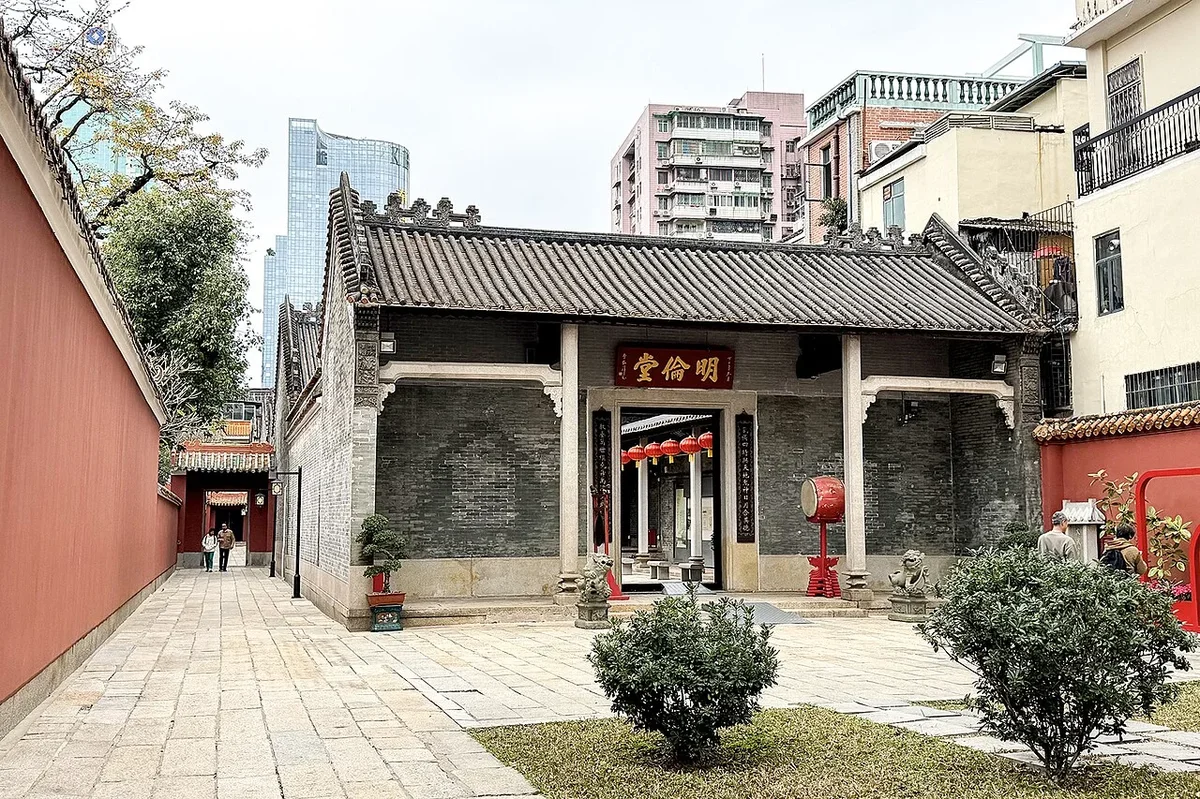
East of the main temple axis lies the academy wing centred on Minglun Hall (Hall of Elucidating Human Relations). Named after an ancient precept from Mencius on educating citizens in moral duty, this spacious hall was where the county magistrate and instructional masters delivered classical lectures to candidate scholars.
Architecturally, Minglun Hall displays distinctive regional Cantonese engineering, including soaring stepped wok-ear gables (wok yi uk) made of dense grey brick and timber tie-beams that provide cooling ventilation against Guangzhou’s humid subtropical climate. A traditional leather drum and a pair of stone guardian lions stand sentinel outside the entrance.
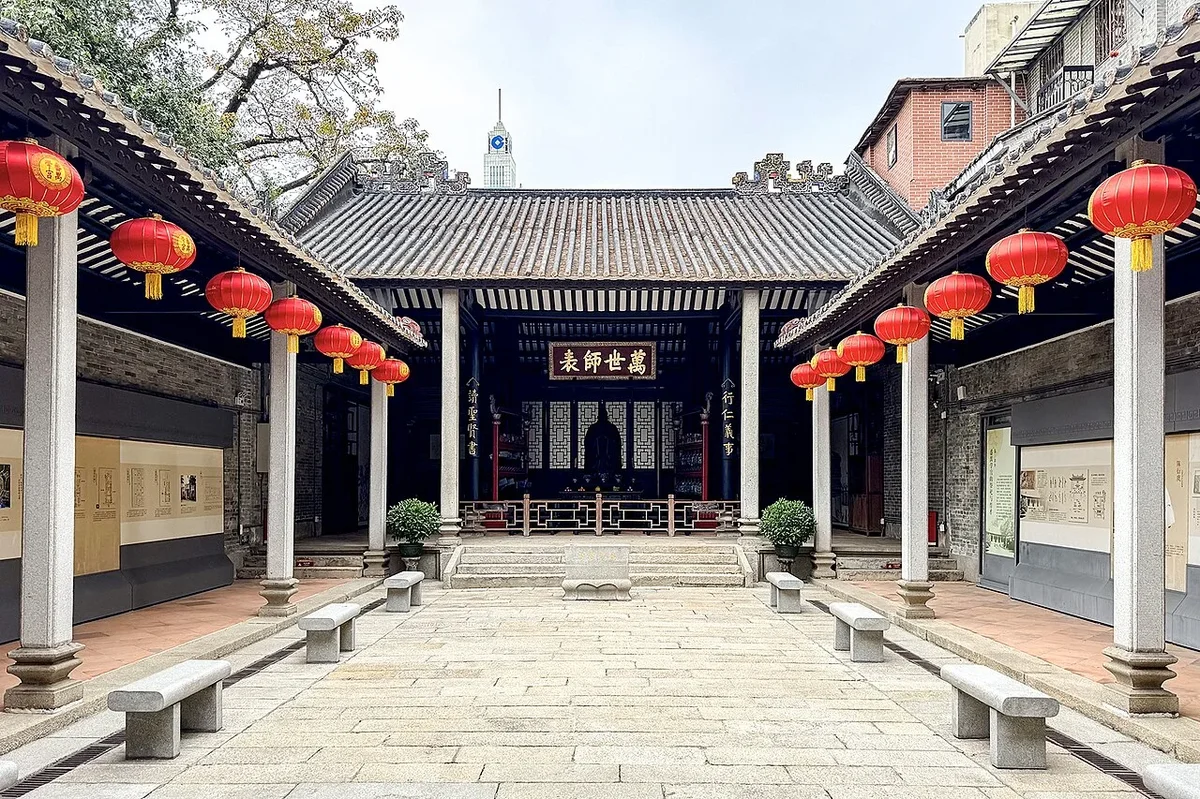
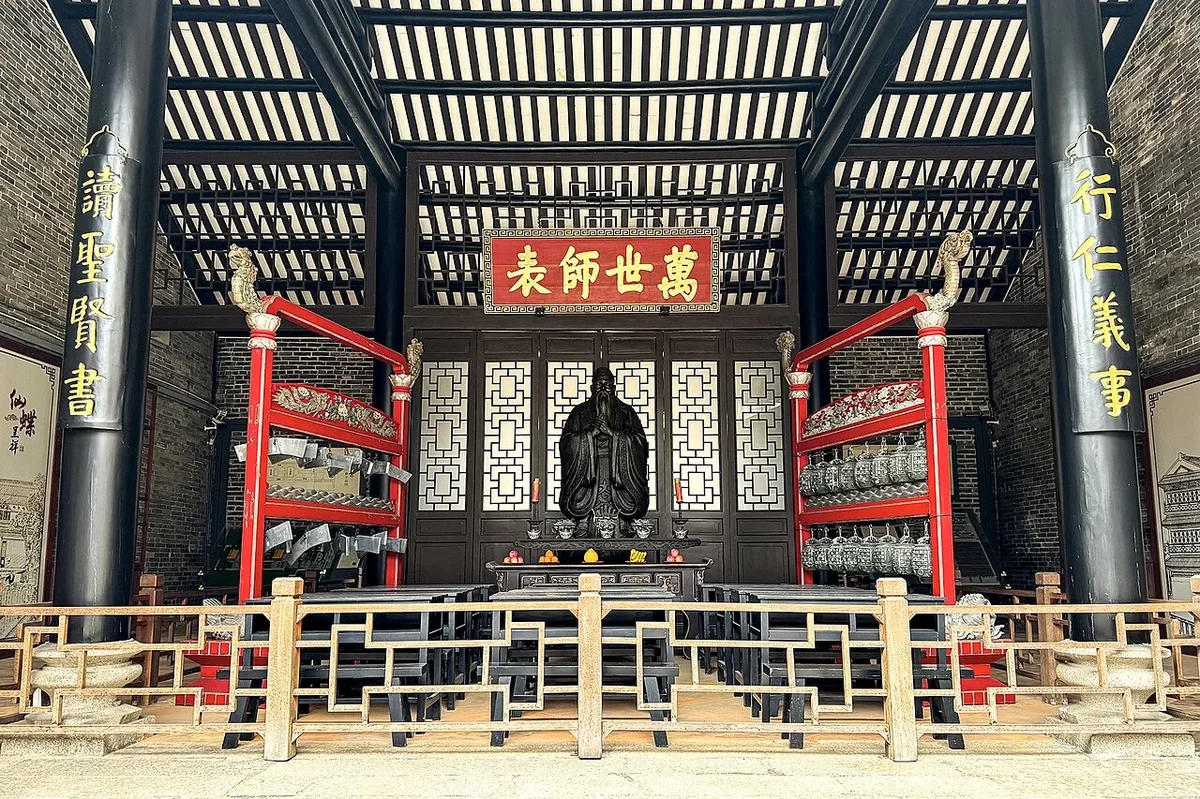
Inside, the open-air courtyard gives way to a grand shrine hall presided over by a bronze statue of Confucius in the teaching posture. Overhead hangs a large crimson plaque inscribed with the four gold characters Wan Shi Shi Biao (Model Teacher for Ten Thousand Generations), a royal honorific granted by the Qing Emperor Kangxi. Flanking the statue are complete ceremonial orchestra sets of bronze bells (bianzhong) and tuned chime stones (bianqing). Modern display galleries around the courtyard explain the evolution of the imperial examination system in Guangdong, complete with authentic historical examination papers, scholar registries, and academy administrative codes.
The Little Forbidden City red walls and spring kapok blooms
Beyond its historical gravitas, the Peasant Movement Institute has emerged as one of Guangzhou’s premier photography destinations. The signature vermilion boundary walls and golden ceramic eaves create an atmosphere reminiscent of ancient Beijing palaces, earning the complex its beloved moniker of Guangzhou’s Little Forbidden City.
The dappled sunlight filtering through the banyan tree crowns creates picturesque shadow patterns along the aged plaster walls. Photographers and traditional costume enthusiasts frequently visit in Hanfu or vintage 1920s attire to capture portrait compositions along the stone arcades and moon bridge.
The most spectacular visual season arrives in March and April when the ancient kapok trees (Bombax ceiba) inside the courtyards burst into full bloom. Kapok is Guangzhou’s official municipal flower, known locally as the Hero Tree for its tall upright trunk and brilliant red petals. When the towering centenary trees shed their leaves and produce massive fiery crimson blooms against the yellow glazed tiles and deep red walls, the visual contrast is genuinely breathtaking. Fallen petals gather on the stone terraces and the calm waters of the Pan Pond, creating unforgettable springtime vistas.
Visiting tips and Yuexiu historic walking loop
Planning a visit to the Peasant Movement Institute is uncomplicated, whether you spend a quiet hour admiring ancient woodwork or spend an afternoon exploring the surrounding Yuexiu historic district.
- Admission and opening hours Admission is completely free for all domestic and overseas visitors. The complex is open from Tuesday to Sunday between 9 AM and 5 PM, with final admission at 4.30 PM. The museum is closed on Mondays for monument conservation and maintenance.
- Ticketing and ID requirements Foreign visitors can simply show their original passport at the entrance security gate for on-site registration. Advance reservations are generally not required on normal weekdays, though during peak statutory holidays booking a free timed-entry slot through the official WeChat miniprogramme guarantees smooth entry.
- Best times for photography For the softest light and thinnest crowds, arrive promptly at opening time around 9 AM or during the late afternoon golden hour between 3.30 PM and 4.30 PM. Overcast days are also wonderful for saturated red wall photography without harsh shadows.
- Historic Yuexiu walking itinerary Combine your visit with nearby historic attractions along Zhongshan Road. From the institute gates, walk five minutes west to the archaeological gardens of the Nanyue King Museum and the buzzing shopping arcades of Beijing Road. Head ten minutes north via Cangbian Road to stroll along the restored ecological canal of Donghaochong Greenery, or take Line 1 two stops west to explore the stately memorial hall dedicated to Sun Yat-sen at the Sun Yat-sen Memorial Hall, or take Line 1 and Line 7 out to Changzhou Island to tour the Memorial Museum of 1911 Revolution and the Whampoa Military Academy.
Frequently asked questions
Is admission to the Peasant Movement Institute free
Admission is completely free for all visitors. You do not need to purchase any tickets. Visitors can register at the entrance by presenting a valid ID card or foreign passport.
How much time should I spend at the complex
Most visitors spend between forty-five minutes and an hour and a half exploring the courtyards, stepping inside the restored dormitories, and photographing the vermilion walls and Pan Pond.
What is the closest metro station
The museum is directly served by Peasant Movement Institute Station on Guangzhou Metro Line 1. Take Exit C and walk thirty metres west along Zhongshan 4th Road to reach the main southern entrance.
When is the best time to see the kapok flowers blooming
The centenary kapok trees inside the courtyards typically bloom between early March and mid-April, depending on early spring weather and temperature patterns.
Are flash photography and tripods permitted
Casual handheld photography is warmly welcomed throughout the outdoor courtyards and exhibition halls. Tripods, professional reflectors, commercial filming, and flash lighting are prohibited inside the historic timber halls to safeguard ancient wooden structures and respect other visitors.