Guangzhou Attractions 7 min read
Canton Customs Museum and Clock Tower Guide
Explore the Canton Customs Museum in Guangzhou, featuring the 1916 Neoclassical Clock Tower, maritime trade artifacts, and Changdi Bund riverfront walks.
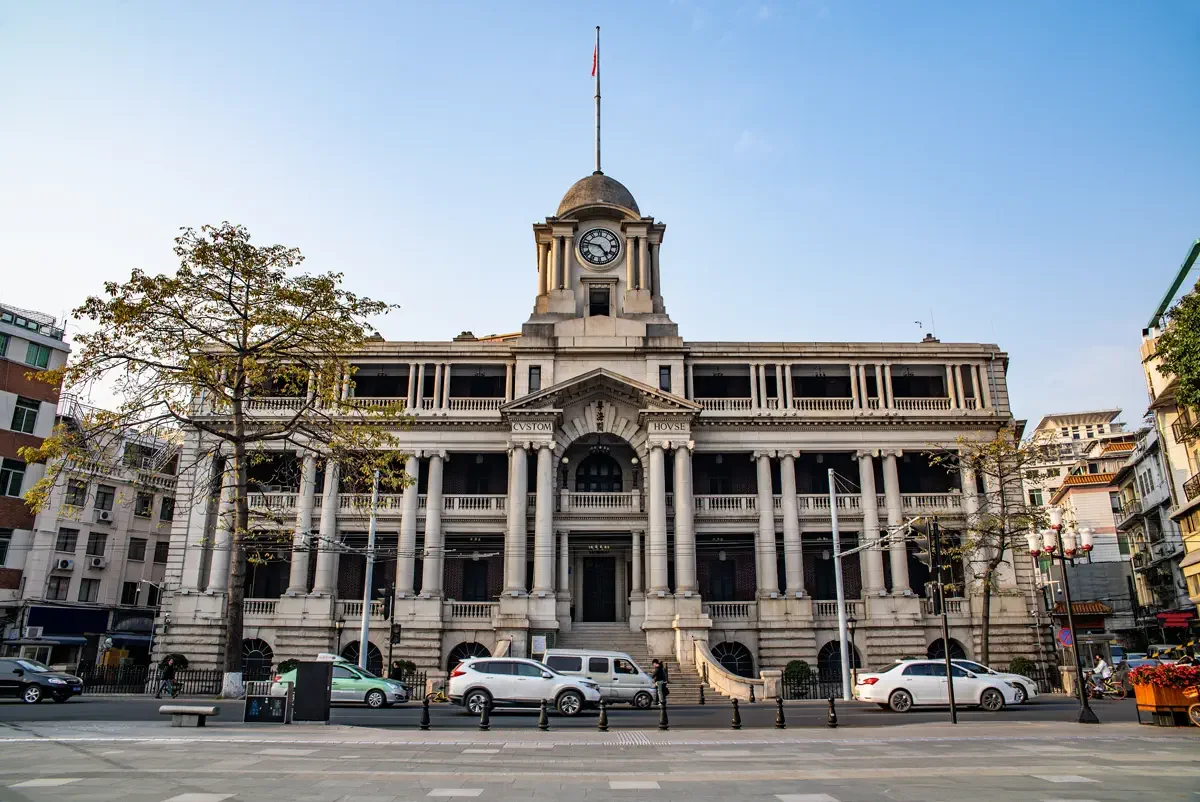
Along the scenic northern riverfront of Yanjiang West Road, an imposing stone monument watches over the bustling currents of the Pearl River. With monumental granite porticos, disciplined red brick masonry, and an octagonal copper cupola, the Canton Customs House ranks among the most distinctive European architectural landmarks in southern China. Affectionately called Dagzhonglou or the Big Clock Tower by local residents, this structure has marked Guangzhou riverfront time for over a century. Together with nearby Shamian Island and the historic promenades connecting to Haizhu Bridge and Haizhu Square, it preserves the living legacy of Guangzhou as a premier global trading hub.
Maritime gateway and modern customs heritage
Maritime commerce has anchored Guangzhou for over two millennia. In 1685, during the twenty-fourth regnal year of Emperor Kangxi, the Qing imperial government established the Canton Customs superintendency, designating the provincial capital as its supreme headquarters. For more than eight decades following the Single Port Commerce policy enacted in 1757, Canton retained a nationwide monopoly on direct sea trade with European and American nations, with foreign merchants concentrated along the riverbanks of the Thirteen Hongs.
Following the First Opium War and the Treaty of Nanking, Guangzhou became an open treaty port, and the Imperial Maritime Customs Service took control of maritime tariff collections. The old wooden administrative compound at Xiti proved too small and antiquated to handle increasing vessel clearance duties. In 1913, customs authorities cleared the riverfront site and commissioned British architect David Dick to draft a stately permanent headquarters. The British engineering firm Armstrong Whitworth secured the construction contract, fabricating the internal structural steel frames and completing the edifice in June 1916.
Having weathered regional conflicts, foreign occupation, and civil warfare, the building was designated a Major National Historical and Cultural Site in 2006. On its centenary anniversary in 2016, the building officially reopened as the Canton Customs Museum, operating as the Guangzhou branch of the China Customs Museum to present centuries of harbor commerce to travelers worldwide.
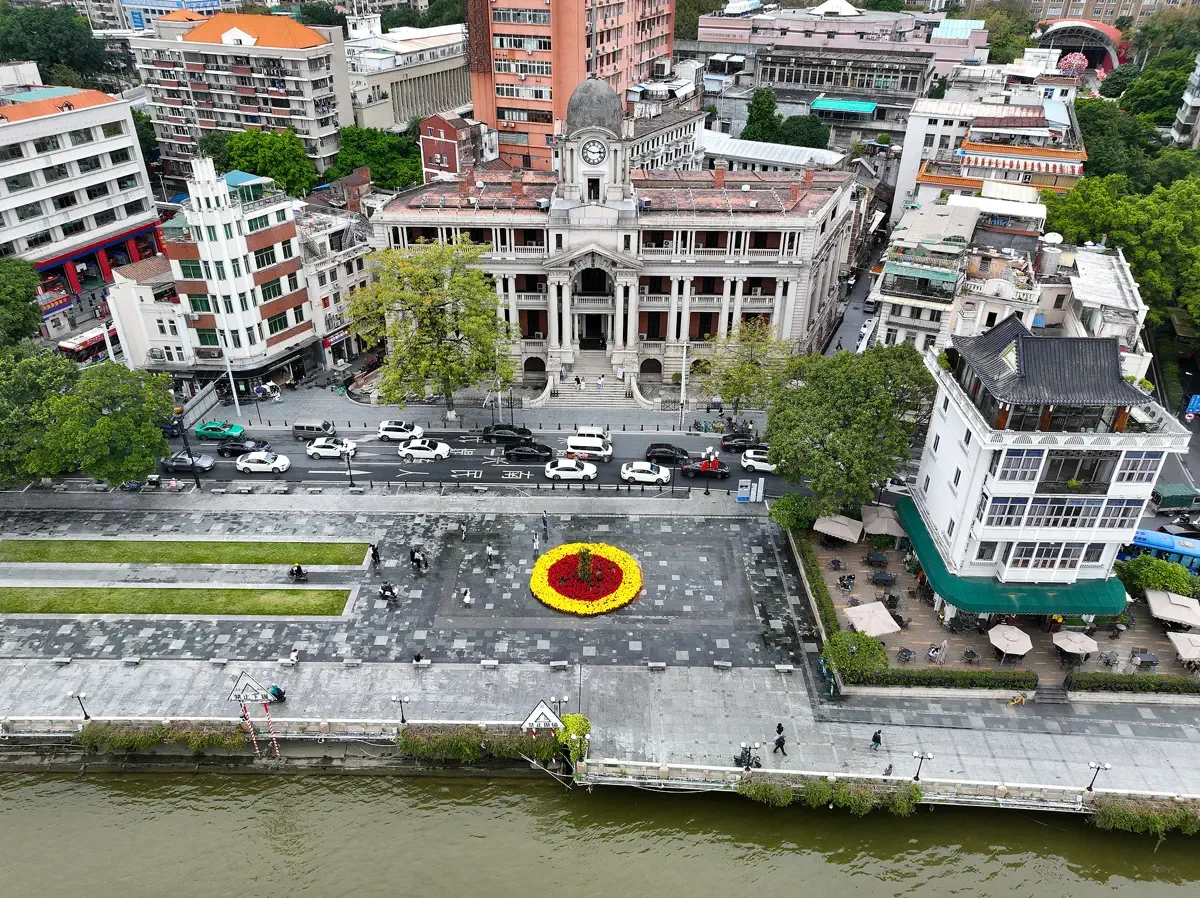
Neoclassical masonry and monumental Ionic colonnades
Occupying fifteen hundred square meters of riverfront ground and offering over forty-four hundred square meters of interior floor space, the Canton Customs building rises nearly thirty-two meters from river level to cupola finial. The edifice exemplifies European Neoclassical architecture with eclectic Edwardian sensibilities, blending Roman monumental gravity with Renaissance balance.
The ground floor rests upon a heavily rusticated plinth assembled from rough-hewn granite ashlar blocks, creating an impression of unshakeable stability. Across the second and third storeys of the main southern frontage stands a grand open loggia framed by eight monumental Ionic columns. Fluted stone shafts stretch skyward to support ornate double-volute stone capitals, casting deep geometric shadows across the verandas in the subtropical sunlight.
Red brick curtain walls contrast pleasantly with white polished granite dressings along the cornices, lintels, and classical triangular pediments. Above the central entry portal, an ornate Baroque open-bed pediment displays intricate stone carvings. Beneath the historical stone veneer, a reinforced concrete frame and riveted structural steel grid have protected the building against typhoons and river flooding for generations.
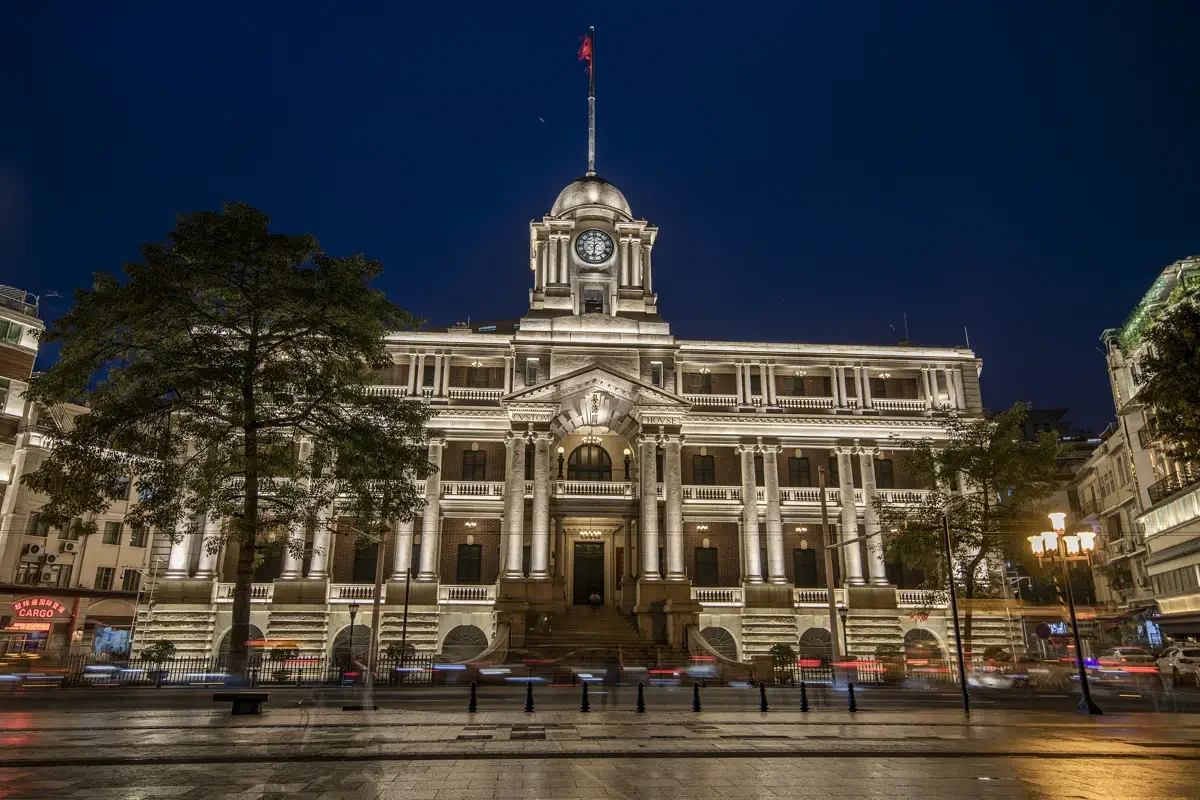
The mechanical clock tower and Westminster chimes
The crowning glory of the customs edifice is the two-tiered clock tower perched above the central entrance roofline. The lower tier forms a rectangular stone pavilion with classical arches and pilasters, while the upper tier opens into an octagonal gallery sheltered beneath a gleaming copper-clad dome.
Housed within the tower is a monumental mechanical weight-driven clock crafted in 1915 by the renowned British horological master JB Joyce and Company of Whitchurch. Operating entirely on mechanical principles, the timepiece depends on heavy lead-alloy counterweights suspended down deep internal shafts. Gravitational pull drives large bronze gear trains, requiring specialist technicians to hand-wind the massive steel cables every week using iron wall winches.
Four frosted glass dials measuring two and a half meters across face each cardinal direction, illuminated from within at night so that boatmen on the river can check the hour from afar. Five tuned bronze bells ring out the familiar Westminster Quarters melody every fifteen minutes, followed by deep hourly strikes corresponding to the exact time. For generations before wristwatches became common, dock laborers, ferry pilots, and market shopkeepers timed their daily lives to these resonant river chimes, which continue sounding today.
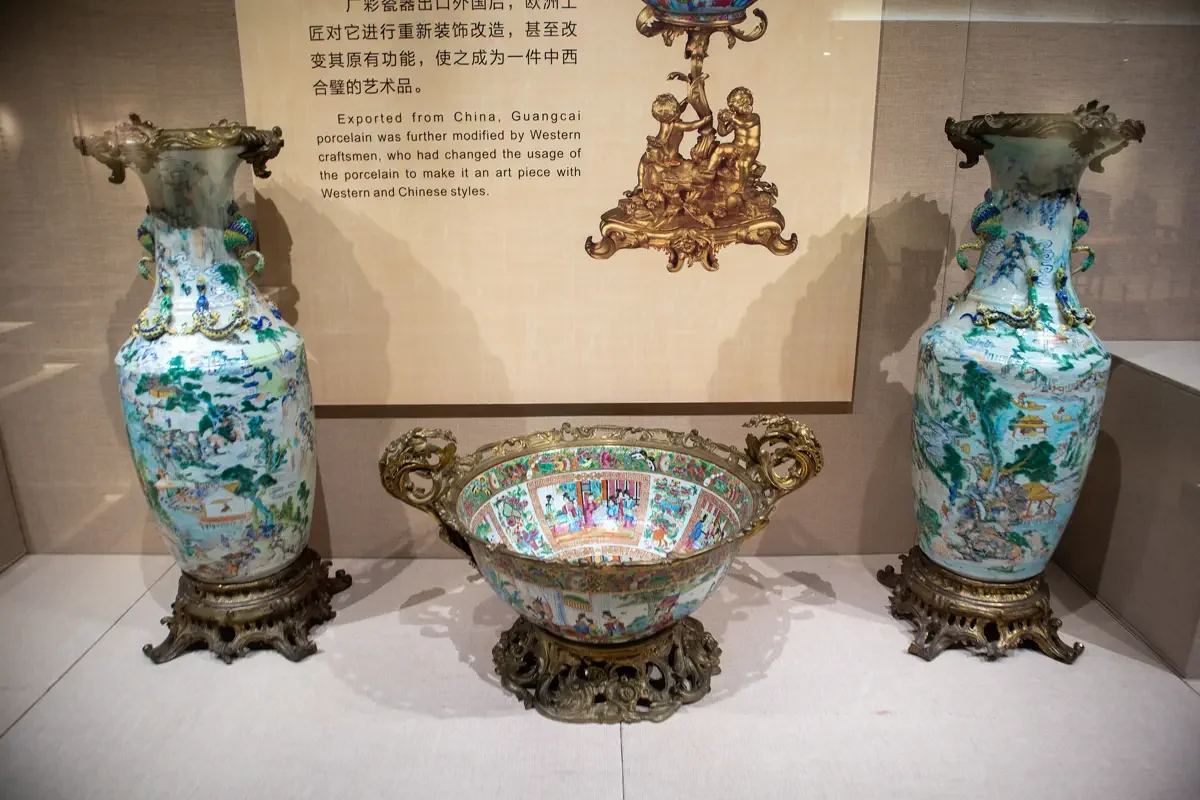
Customs archives and Maritime Silk Road treasures
Past the threshold, the museum interior reveals soaring atrium ceilings, authentic teak staircases, encaustic mosaic floor tiles, and vintage wrought iron balustrades. Permanent galleries guide visitors through imperial tariff ledgers, modern border administration, and the vibrant trade networks of the Maritime Silk Road.
In the fiscal history gallery, visitors examine antique bronze customs seals, imperial trade permits, and Qing dynasty registers recording import duties collected from western clippers. Displays of Customs Gold Unit banknotes and official silver bullion weights illustrate how maritime customs tariffs formed the financial backbone of national trade revenue during the nineteenth and twentieth centuries.
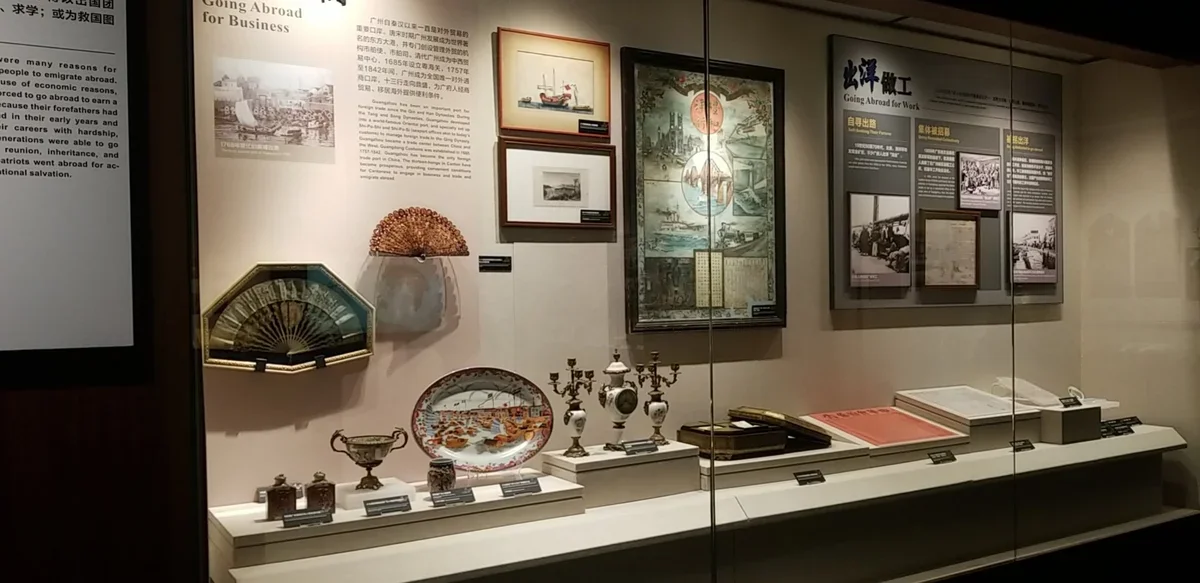
The foreign trade gallery showcases exquisite decorative artworks exported through Canton during the Qing dynasty. Highlights include polychrome Canton enamel porcelain bowls manufactured at Jingdezhen and painted by local workshops with western figures, ships, and harbor factories before shipping abroad. European collectors later mounted these vessels in luxurious gilt-bronze Rococo fixtures, creating hybrid treasures that fuse Chinese ceramic artistry with western metalsmithing. Other showcases feature intricately carved tortoiseshell fans, black lacquer cabinets, silver tea sets, and vintage maritime law enforcement equipment.
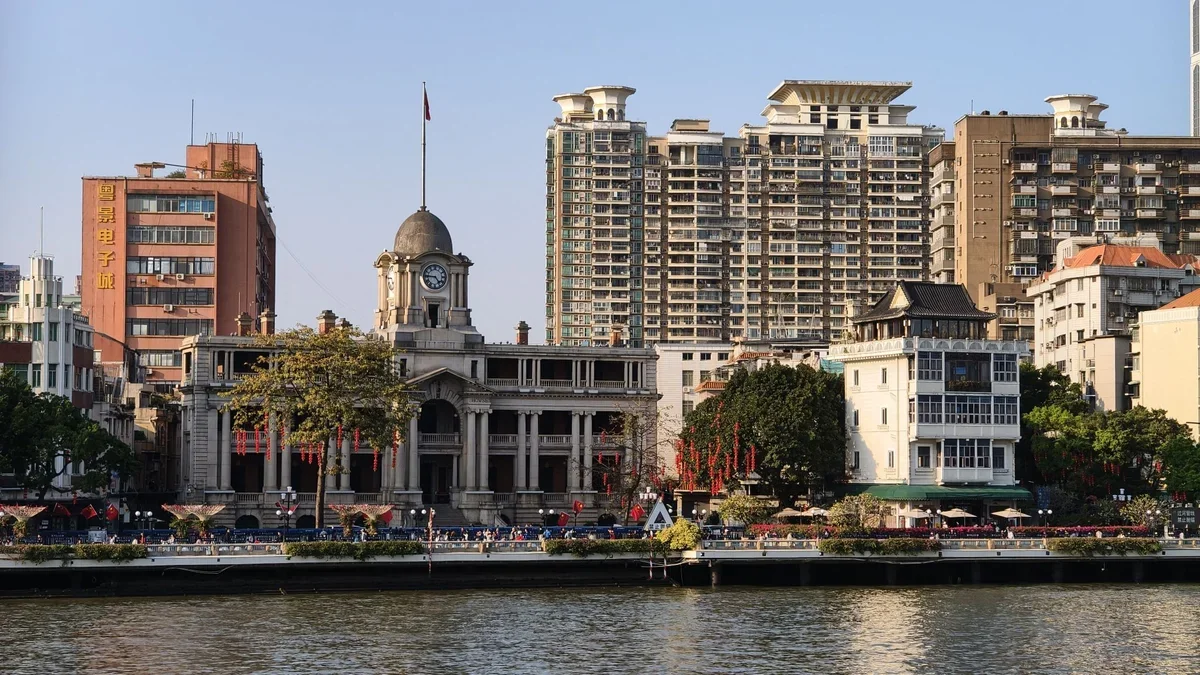
Changdi Bund walking route and waterfront landmarks
A visit to the museum connects seamlessly with an architectural walk along the Changdi riverfront, commonly hailed as the historic Bund of Guangzhou.
Stepping onto the river promenade directly outside the customs house places visitors beside Xiti Pier, a major boarding point for the Pearl River Night Cruise. A few paces to the east stands the Taying Building, a four-storey red brick villa completed in 1919 as the residence and office of revolutionary statesman Chen Shaobai. A traditional hip-and-gable pavilion crowns the roof, reflecting its silhouette into the river at sunset.
Continuing east along Yanjiang West Road brings travelers to the imposing Nanfang Building, opened in 1922 as the Daxin Company department store and celebrated as south China’s tallest early concrete high-rise. Further along the avenue, the arcade colonnades of the Xinhua Hotel and the Gothic Art Deco prow of the Aiqun Hotel line up to form a continuous kilometer of early twentieth-century architecture.
Walking west from the customs house leads across the stone canal bridge of Shaji Creek directly into the shaded pedestrian avenues of Shamian Island. Looking south across the river toward Baietan reveals the gleaming white hull of the Baietan Greater Bay Area Art Center, creating a striking juxtaposition between historical stone customs architecture and modern waterfront cultural institutions.
Frequently asked questions
What are the opening hours and admission charges for Canton Customs Museum
Admission to the museum is completely free for all domestic and international visitors. The galleries welcome guests from 0900 to 1700 Tuesday through Sunday, with final entry permitted at 1630. The facility remains closed every Monday for heritage maintenance, except on official Chinese public holidays.
How do visitors get to Canton Customs Museum by metro
Travelers can take Guangzhou Metro Line 6 or Line 8 to Cultural Park Station. Leaving via Exit A, walk south along Xiti 2nd Road for about three hundred meters to reach the entrance along Yanjiang West Road. Arriving by public water bus at Xiti Pier offers an equally picturesque approach from the river.
Can visitors climb up inside the clock tower to view the bells
Because the mechanical timepiece contains delicate century-old gears and high-tension counterweight cables, the interior belfry remains closed to the general public. Visitors can inspect detailed structural scale models and video demonstrations of the mechanism on the ground floor, and listen to the authentic Westminster chimes from the open-air riverfront loggia every hour.
Where are the best photo spots for the Canton Customs House
Excellent photo positions include the riverside esplanade directly across the street for wide-angle views of the Ionic columns, the pedestrian walkway of Renmin Bridge looking northeast across the water, and the river cruise boats at dusk when the building glows under warm architectural floodlights.