Guangzhou Attractions 7 min read
Nansha Tianhou Palace Guide and Coastal Walk in Guangzhou
Visit Nansha Tianhou Palace in southern Guangzhou. Discover the 14.5-meter Mazu granite statue, Nanling Pagoda, Qing coastal forts, and Metro Line 4 access.
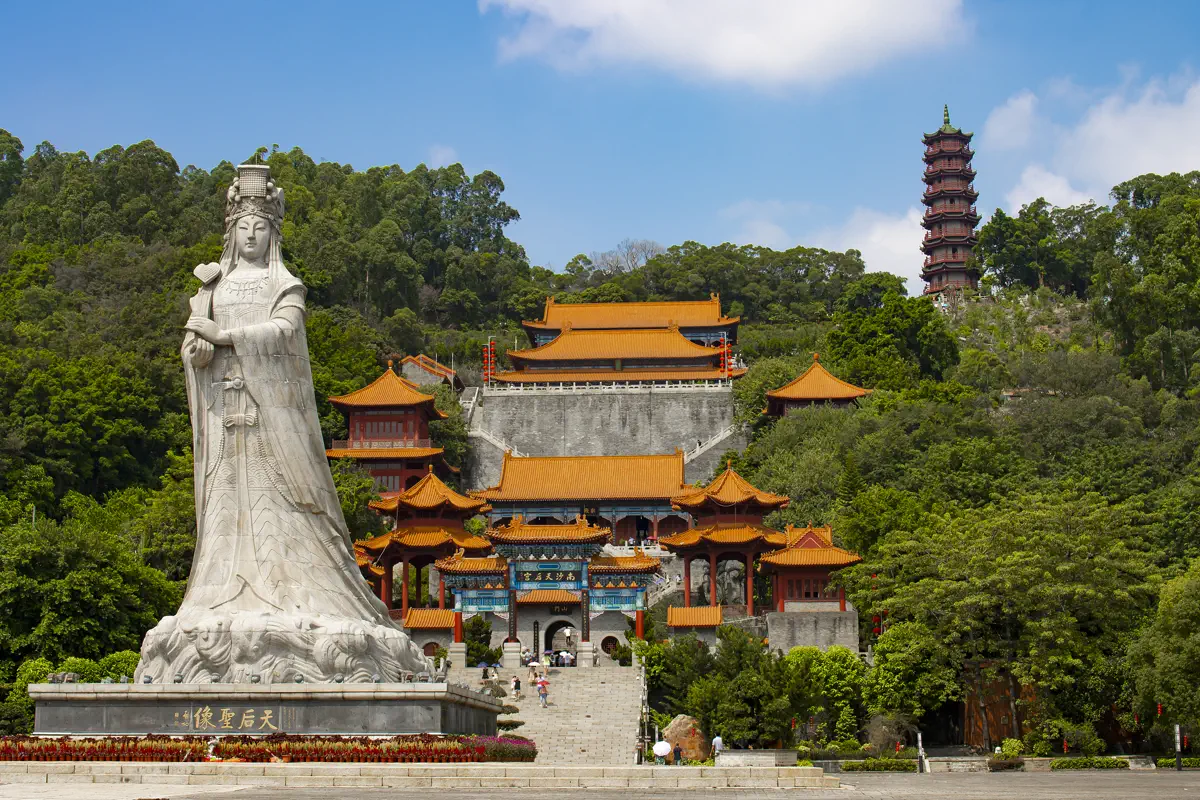
At the southern tip of Guangzhou, green coastal headlands meet the widening mouth of the Pearl River estuary. Nansha Tianhou Palace rises along the southeastern slope of Dajiao Hill at 88 Tianhou Road. Overlooking the tidal waters of Lingding Bay, it stands as Southeast Asia’s grandest shrine honoring Mazu, the Chinese sea goddess.
Travelers standing on upper terraces look across busy shipping lanes toward Humen Strait. Downtown shrines like Nanhai God Temple preserve ancient Tang stone tablets. By contrast, this seaside sanctuary pairs imperial palace halls with Qing coastal artillery forts. Together, these hills reveal how sailors and garrison troops crossed and guarded southern Chinese waters.
Maritime Faith and the Rebuilding of Nansha Tianhou Palace
Devotion to Tianhou centers on Lin Moniang, a tenth-century coastal woman born in Putian, Fujian Province. Sailors across southern coastal provinces have long revered her as Mazu, guardian of fishing fleets and ocean trade. During the Ming Dynasty, villagers at Lujing constructed a humble seaside Tianfei Temple at the base of Dajiao Hill.
Local magistrates and seafarers expanded that coastal shrine during the Qing Qianlong reign. Tragedy struck during the War of Resistance against Japanese Aggression, when artillery bombardments reduced the timber sanctuary to rubble. Weeds and scrub pines gradually reclaimed the empty foundation stones above the bay.
In 1994, prominent Hong Kong industrialist Henry Fok Ying-tung initiated and financed a massive reconstruction project while developing Nansha Bay. Builders labored for two years to raise a monumental coastal landmark along the hillside. The complex officially opened in May 1996 during traditional celebrations honoring Mazu’s birthday.
Palace Architecture Merging Northern and Southern Traditions
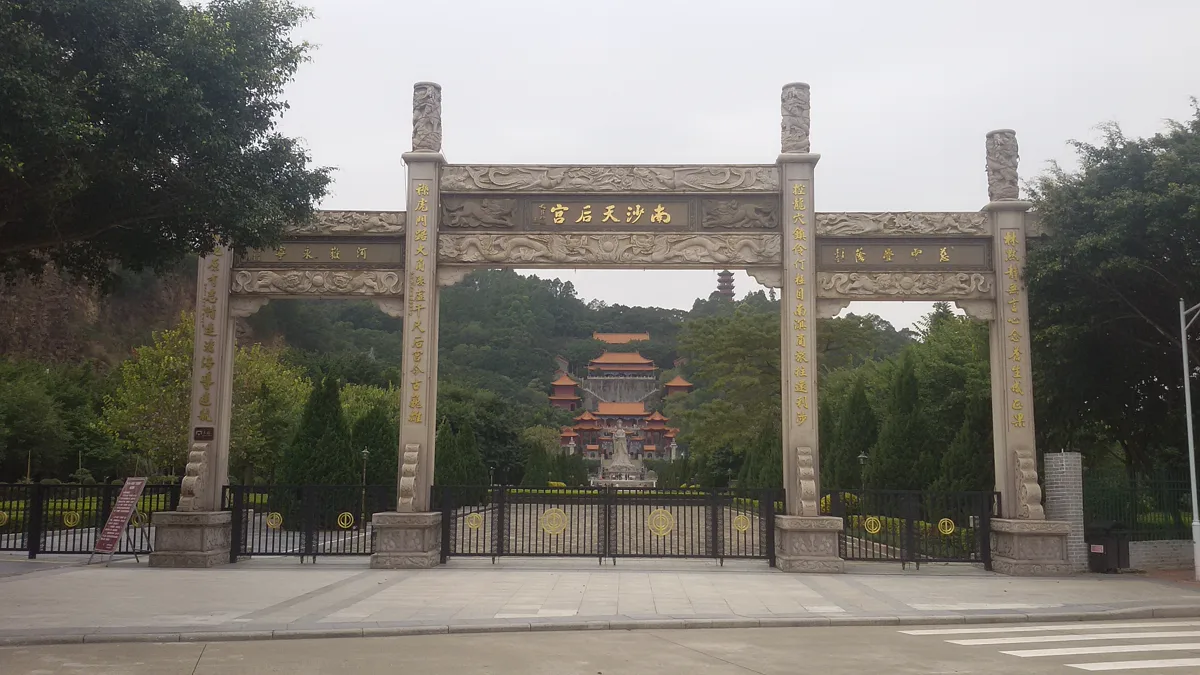
Passing beneath the four-pillar granite archway at the shoreline unveils a striking architectural departure from older Cantonese shrines. Designers fused Beijing imperial palace forms with hillside terraces inspired by Nanjing’s Sun Yat-sen Mausoleum.
Glazed golden roof tiles shimmer against steep pine slopes. Wide stone staircases climb upward along the hillside. This unbroken ceremonial axis links the waterfront plaza directly to the ridge peak. Such monumental scale echoes maritime beacons upriver at Lianhuashan in Panyu District.
Red sandstone masonry supports tall retaining terraces along each elevation change. Deep eaves shelter visitors from sudden subtropical downpours and blazing summer midday glare. Sea breezes sweep steadily up these wide stone flights, keeping open courtyards comfortable even during humid afternoon hours.
The Granite Statue and Central Axis Halls at Nansha Tianhou
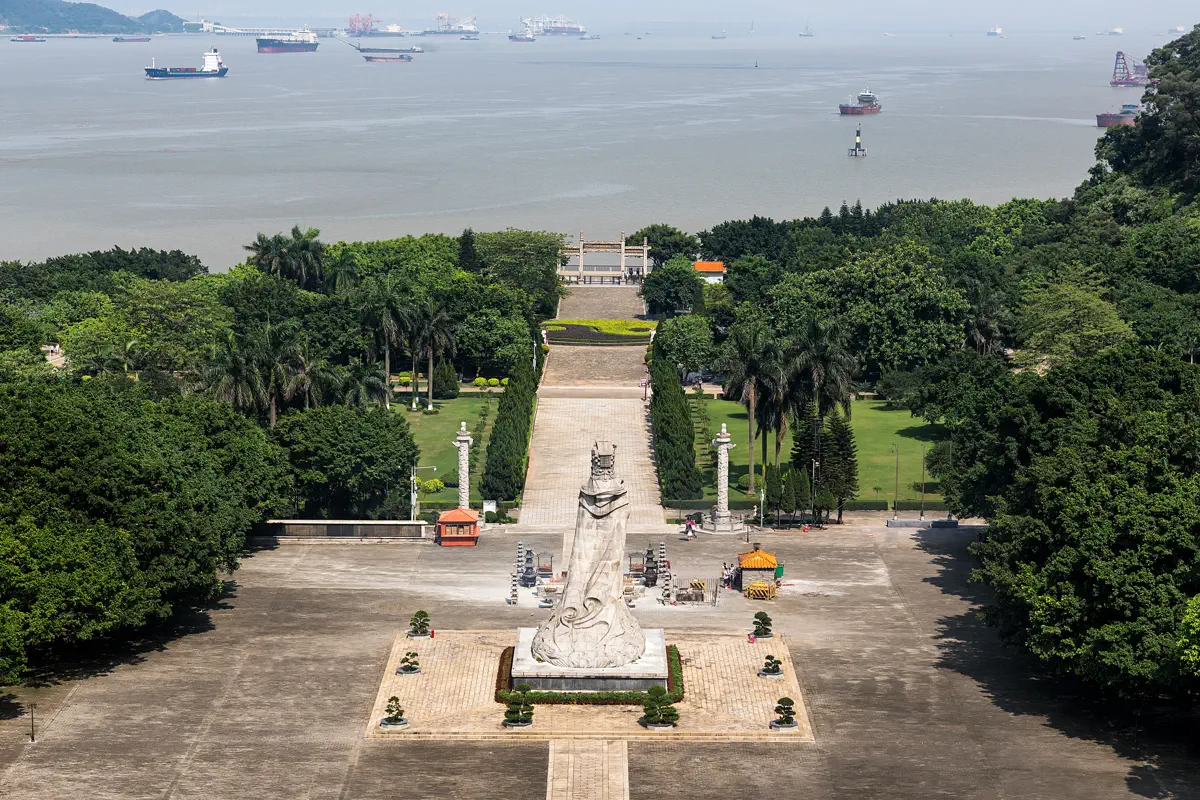
Tianhou Square dominates the lower coastal plain before the steep hillside ascent begins. Standing squarely at the center is a towering 14.5-meter granite sculpture of Mazu gazing eastward across Lingding Bay. Skilled carvers assembled 365 interlocking blocks of white granite to form this serene figure.
That exact stone count carries deep devotional meaning among coastal communities. Each stone symbolizes one calendar day of continuous protection over mariners navigating unpredictable monsoon seas. Flanking dragon-carved stone columns and heavy bronze incense burners frame the wide paved esplanade.
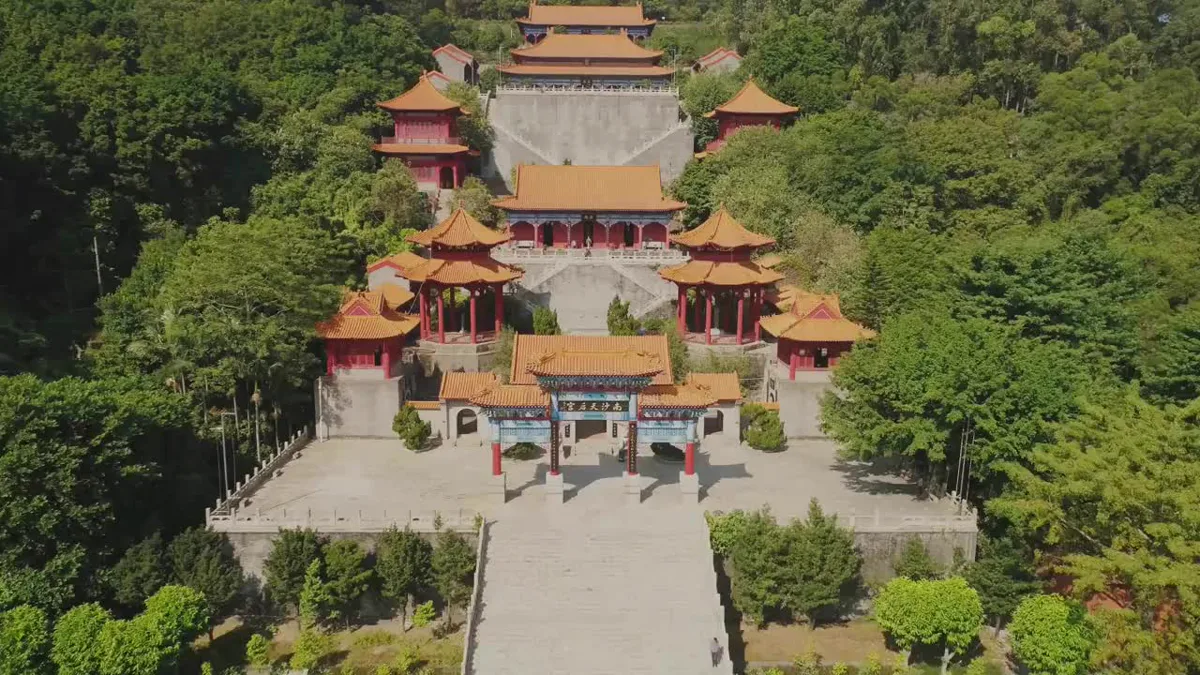
Ascending past twin octagonal Bell and Drum Towers brings pilgrims to the Offering Hall and Main Hall. Inside stands a gilded camphorwood Mazu statue. Her loyal scouts, Thousand Mile Eyes and Wind-Following Ears, guard both sides. Further up sits the quieter Rear Bedchamber Hall, displaying timber furnishings and traditional coastal rescue legends.
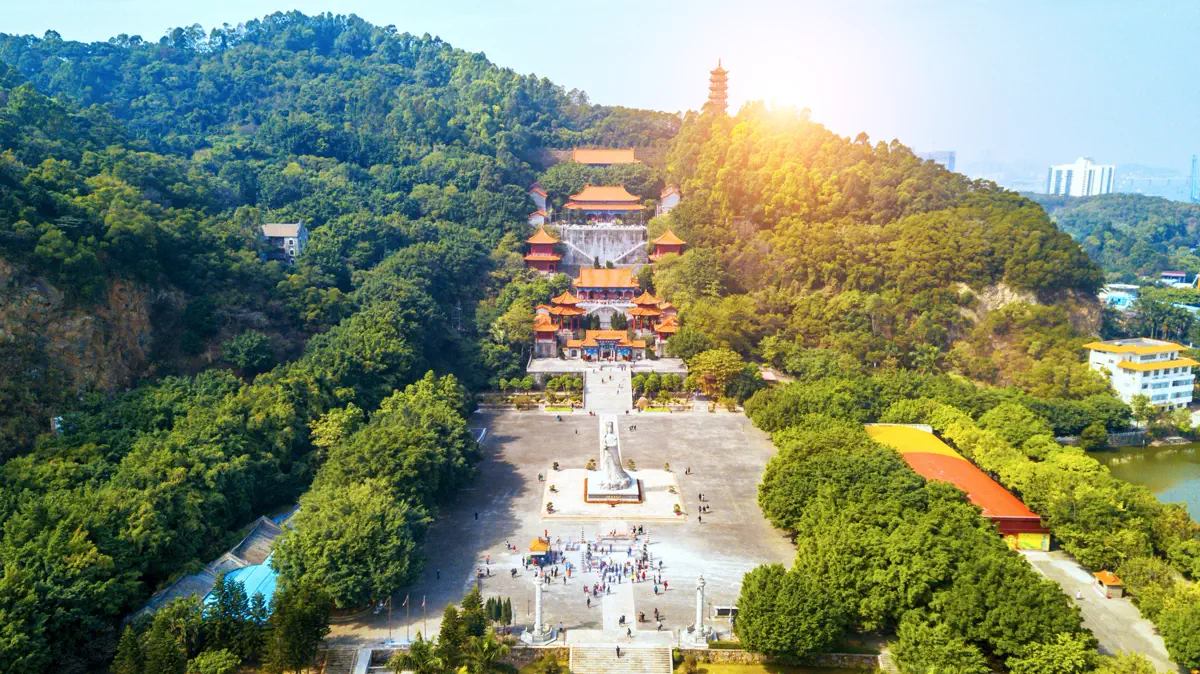
The Eight Story Nanling Pagoda and Even Number Symbolism
Crowns of forest trees yield at the summit of Dajiao Hill to reveal the octagonal Nanling Pagoda. Rising approximately 45 meters above the peak, this red-pillared timber-and-brick tower anchors the entire skyline. Green glazed eaves curve upward at every corner, functioning both as a scenic overlook and a daytime coastal navigation marker.
Seasoned travelers examining Chinese temple architecture often notice an intriguing numerical detail here. Traditional Buddhist and scholarly pagodas across China almost always adopt odd tier counts such as seven, nine, or thirteen levels. Nanling Pagoda intentionally rises eight stories tall.
In classical Chinese cosmology, odd integers express masculine yang forces, while even numbers align with feminine yin energy. Because Mazu is revered as a female maritime deity, builders deliberately incorporated even numbers throughout this hill complex. Several stone staircase segments and structural bay counts mirror this thoughtful homage to feminine coastal tradition.
Coastal Artillery Ruins on Historic Dajiao Hill
Walking along shaded ridge trails behind the pagoda leads travelers into a different chapter of Lingnan history. Dajiao Hill projects sharply into the Pearl River narrows opposite Dongguan’s Shajiao headland. Qing military planners therefore fortified this headland as Guangzhou’s outer maritime gate.
Military commanders rebuilt breastworks and mounted iron cannons along Dajiao Fort around 1834 to guard against unauthorized foreign warships. In January 1841, during the First Opium War, British naval forces launched fierce bombardments against Dajiao and neighboring Shajiao forts. Outgunned coastal garrisons fought fiercely across these stone parapets before the outer defensive line collapsed.
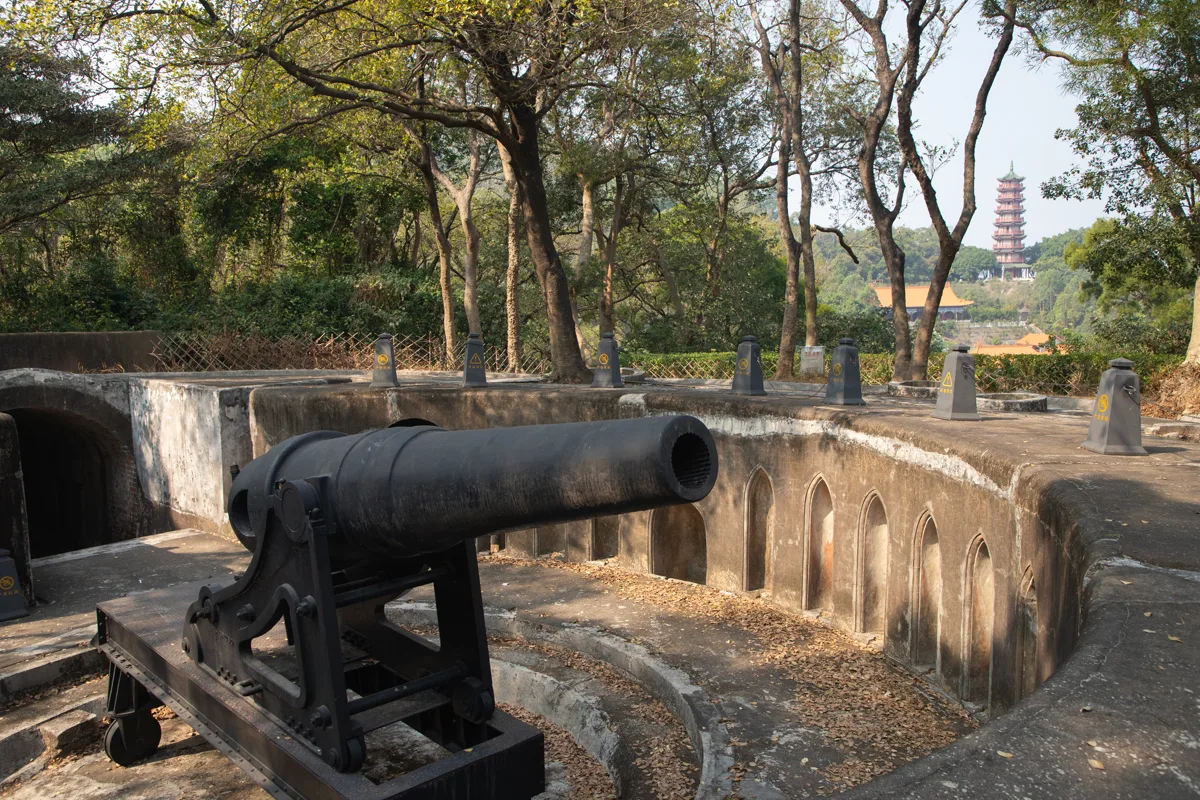
Restored masonry bunkers, underground ammunition chambers, and iron muzzle-loading cannons on steel rail carriages remain accessible today. Standing beside these silent artillery emplacements puts Guangzhou’s wider modern history into clear focus. History enthusiasts can later explore upriver defenses at Whampoa Military Academy. Nearby trading docks await further inland at Huangpu Ancient Port.
Curated Coastal Walking Route Around Nansha Tianhou Palace
Allow two to three hours to explore the coastal grounds comfortably without rushing the steep stairways. Following a bottom-to-top sequence captures both ceremonial spaces and cool ridge vistas.
- Begin at the seaside four-pillar granite archway along Tianhou Road for wide photographs framing the palace slope.
- Stroll across Tianhou Square to inspect the 365 carved granite blocks supporting the 14.5-meter Mazu statue.
- Climb the central stone steps past the Bell and Drum Towers into the Offering Hall and gilded Main Sanctuary.
- Pause at the high upper terrace before the Rear Bedchamber Hall to photograph ocean freighters crossing Lingding Bay.
- Follow pine-shaded stair paths up to the eight-story Nanling Pagoda at the hilltop peak.
- Walk west along ridge trails to examine the preserved masonry parapets and iron cannons at Dajiao Fort.
- Exit onto coastal paths linking directly into adjacent Puzhou Garden and Dajiao Hill Seaside Park.
For a full southern Guangzhou day trip, pair a morning coastal walk here with Panyu water-village heritage. Board Metro Line 4 northbound toward Shiqi Station to tour Baomo Garden or wander historic alleyways inside Shawan Ancient Town. Consult our regional Guangzhou travel guide or 3-4 day Guangzhou itinerary for smooth inter-district transfers.
Practical Visitor Guide for Nansha Tianhou Palace
Getting down to Nansha District takes roughly seventy to ninety minutes from central Tianhe or Yuexiu via Metro Line 4. Standard admission remains affordable and requires either online reservation or passport verification at the ticket counter. All operating times and admission rates below reflect conditions as of 2026 and remain subject to change during holiday festivals.
| Category | Details and Practical Advice |
|---|---|
| Chinese Address | 88 Tianhou Road, Nansha District, Guangzhou |
| Nearest Subway | Nansha Passenger Port Station on Metro Line 4 via Exit B |
| Final Transit | Walk 15 minutes southeast, ride Bus Nansha 1 or 3, or take a 5-minute taxi |
| Opening Hours | Daily from 0830 to 1730, last entry generally between 1630 and 1700 |
| Adult Admission | 20 RMB per person as of 2026, subject to seasonal festival adjustments |
| Concessions | 10 RMB for ages 60 to 64, students, and children 1.2 to 1.5 meters tall |
| Free Entry | Children under 1.2 meters and seniors aged 65 or older with valid ID |
| Recommended Duration | Two to three hours including the fort trails and waterfront boardwalk |
Comfortable walking shoes are essential because climbing from sea level to Nanling Pagoda involves hundreds of granite steps. Electric shuttle carts run up paved side roads for travelers preferring to skip the steepest climb. Sun protection and bottled water help considerably along the exposed harbor esplanade.
Frequently Asked Questions
When is the best season to visit Nansha Tianhou Palace?
Autumn and winter months from October to March provide clear skies and cool sea breezes across Lingding Bay. Spring brings colorful blossoms to nearby Puzhou Garden and vibrant folk celebrations around Mazu’s birthday in the third lunar month.
Are sightseeing shuttle carts available inside the hilly park?
Sightseeing battery carts link the main plaza and upper hillside gates for a modest fee. Visitors with limited mobility can ride uphill first and descend slowly along gentle stairs.
Can international visitors purchase tickets directly at the gate?
Foreign travelers can purchase entry tickets directly at the ticket office near the seaside archway. Bring a physical passport for identification alongside cash, Alipay, or WeChat Pay.
What nearby waterfront dining options are available after touring?
Seafood restaurants line Nansha Bay along Gangqian Avenue near Nansha Passenger Port Station. Local kitchens prepare steamed coastal crabs, braised sea bass, and tender Nansha lotus root dishes.