Guangzhou Attractions 9 min read
Yuyin Shanfang: Complete Lingnan Garden Guide
Explore Yuyin Shanfang in Panyu, Guangzhou. Qing Dynasty water courtyards, stained glass Manchurian windows, wood carvings, and metro access from Banqiao.
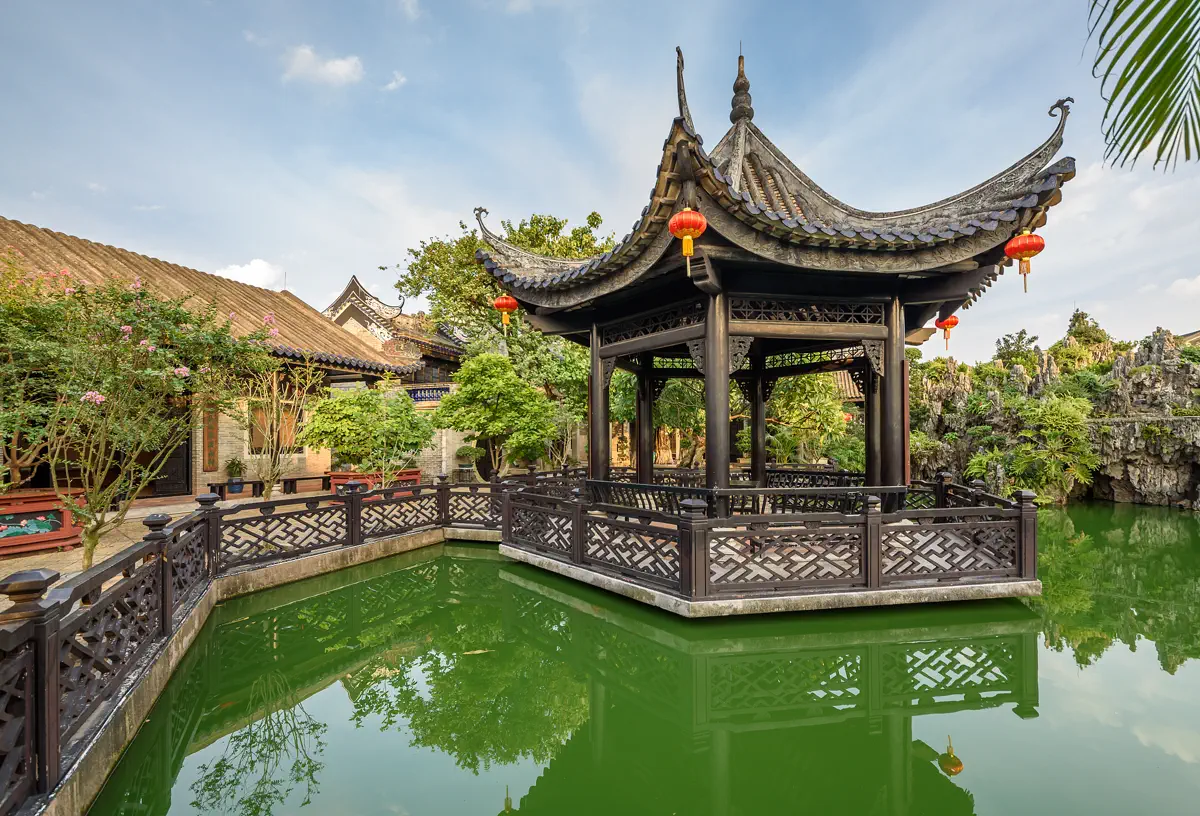
Tucked inside the historical lanes of Nancun Town in northern Panyu, Yuyin Shanfang (余荫山房), also known as Yuyin Garden, ranks among the most celebrated historic residences in Guangdong. Commissioned in 1867 during the reign of Emperor Tongzhi in the late Qing Dynasty, the garden was completed in 1871 by Wu Bin (邬彬), a prominent imperial scholar who served as a senior official in the Ministry of Justice. After retiring from public office, Wu returned to his ancestral home to build a private retreat where his family could read, cultivate orchids, and host intellectual salons.
The garden’s poetic name reflects classical Confucian filial piety: Yuyin (余荫) means “sheltered by the lingering virtue of ancestors while passing down blessings to posterity,” while Shanfang (山房, literally “mountain cottage”) represents a humble scholar’s retreat. Alongside Liang Garden in Foshan, Keyuan in Dongguan, and Qinghui Garden in Shunde, Yuyin Shanfang forms the prestigious Four Great Lingnan Gardens. In 2001, it was formally designated as a National Key Cultural Relics Protection Unit.
What makes Yuyin Shanfang truly peerless among classical Chinese landscapes is its breathtaking spatial economy. The core historic garden covers a mere 1,598 square metres (less than a third of an acre). Yet within this compact footprint, its master builders synthesized pavilions, covered corridors, arched bridges, lotus ponds, and miniature mountain peaks. Architecture historians celebrate it as the supreme real-world embodiment of suolong chengcun (缩龙成寸)—condensing an immense dragon into mere inches to evoke a vast natural universe within a confined urban plot.
Getting to Yuyin Shanfang in Panyu
Yuyin Shanfang is situated on Beida Street in Nancun Town, roughly 20 kilometres south of Tianhe’s central business district and 15 kilometres northeast of central Panyu’s Shiqiao area.
- Metro plus bicycle or bus: Take Guangzhou Metro Line 7 directly to Banqiao Station (板桥站). Exit through Exit A, where you can either ride a shared bicycle westward along Nanda Road for 1.5 kilometres (roughly 8 minutes) or transfer to local public bus Route Pan 30 or Pan 72 for two stops directly to the "Yuyin Shanfang Stop" (余荫山房站). Alternatively, alight at Yuangang Station (员岗站) on Line 7 and take bus Route Pan 30 to the main entrance.
- Taxi and ride-hailing: A direct ride-hailing journey (such as Didi) from Tianhe Sports Center or Zhujiang New Town takes roughly 35 to 45 minutes via the South China Expressway (Huanan Expressway) and costs between 45 and 60 RMB. From the modern Nancun Wanbo CBD shopping corridor, the ride takes just 10 minutes and costs about 15 RMB.
- Self-driving: An outdoor surface parking lot operates immediately opposite the garden entrance plaza, charging standard rates of 5 RMB per hour.
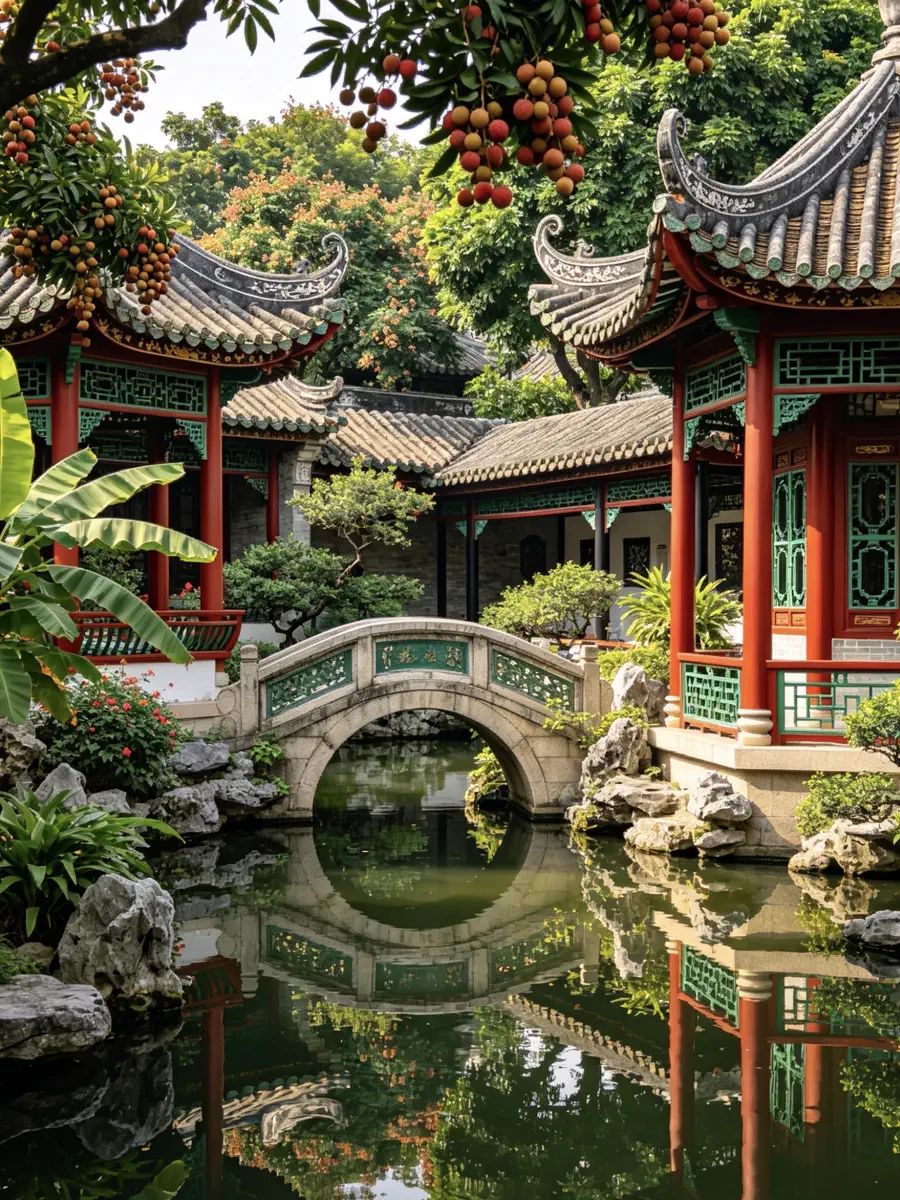
Water-centric layout and borrowing scenery in compact spaces
The core Qing Dynasty garden is divided into eastern and western courtyards, linked through winding porticos while centered entirely upon open water.
The eastern enclosure serves as the primary formal garden, anchored by a deep square pond. Spanning the center of this pond is the “Huanhong Kualv Bridge” (浣红跨绿廊桥, literally “washing red and striding green”). Measuring only a few metres in length, this covered stone bridge features a gray-tiled gable-and-hip roof with vermilion timber columns. It does not merely link two banks: it functionally divides the pond into two micro-bodies of water while allowing cross-breezes to circulate freely.
West of the bridge rises the iconic Linglong Water Pavilion (玲珑水榭). Shaped as an open octagonal pavilion floating directly over the pond, it features floor-to-ceiling wooden lattice windows on all eight facets. When all window panels are propped open on balmy afternoons, the pavilion functions as a natural viewing platform. Visitors sitting on the built-in curved wooden benches (meirenkao) enjoy 360-degree views of schooling koi, weeping willows, and miniature karst rockeries without leaving the shelter.
Facing the water from the south is the garden’s formal grand hall, the Shenliu Hall (深柳堂). Named after Tang Dynasty poet Liu Shenxu’s verse describing reading inside deep willow groves, it served as Wu Bin’s primary reception room for guests. The hall opens toward a stone terrace shaded by mature trees, while its interior houses museum-grade timber carvings and inscribed calligraphy tablets by prominent Qing Dynasty masters including Liu Yong (刘墉), Weng Fanggang (翁方纲), and Yi Bingshou (伊秉绶). North of the water sits the Linchi Bieguan (临池别馆), the owner’s quiet waterside study.
The western courtyard contains Yuyuan (瑜园), an adjoining residential enclosure added during the early Republican period by Wu Bin’s grandson, Wu Zhongyu. Locally nicknamed the “Miss’s Quarters” (小姐楼), this two-storey brick-and-timber mansion served as the private domestic domain for female members of the household. The upper level includes private dressing parlours, living chambers, and narrow internal verandas overlooking internal lightwells and garden ponds, offering a poignant look into late imperial domestic privacy.
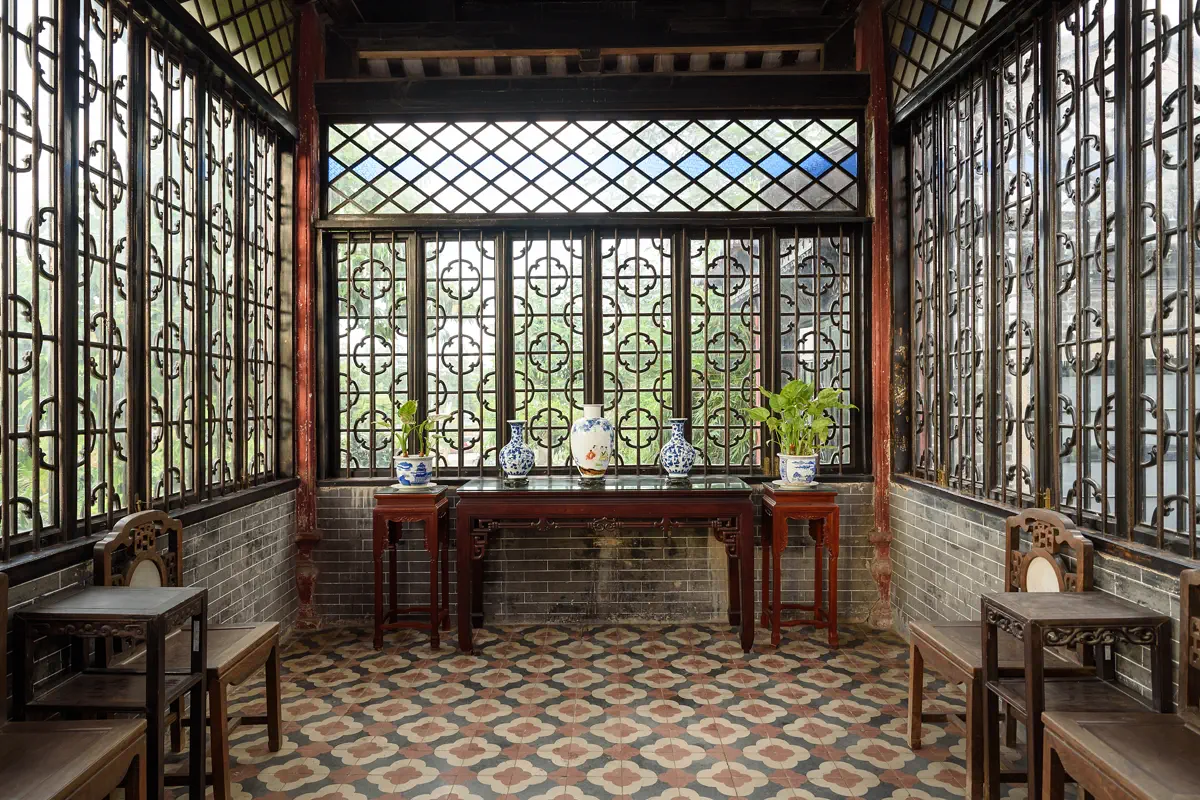
The craft treasures: carvings, plaster moldings, and Manchurian windows
Much like the grand Chen Clan Ancestral Hall in downtown Liwan, Yuyin Shanfang is recognized as a living encyclopedia of Lingnan decorative building crafts: timber carving, brick carving, stone carving, lime plaster relief (ash sculpture), and stained-glass Manchurian windows.
Inside Shenliu Hall, the woodwork illustrates the zenith of Guangzhou wood carving craftsmanship. The centerpiece is a masterwork partition screen carved from solid nanmu wood. Craftsmen utilized intricate multi-tiered openwork piercing to sculpt life-sized lychee clusters, spreading banana leaves, and plum blossom branches with chirping songbirds. Every individual leaf vein and bird quill remains crisp to the touch, having survived over a century without structural warping.
Along external perimeter walls, master brick masons carved high-relief narrative friezes into water-polished blue bricks. Utilizing incisions as fine as strands of silk, these panels depict Cantonese folklore, scholars playing zithers, and auspicious botanical motifs. Overhead, the roof ridges and pediments are topped with vivid lime plaster moldings (huidiao), depicting the Hundred Birds Paying Homage to the Phoenix and mythical immortals using mineral pigments that resist subtropical typhoons and monsoon rains.
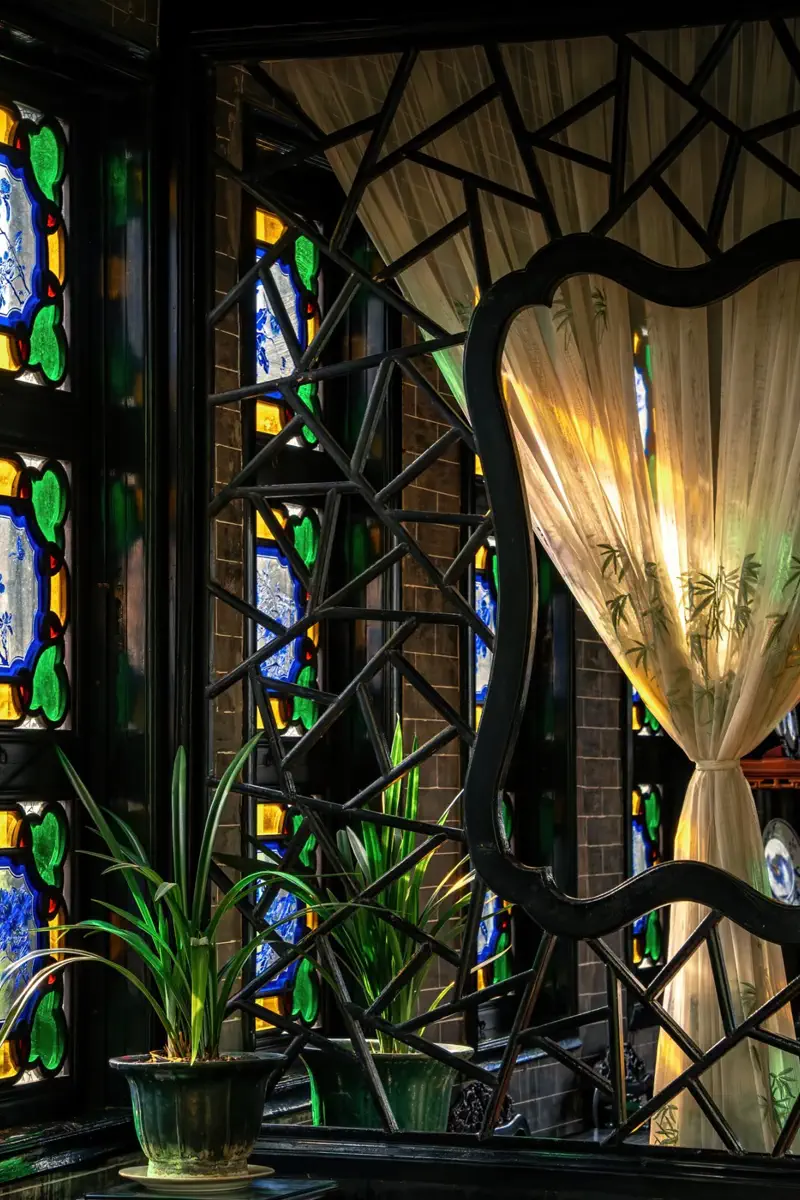
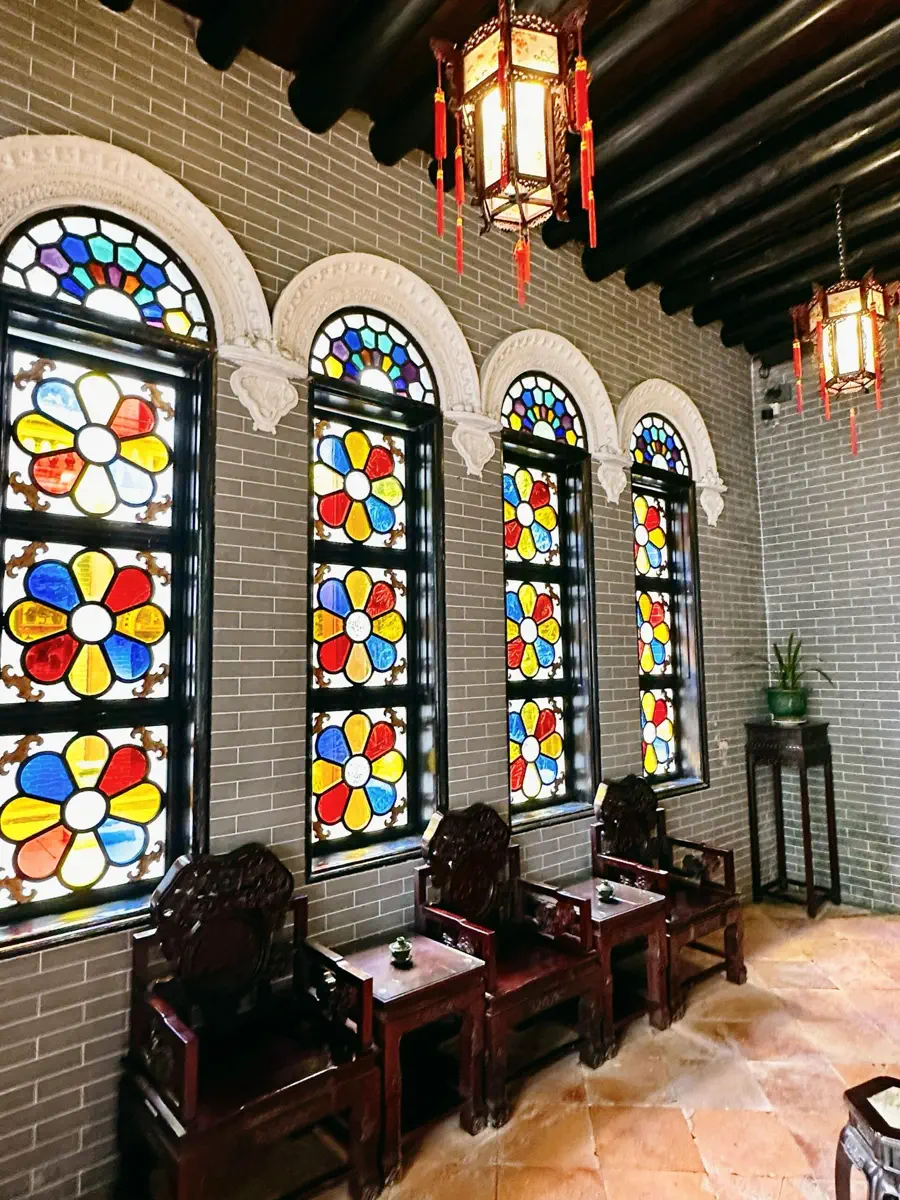
The crown jewel of Yuyin Shanfang’s visual identity, however, is its extraordinary ensemble of authentic Manchurian windows (满洲窗). Imported colored etched sheet glass in ruby red, sapphire blue, emerald green, and amber gold was fitted into Cantonese hardwood frames. Along the western colonnade of Shenliu Hall, four soaring arch-topped windows feature petal-patterned glass centerpieces with hand-etched floral arabesques. As midday sunlight streams through, it casts vibrant kaleidoscopic geometric color patches across the cool grey-brick floor, producing an enchanting fusion of Qing scholarly refinement and Western colonial design.
Expanding the grounds: Shanyan Ancestral Hall and Wenchang Pavilion
To protect the historic core and accommodate heritage tourism, conservation authorities integrated the adjacent ancestral complex and rear gardens into the Yuyin Shanfang scenic area.
Immediately flanking the garden to the east stands Shanyan Wu Clan Ancestral Hall (善言邬公祠). Spanning three deep ceremonial courtyards, this solemn ancestral hall features massive granite columns, heavy timber lintels, and ancestral tablets recording the civil service achievements of the Wu lineage. Its monumental scale and dignified symmetry provide a striking spatial counterpoint to the whimsical, asymmetrical intimacy of the private pleasure garden beside it.
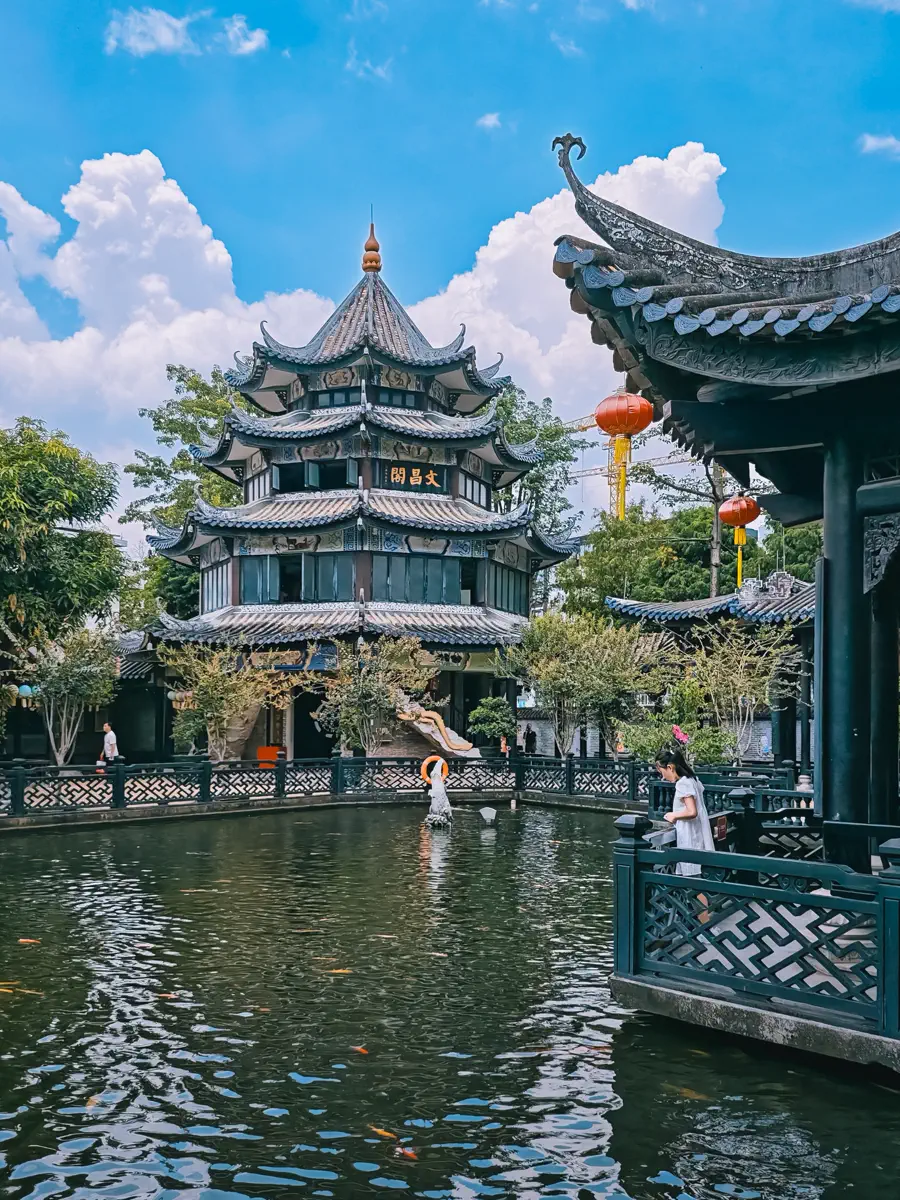
Further back in the expanded rear park rises the commanding Wenchang Pavilion (文昌阁). Built as an octagonal, three-tiered pagoda with upturned eaves overlooking an expansive carp pond, it honors the Daoist god of culture and literature, symbolizing the clan’s devotion to scholarly success. Visitors who climb the pavilion enjoy sweeping views across the grey-tiled rooftops of old Nancun Town and the dense tree canopies of Yuyin Shanfang. The vast pond below features cascading artificial waterfalls, ancient wisteria vines, and hundreds of vibrant orange and white koi swimming beneath arched footbridges.
Opening hours, ticket prices, and visiting tips
Yuyin Shanfang maintains reliable daily visitor operations throughout the year:
- Opening hours: Open daily from 08:00 to 18:00. Ticket booths stop selling admission and turnstiles close for entry at 17:30.
- Admission prices: Full adult admission is just 18 RMB per person. Students and senior citizens aged 60 to 64 enjoy a half-price concession rate of 9 RMB upon presenting valid credentials. Seniors aged 65 and above and young children enter completely free. Tickets can be purchased on the spot via WeChat QR codes or at the cashier counter without advance lottery reservations.
- Recommended duration: Allow 1.5 to 2 hours to tour the historic courtyards, admire the wood carvings, and explore the ancestral hall and Wenchang Pavilion.
- Best time to visit: Visit between 14:00 and 17:00 on clear sunny days. During these afternoon hours, sunlight hits the Manchurian windows at an oblique angle, projecting brilliant ruby and sapphire silhouettes across internal hallways. Avoid weekend midday crowds (10:30 to 12:30) when local tour groups congregate around the narrow bridge.
- Footwear advice: Pathways throughout the historic garden consist of heritage granite flagstones and polished threshold timbers that can turn slick during humid weather. Flat, slip-resistant walking shoes are highly recommended.
Combined Panyu travel itineraries
Because Yuyin Shanfang is situated in northern Panyu, it pairs effortlessly with other cultural destinations across the district:
- The Lingnan Garden and Water Village Route: Start your morning at 09:00 exploring the scholar gardens of Yuyin Shanfang. At 11:30, head to Nancun Town center to sample authentic Cantonese culinary staples such as steamed ginger milk curd (jiangmainai), crispy fish-skin dumplings, and fragrant lychee-wood roast meats (see our guide to Cantonese roast meats). After lunch, take a 25-minute taxi southwest to Shawan Ancient Town to wander through eight centuries of oyster-shell walls and ancestral shrines, followed by an afternoon tour of Baomo Garden to admire its monumental brick relief walls and waterside pavilions.
- The Ancient Quarry and Maritime History Route: Tour Yuyin Shanfang in the morning, then take Line 7 or a taxi eastward toward the Pearl River Estuary to hike the dramatic 2,000-year-old Han Dynasty stone bluffs at Lianhuashan.
- Downtown to Panyu Cultural Day: Pair a morning visit to downtown Guangzhou's Chen Clan Ancestral Hall with an afternoon trip on Line 7 to Yuyin Shanfang to contrast public lineage architecture with private domestic garden aesthetics, as outlined in our curated 10 best Lingnan attractions and our practical 3–4 day itinerary.
Frequently asked questions
What makes Yuyin Shanfang one of the Four Great Lingnan Gardens?
Unlike massive northern imperial gardens, Yuyin Shanfang exemplifies the Lingnan aesthetic of "condensing dragons into inches." Despite covering under 1,600 square metres, its sophisticated water-centric layout, octagonal floating pavilion, and master-level wood carvings and stained glass make it an architectural tour de force.
How does Yuyin Shanfang differ from Baomo Garden?
While Baomo Garden spans over 100,000 square metres with grand canals, expansive bridges, and sweeping modern reconstructions, Yuyin Shanfang is an authentic, preserved 19th-century private scholar residence celebrated for its intimate, human-scale micro-gardens.
Is Yuyin Shanfang easy to reach via the Guangzhou Metro?
Yes. Simply take Guangzhou Metro Line 7 to Banqiao Station (Exit A). From there, it is a quick 8-minute shared bicycle ride (1.5 km) or a two-stop ride on local bus Route Pan 30 or Pan 72 directly to the gate.
Are photography and traditional clothing allowed inside the garden?
Yes. Yuyin Shanfang is widely regarded as one of Guangzhou's premier photo backdrops for traditional Hanfu and modern Qipao photography due to its authentic Manchurian windows and waterside corridors. Tripods and portrait photography are permitted, provided they do not block narrow historic bridge crossings.