Guangzhou Attractions 7 min read
Lianhuashan: Ancient Quarry, Guanyin Statue & Fort
Explore Lianhuashan (Lotus Mountain) in Panyu, Guangzhou. 2,000-year-old Han quarry cliffs, the 40.88m gold Guanyin, Ming-era pagoda, and coastal fortress.
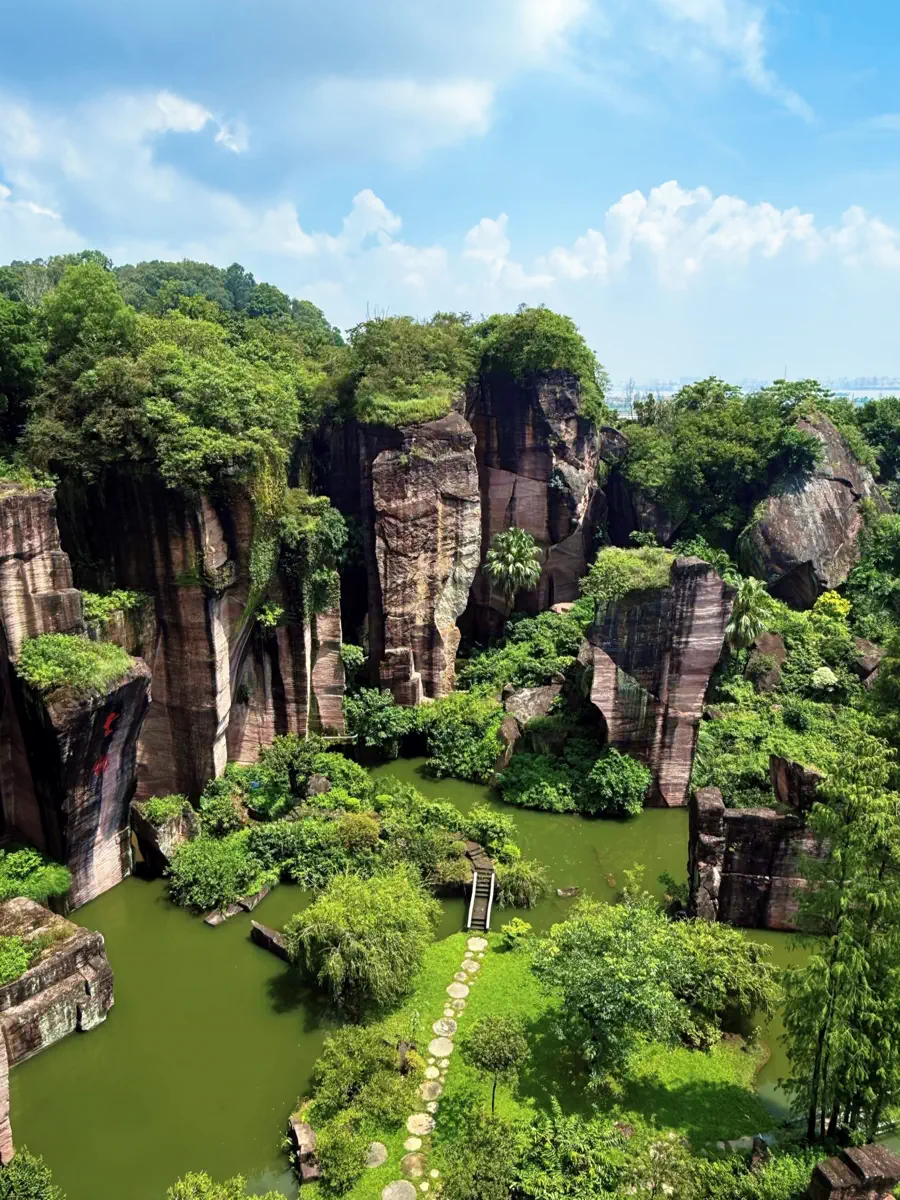
While most visitors to Guangzhou hike the lush forested paths of Baiyun Mountain, those seeking raw maritime geology and ancient archaeological drama head southeast to Lianhuashan (莲花山, Lotus Mountain). Situated in eastern Panyu along the mouth of the Shiziyang channel where the Pearl River broadens into the sea, this scenic coastal ridge preserves one of China’s most significant ancient engineering wonders: a massive open-pit stone quarry operated continuously from the Western Han Dynasty (202 BC–8 AD) through the Qing Dynasty.
Over two millennia of patient manual quarrying sculpted natural red sandstone hills into perpendicular precipices, freestanding stone pinnacles, and secluded ravines. Crowning the ridges above these dramatic canyon cuts are a 17th-century Ming beacon tower, a fortified Qing coastal citadel, and one of the world’s tallest gilded bronze statues of Guanyin, creating a unique synthesis of coastal history, archaeology, and southern folklore.
Getting to Lianhuashan from central Guangzhou
Lianhuashan is situated at 123 Ximen Road in Shilou Town, Panyu District, approximately 40 kilometres southeast of downtown Guangzhou.
- Metro and feeder bus: Take Guangzhou Metro Line 4 south to Shiqi Station (石碁站). Depart through Exit A, walk roughly 50 metres to the Shiqi Metro bus stop, and board bus Fan 92 (番92路) or Fan 93 (番93路) directly to the Lianhuashan Terminal (莲花山车站). The bus ride takes about 25 to 30 minutes and costs 2 to 3 RMB. From the terminal, walk 5 minutes to the West Gate ticket entrance.
- Taxi or ride-hailing: From downtown districts such as Tianhe or Yuexiu, a direct Didi or metered taxi along the Nansha Port Expressway takes about 45 to 60 minutes and costs 100 to 130 RMB. From the Panyu Square commercial hub or Shiqiao, a taxi takes roughly 25 to 30 minutes (around 50 to 65 RMB).
- Driving and parking: Navigate directly to the West Gate Parking Lot (西门停车场) or South Gate Parking Lot. Both feature extensive surface parking for around 6 to 15 RMB per entry.
The 2,000-year-old Western Han quarry and Swallow Rock
The ancient quarry at Lianhuashan is protected as a Major Historical and Cultural Site Protected at the National Level. Composed of Cretaceous red sandstone and conglomerate, the local stone is remarkably dense, durable, and naturally resistant to weathering and acid rain.
Archaeological excavations at the Museum of the Western Han Dynasty Mausoleum of the Nanyue King in downtown Guangzhou provided direct scientific proof of this connection: petrographic analysis confirmed that the giant red sandstone slabs used to construct King Zhao Mo’s tomb chamber in 122 BC were hewn from the cliffs of Lianhuashan and rafted up the Pearl River estuary on tidal currents.
Rather than using explosives, ancient stonecutters followed the natural vertical jointing of the rock beds, driving iron wedges and chisels by hand in a technique called trenching and cleavage. Slicing downward layer by layer across generations, they removed entire mountainsides, leaving behind an astonishing artificial Danxia canyon landscape.
The most famous section is Swallow Rock (燕子岩, Yanziyan). Perched on footbridges above the chasm, visitors peer down at sheer vertical cliff faces dropping tens of metres into placid green water. The rock walls still bear thousands of individual pickaxe scores, wedge mortises, and chisel grooves left by Han and Tang stonemasons. Isolated stone towers such as Eagle Cliff (飞鹰崖), Eight Immortals Rock (八仙岩), and Sword Gate (剑门) jut straight from the water. Every spring and summer, wild swallows nest inside the high rock crevices, wheeling across the canyon breeze. Near the ridge sits Lion Rock (狮子石), a weathered outcrop shaped like a crouching lion staring out toward the ocean channel.
The 40.88-metre gilded Guanyin and Guanyin Pavilion
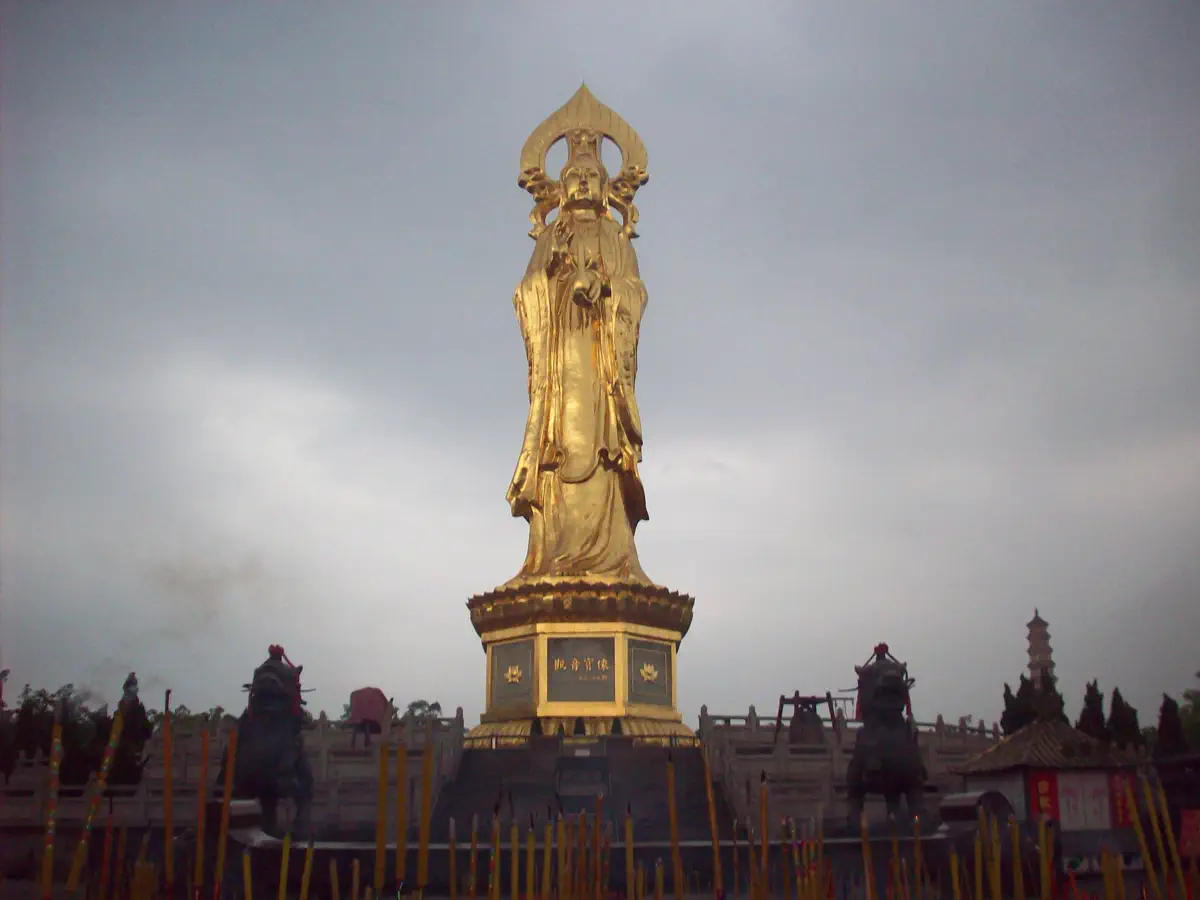
High upon the eastern hilltop overlooking the sea stands the iconic Gilded Guanyin of the South Sea (望海观音).
Consecrated in 1994 with donations from patriotic Hong Kong and Macao philanthropists led by Mr. Edmund Ho Hau-wah, the monument rises 40.88 metres above its lotus pedestal. Cast from 120 tonnes of heavy bronze, the entire surface is sheathed in pure gold leaf using 180 taels (over 9 kilograms) of gold, making it one of the tallest gilded bronze standing Guanyin figures anywhere in the world. Facing east toward the open expanse of Shiziyang Bay, the Bodhisattva cradles a vase of healing nectar in one hand while offering protection to maritime sailors and fishing families.
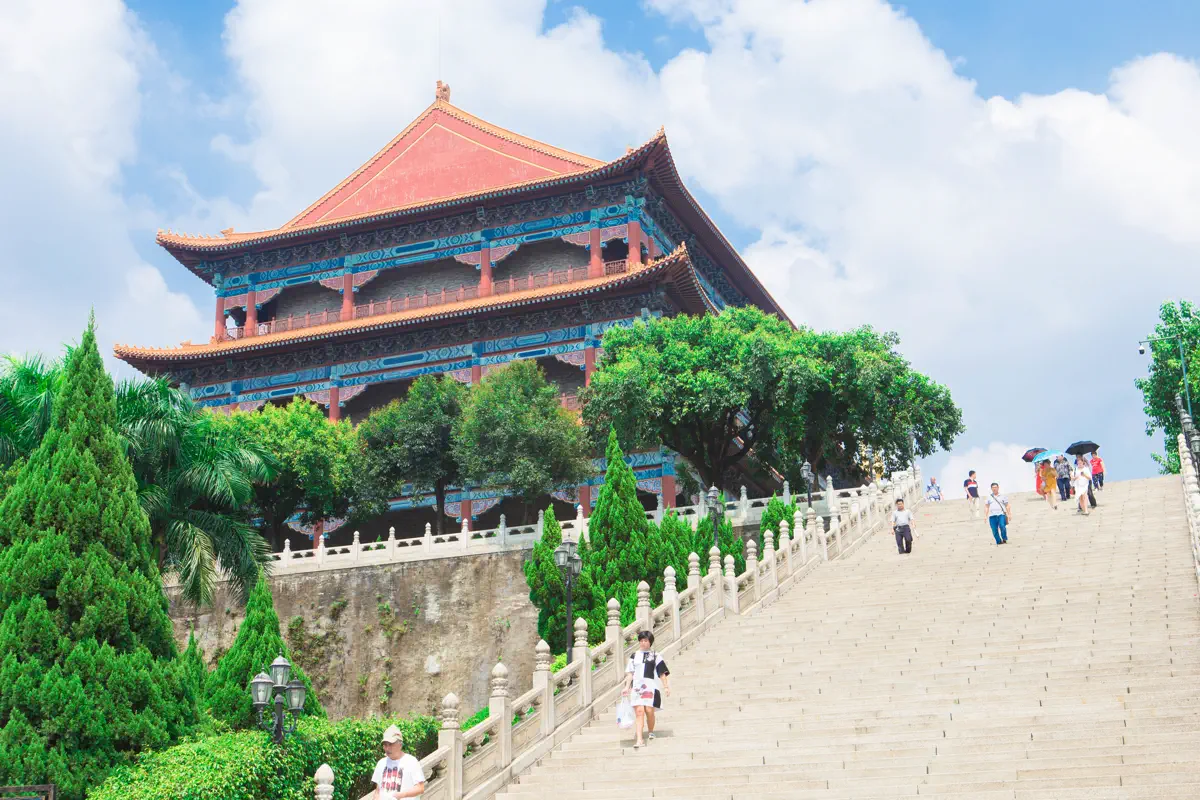
Directly behind the statue stands the grand Guanyin Pavilion (观音阁). Built in classical Ming-Qing style with sweeping bracket sets, green glazed tiles, and red columns, the pavilion is approached via an expansive staircase of carved white marble. On lunar festival days—particularly the 19th day of the second, sixth, and ninth lunar months (Guanyin’s birthday) and Chinese New Year—thousands of pilgrims from across the Greater Bay Area ascend the summit to light incense and pray for blessings.
Lianhua Pagoda and the Qing coastal fort
Beyond Buddhist pilgrimage and prehistoric quarrying, Lianhuashan played a crucial strategic role in southern China’s maritime defense and global trading network.
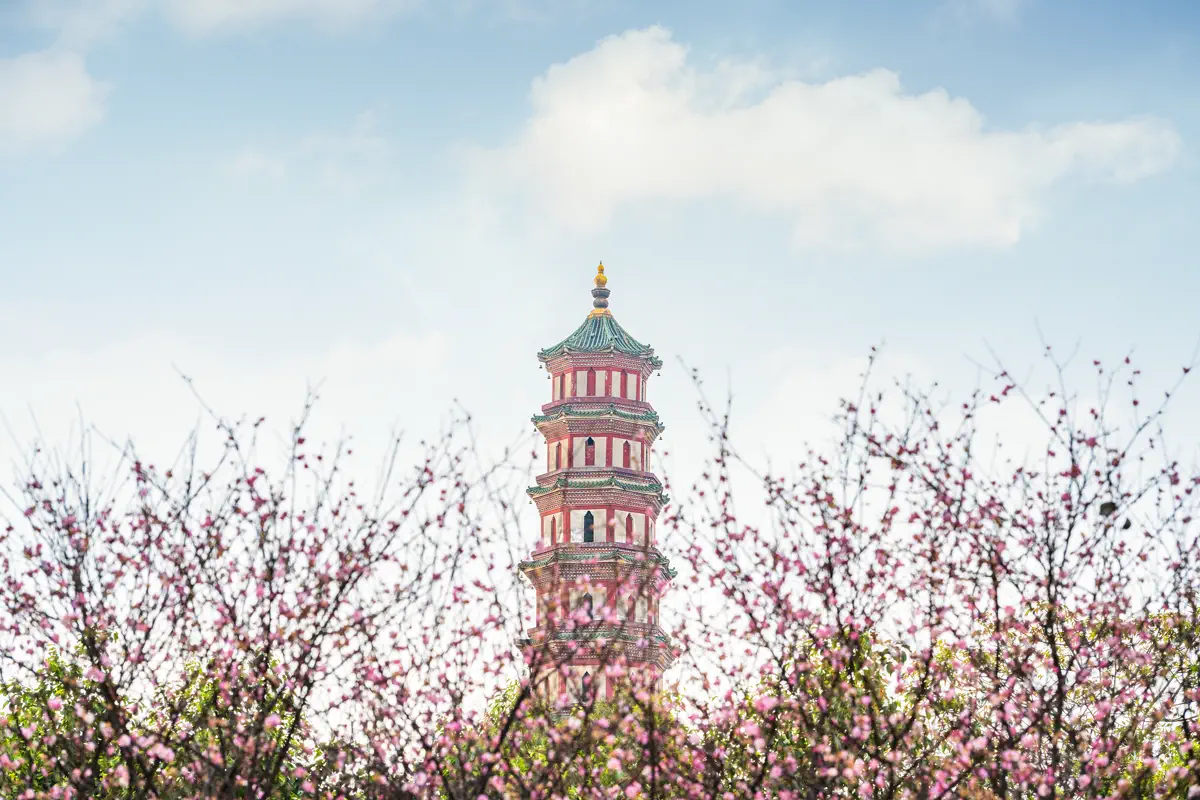
Dominating the highest point of the mountain is the Lianhua Pagoda (莲花塔), constructed in 1612 during the 40th year of the Wanli reign in the Ming Dynasty. This octagonal, nine-storey brick pavilion pagoda stands roughly 50 metres tall, alternating red brick bands with emerald glazed tile cornices. In the era of sail navigation, ocean-going foreign merchant vessels navigating through the Lingdingyang and Bocca Tigris straits toward the Huangpu Ancient Port used this beacon tower as their definitive maritime landmark, earning it the historical nickname “The Pillar of Canton” (省会华表).
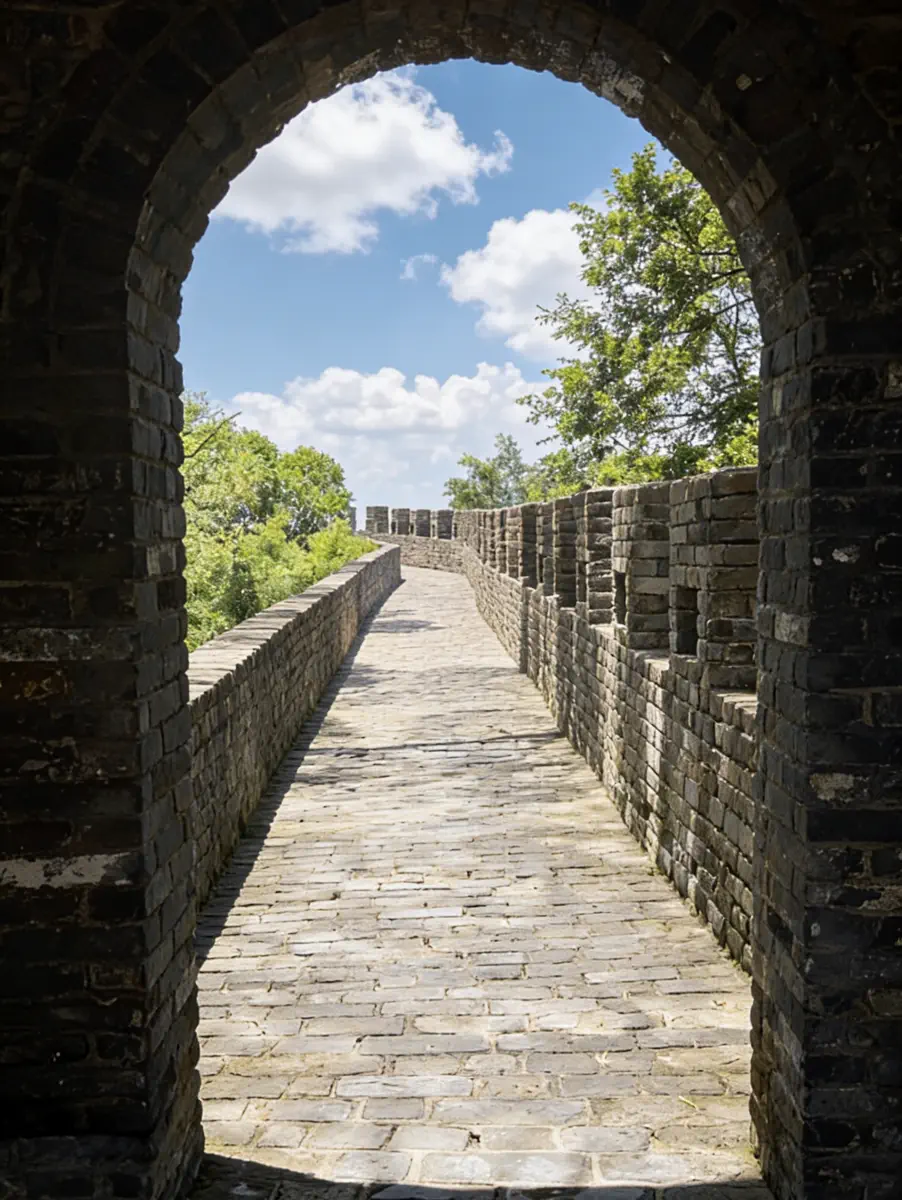
A short walk along the ridge brings you to Lianhua City (莲花城), a stone fortress erected in 1664 during the third year of Emperor Kangxi’s reign. Built to enforce coastal evacuation orders and suppress regional piracy, the fort features solid red sandstone ramparts over 10 metres high and nearly 500 metres in perimeter. Passing beneath its arched stone gate reveals barracks foundations, historic iron cannon emplacements, and an arsenal warehouse. During the First Opium War, Qing commissioner Lin Zexu stationed naval troops here to defend the estuary against British warships.
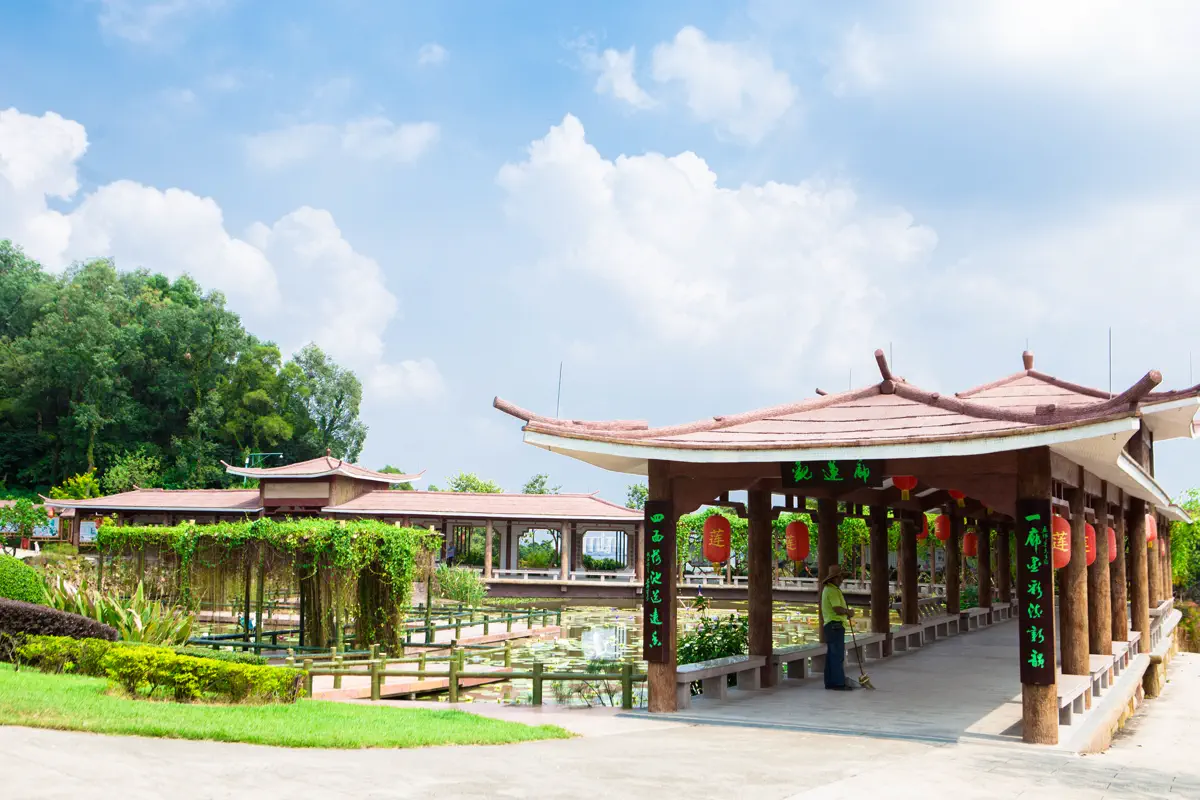
Lotus Wonderland and summer flower exhibits
True to its namesake, the lower foothills feature Lotus Wonderland (莲花仙境), a landscape garden of tranquil ponds connected by covered wooden walkways, vermilion lanterns, and waterside gazebos.
The garden cultivates nearly 1,000 distinct species of lotus and tropical water lilies. Every summer from June to August, the mountain hosts the National Lotus Flower Exhibition. Botanists and travelers flock here to see exquisite pink, white, crimson, and golden blossoms. Lianhuashan has gained national renown for repeatedly producing rare botanical marvels, including natural “twin lotus” flowers (并蒂莲) blooming simultaneously on a single stem, as well as documented three-stem and five-stem variations.
Tickets, opening hours and day trip planning
Lianhuashan operates daily year-round with straightforward ticket policies:
- Opening hours: Daily from 07:00 to 17:00.
- Admission price: Standard adult tickets are approximately 54 RMB (half-price concessions apply for seniors aged 60+ and students with ID; free entry for children under 1.2 metres and seniors aged 65+).
- Suggested visit length: 3.5 to 5 hours.
Suggested day trip itinerary
- 08:30 – 10:00: Take Metro Line 4 to Shiqi Station and transfer to bus Fan 92 to the West Gate.
- 10:00 – 11:45: Explore the ancient quarry floor at Swallow Rock. Cross the stone bridges over the emerald quarry lakes, photograph the chisel marks on the vertical cliff walls, and wander through Eagle Cliff.
- 11:45 – 12:45: Stroll through Lotus Wonderland to enjoy the lotus ponds and rest in the covered pavilions. Have a casual lunch of Cantonese roast goose or claypot noodles at the park restaurant.
- 12:45 – 14:15: Climb to the summit plaza to marvel at the 40.88-metre gold-leaf Guanyin statue, take in panoramic vistas across Shiziyang Bay, and explore the Guanyin Pavilion.
- 14:15 – 15:30: Visit the Ming Dynasty Lianhua Pagoda and tour the stone ramparts of the Lianhua City fort.
- Afternoon extension: Take bus Fan 92 or a taxi back toward central Panyu to explore the 800-year-old clan village of Shawan Ancient Town, stroll the koi ponds of Baomo Garden, or visit the royal tombs at the Southern Han Mausoleums Museum in Guangzhou Higher Education Mega Center. For regional trip planning, consult our 3–4 day Guangzhou itinerary and comprehensive Guangzhou travel guide.
Frequently asked questions about Lianhuashan
Is Lianhuashan strenuous to hike?
No. The peak elevation is roughly 108 metres above sea level. Most main trails consist of paved stone steps and gentle inclines with shaded rest pavilions. Sightseeing shuttle carts are also available inside the park for visitors who prefer not to walk between distant zones.
When is the best time of year to visit?
Summer (June to August) is ideal for blooming lotus flowers and clear ocean vistas, though visitors should pack sunscreen and hydration. Autumn (October to December) offers the most pleasant temperatures and clear blue skies for photography.
Can I see Hong Kong or Macau from the summit?
No. While Lion Sea is part of the Pearl River estuary connecting toward Hong Kong and Macau, they are situated roughly 80 to 100 kilometres south. However, you can clearly view the busy shipping lanes of the Pearl River, large container vessels, and the opposite shoreline of Dongguan.